
Sativex: the story of a French-style blockage

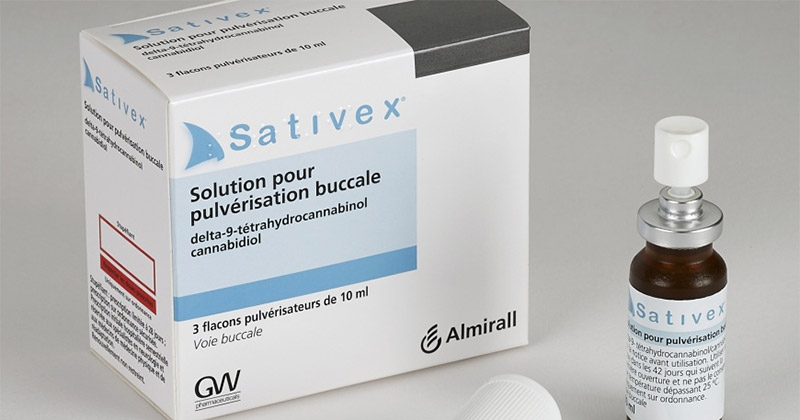
Here we often talk about Sativex, the only natural cannabis-based medicine authorized for sale in France. This oral spray containing CBD and THC is designed to relieve spasticity (muscle contractures) in patients with multiple sclerosis. But when its name is mentioned, it's always to say that it is indeed authorized, but not available in pharmacies. And that's the only consistent thing about this story. There are many reasons why Sativex has been blocked. Yet only one is mentioned most often: the price. Here we provide you with all the information available on the subject.
What is Sativex?
Sativex is a drug developed by GW Pharmaceuticals, a British pharmaceutical company. It is marketed as an oral spray, consisting of equivalent doses of THC and natural CBD. Sativex is available by prescription in several European countries (UK, Italy, Poland, Norway, Spain) and further afield (Canada, New Zealand, Israel).
Sativex received its French marketing authorization (AMM) in January 2014, for “spasticity in multiple sclerosis after failure of other therapies”, i.e. where other drugs don't work. And yet, not a single patient has yet been able to obtain it.
1st obstacle: price
Officially, the stumbling block is the price. A mouth spray costs €440, for 22 days' use at a rate of 4 sprays a day. That's a €600-a-month treatment.
The reimbursement recommended by the Comité économique des produits de santé (CEPS) is 15%. After negotiations between the CEPS and Almirall (the laboratory that markets Sativex in France), the laboratory proposed lowering the price to €350 per spray. The CEPS is demanding a price of €60 from the lab, which Almirall obviously does not accept. Why is the CEPS continuing to fight, when the price proposed by the company is already lower than in all other European countries (where it is not necessarily reimbursed, for example in Germany)? A mystery.
So much for the first official reason.
2nd stumbling block: efficiency
The second official reason, which is less often mentioned, is the efficacy of Sativex. The medical services rendered (SMR) for spasticity are low. It is effective “only” on 10% of patients, representing around 5,000 people in France. On the other hand, Sativex has few side effects (dry mouth, sleepiness, etc.). Just like weed.
This could be explained by the relationship between price and effectiveness - an expensive product that is «only» used by 5,000 people. But solutions do exist. Its use could be extended to other types of pain, to benefit more patients. But this has never been on the agenda of Ministry of Health meetings.
The risk of misuse is also raised. Some “drug addicts” might buy Sativex for “recreational” use. At 400 bucks a bottle, it's hard to see how...
3rd blockage: the Académie de Médecine
The Académie de Médecine, or “An institution in its time” as its website puts it. In its time, ok, but the time of its creation then (1820).
This academy had taken a strong stance against the use of cannabinoids in medicine, with arguments that could be described as strange, to say the least:
- The presence of THC, “in a poorly justified proportion” (the Academy doesn't tell us why or give a recommendation, doubtless 0 for that matter), and CBD, “with an uncertain mechanism of action, in order to reduce the harmful effects of THC”.”
- The risk of psychological and physical dependence (a good morphine is still better)
- Numerous and troublesome drug interactions“ (hang on to your hat) with benzodiazepines (Xanax) and alcohol. Two harmless drugs after all.
- The risk of off-label prescriptions to “wean drug addicts, alleviate the nausea of chemotherapy patients, restore the appetite of AIDS patients”, etc. Helping the sick, yes. But not with cannabis.
This official position, which helped to block the marketing of Sativex, is quite logical when you consider the members who make it up, in particular Pr. Jean Costentin, addictologist and leading voice for cannabis prohibition in France. approximations and untruths.
Is the Académie de Médecine influential enough to block a drug with arguments from another era? We don't really know. But it certainly doesn't help speed things up.
In the end...
... it's the patients who suffer. Most of the patients we spoke to on this subject treat themselves, either with imported products, or by gardening themselves, which obviously puts them in the uncomfortable position of illegality. What they generally fail to understand is why certain ineffective drugs are still being marketed, while Sativex, which has beneficial effects for their pathology, is not. They are ready to pay, to suffer less, sometimes almost to regain a normal life. Marisol Touraine was conspicuous by her absence on this issue.











CBD is said to promote athletic recovery, without improving performance

294 cannabis clubs in Chile: a booming movement with uneven distribution

Chronic Sciatica: New York Approves First Clinical Trial of a THC-Based Medication

United States: The DEA is accelerating the integration of medical cannabis at the federal level

Florida is nearing one million patients using medical cannabis

Uruguay Revives Its Plan to Allow Tourists to Legally Access Cannabis

In Brazil, researchers are developing an innovative CBD eye drop

Autism: Medical Cannabis Is Linked to Reduced Anxiety

The $28 billion U.S. hemp market remains under threat

Jamaica Eases Small Farmers' Access to the Cannabis Market
-
 Business5 days ago
The legal cannabis market in New York exceeds 4 billion $ in revenue
-
Cannabis and driving4 weeks ago
Cannabis and CBD: French Drivers Can Now Lose Their License Even Without a Positive Test Result
-

 Cannabis in France2 weeks ago
Which countries legalized medical cannabis before France?
-
Business2 weeks ago
South Korea is preparing to begin local production of medical cannabis to meet rising demand
-
Cannabis in the Netherlands4 weeks ago
One year after the launch of the Dutch cannabis experiment, the first trends are emerging
-
Cannabis in Thailand2 weeks ago
From the boom in dispensaries to a purely medical approach: Thailand is revising its cannabis policy
-
Cannabis in France4 weeks ago
French medical cannabis remains stalled at the Ministry of Health
-
Cannabis in Argentina3 weeks ago
Argentina Opens Its Market to Hemp Flowers Containing 1% of THC

















kev
January 24, 2017 at 19 h 12 min
«MDR» as always when talking about cannabis in France
gh0stwrit3r
January 24, 2017 at 22 h 05 min
The shame of an outdated, archaic system.