Drought: Could Hemp Become the New Hope for French Farmers?
In light of the increasing frequency of droughts, agricultural hemp is emerging as a diversification option for French farmers. Low in water requirements, well-suited to crop rotation, and offering market opportunities in construction, food, and industry, it is currently the subject of several pilot projects, from Brittany to Gironde, including Charente-Maritime.


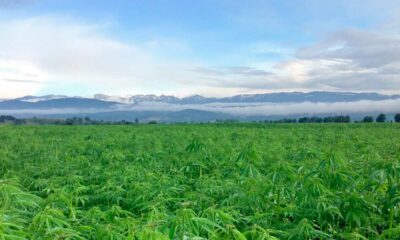
While grain crops are being severely affected by summer droughts, some hemp fields still have green plants at the end of the summer. In Brittany, the network of farmers supported by Terrachanvre, in Morbihan, is thus preparing to harvest his fields without having used irrigation.
«We planted in early May, just as the soil was warming up. Hemp synchronizes its maturation with the length of the day and blooms after the summer solstice,» explains Hervé Derrien, founder of Terrachanvre, as quoted by Ouest-France.
The harvest is scheduled for mid-September, as in previous years. Despite a severe drought, farmers did not observe the expected impact on the plant. The lack of water seems to have affected seed production the most.
«We’ll harvest in mid-September, just like every year. We expected the drought to have an impact, since we don’t use irrigation, but it hasn’t—except that there are fewer seeds. The heads are green. We only need water when we’re planting.»
Trials to Assess the Potential of Hemp
However, this resilience does not mean that the plant can be grown without water in all situations. The establishment phase remains critical, and performance may depend on soil type, planting date, and local conditions. This issue is currently being studied in several regions facing drier summers.
Visit Gironde, 17 farmers planted 34 hectares of hemp in 2026 as part of a pilot project conducted by the Gironde Chamber of Agriculture and theLibournais Hemp Association. The plots allow for comparisons of different methods: surface seeding versus buried seeding, with or without irrigation, and various planting times.
The initial observations made during the growing season are encouraging. Despite dry conditions, the hemp appears to have withstood the lack of water relatively well. However, a true assessment will need to take into account the yields obtained, which will help determine whether this resilience also translates into economically viable production.
The same line of reasoning applies in the Boutonne River Basin, in Charente-Maritime. In 2026, four farmers took part in a trial covering 16 hectares. One of the main goals is to develop a farming plan suited to a region where water availability is a major challenge.
Less water, fewer inputs
The value of the hemp does not depend solely on its ability to survive periods of drought. Its deep root system allows it to tap into the soil's water reserves, while its rapid growth naturally limits competition from weeds.
In Normandy, farmer Damien Odienne sums up his experience this way: «Hemp is very drought-tolerant.» He also points out that «the plant suppresses weeds.»
Other farmers highlight their limited use of pesticides and fertilizers. Ludovic Rivière, a farmer in the Eure department, sees this farming method as a way to reduce his farm’s exposure to weather-related risks.
«Just as with organic farming, we have to adapt in conventional farming as well. The world’s population is growing; we’ll have to feed it and find solutions. Hemp, however, doesn’t require pesticides and needs very little water.»
However, growing this crop is not without its challenges. Sowing requires precision, the seeds are costly, and conventional equipment is not always suitable for a plant whose stems can reach several meters.
An industry that still needs to be structured
The development of the industrial hemp It therefore depends as much on its agronomic qualities as on the ability to organize its processing and marketing.
In Brittany, Terrachanvre is currently preparing a new processing plant, announced as a 5-million-euro project. In Charente-Maritime, a fiber-extraction plant is also set to be built in Saint-Julien-de-l’Escap, with an announced investment of 7.6 million euros.
In the Boutonne basin, this plant is expected to process approximately 2,000 metric tons of hemp per year, corresponding to about 400 hectares of production. But reaching this volume will also require winning over farmers, particularly regarding the purchase price and yields.
There is a precedent: past experience has shown that agronomic resistance alone is not enough to guarantee profitability. Harvesting, in particular, is a sensitive issue due to the lack of a sufficiently developed fleet of machinery.
Crop rotation also poses a challenge. In Gironde, industry stakeholders note that hemp can be grown on the same plot of land only once every five to six years. It must therefore be incorporated into an overall rotation strategy that includes grains and other crops.
Opportunities Beyond Agriculture
Another argument in favor of hemp is its versatility. Fibers and hemp shives can be used in building materials, particularly for insulation. The seeds are used in food products and can be used to produce oil. The fiber is also of interest to certain industries, particularly for manufacturing composite materials for the automotive industry.
This diversity is important for an industry seeking to grow locally: simply producing more is not enough; there must also be processing facilities located near the farms.
Hemp also has potential benefits for the climate. Its rapid growth allows it to capture CO2 from the atmosphere and store some of it in biomass. When the fibers are then incorporated into sustainable materials, some of that carbon can remain sequestered for the duration of their use.
It would nevertheless be an overstatement to consider it the sole solution to climate change. The benefits depend on agricultural practices, crop yields, transportation, and, above all, how the biomass is processed and used.
One Approach to Adapting to Climate Change
In France, the Hemp remains a minor crop, but initiatives are on the rise in regions where access to water is becoming more uncertain. Brittany, Gironde, Normandy, and Charente-Maritime are each exploring, on their own scale, the conditions necessary for its development.
Its appeal lies less in the promise of a large-scale replacement of existing crops than in its ability to diversify crop rotations with a plant that requires relatively little water and has access to several markets.
In a context where farmers must cope with more frequent droughts, the issue is therefore less about finding a “miracle crop” than about identifying crops capable of maintaining production with fewer resources. Hemp is now among the options being tested in the field. It remains to be demonstrated, plot by plot, that its climate resilience can also be transformed into a viable agricultural model.















Morocco: Three Cannabis-Based Medications Approved for the Treatment of Epilepsy

Canopy Growth Receives New EU-GMP Certification to Strengthen Its Presence in Europe

Three years after legalizing medical cannabis, Albania continues to establish regulations for it

The first plant-based medical THC spray arrives in the United Kingdom

Medical Cannabis in Germany: THC Prices Vary by a Factor of 12

France already has 3,000 cannabis retail outlets. None of them are legal.

Morocco's exports of legal cannabis have expanded to 15 countries

Aurora Cannabis Doubles Its Production Capacity in Germany

Tilray is accelerating its operations in Europe thanks to a license in Portugal

Boston will host the 10th annual State of the Cannabis Industry Conference on October 26
-
 Business2 weeks ago
The legal cannabis market in New York exceeds 4 billion $ in revenue
-

 Cannabis in France3 weeks ago
Which countries legalized medical cannabis before France?
-
Business4 weeks ago
South Korea is preparing to begin local production of medical cannabis to meet rising demand
-
Cannabis in Thailand3 weeks ago
From the boom in dispensaries to a purely medical approach: Thailand is revising its cannabis policy
-
Cannabis in France3 days ago
France already has 3,000 cannabis retail outlets. None of them are legal.
-
Cannabis in the U.S.4 days ago
A DEA report confirms that there are no fatal cannabis overdoses
-
Cannabis and driving3 weeks ago
Medical Cannabis and Driving: New South Wales Ends Automatic Penalties for THC
-
Autism3 weeks ago
Autism and Cannabis: Results from the First Placebo-Controlled Trial of NTI164















You must be logged in to post a comment Login