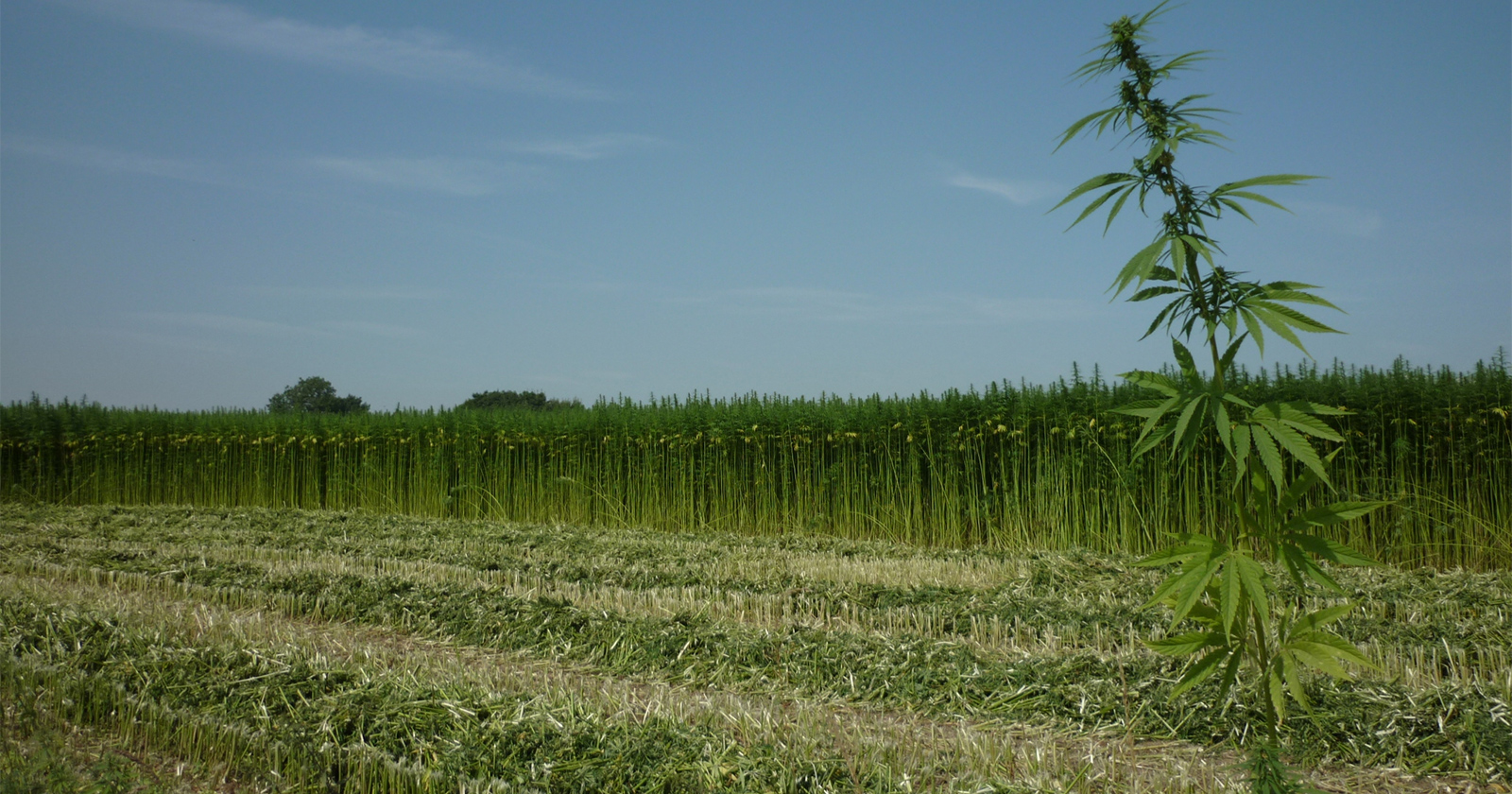
What is industrial hemp?
France remains one of Europe's leading hemp producers, with a historically dominant share of the continental market. The French industry represents several tens of thousands of hectares cultivated annually, supported by cooperatives such as Chanvre & Territoires and growing outlets in construction, textiles and CBD.
What is hemp?
Let's start by recalling the definition of hemp, the source of much confusion.
Hemp, a French name derived from the Latin Cannabis sativa L. (“cultivated hemp”, the L standing for “according to Linnaeus”, the botanist who first characterized the plant in the 18th century), is a petalled dicot of the Urticales order, Cannabaceae family.
Common to the latitudes of mainland and overseas France, this annual herbaceous plant, which can grow up to 5 m tall, is mainly dioecious, with slender, spindly male plants, and sometimes monoecious or hermaphrodite. Female plants are generally more branched. However, it's only with the formation of the buds (commonly called “flowers”) that we can determine whether the plant is dioecious, hermaphroditic or monoecious.
Hemp and cannabis
Botanically speaking, hemp and “Cannabis” refer to the same plant. What is commonly referred to as hemp or industrial hemp represents a sub-category of Cannabis sativa L. plants which do not exhibit any noticeable euphoric character, and whose cultivars therefore contain insignificant amounts of THC. This sub-category has been scientifically identified as being of the hemp fiber type. distinct from two other types.
In France, the term “industrial hemp” refers to authorized varieties of Cannabis sativa L. intended for the fiber and seed industry. However, industrial use is not the only possible use for this plant. A distinction is therefore made between :
- industrial hemp: Cannabis varieties authorized with <0.3% THC, for fiber and seed use
- hemp for wellness use: authorized Cannabis varieties with <0.3% THC, for the full use of the plant's spectrum and in particular the top / ”flowers” for raw use or the extraction of non-euphoric active ingredients (mainly CBD) and not prefiguring any therapeutic claim.
- medical or therapeutic cannabis: Cannabis varieties for medicinal use
- adult-use cannabis, also known as “social” or "recreational" cannabis: varieties >0.3% THC, now illegal in France
Agricultural or industrial hemp seeds for hemp cultivation can be purchased from approved cooperatives such as Hemp-It in France, but also from certified retailers throughout Europe. Varieties must be included in the European hemp catalog to be legally cultivated.
A brief history of hemp
The American market and rising oil prices have recently forced the return of legal hemp to the economy. After having been totally abandoned at the end of the 30s, the market is reborn. In 15 years, America has increased its imports of industrial hemp tenfold, from 1.4 to 11.5 million $. This rise in imports can be attributed to increased worldwide demand for fiber, seeds and oil for cosmetics. Incidentally, the US relegated hemp to the federal level in 2018, both to revitalize the agricultural sector and to embrace the CBD sector with a considerable asset: US agricultural capabilities.
But the benefits of hemp have been known historically for a very long time. As we report in our A brief history of cannabis, The first recorded use of hemp dates back to -3000 BC. Hemp was used for both medicinal and recreational purposes, particularly in religious settings. The whole hemp plant was already in use, having been cultivated for its fibers as early as the 16th century in South America, imported as seeds by Spanish sailors. Queen Victoria used hemp for her health: her personal physician prescribed a tincture of hemp to relieve her painful periods.
Hemp has sailed through all cultures as populations have moved, and it's only very recently that a distinction has been made between hemp and cannabis, separating the plant for industrial use from that for psychotropic purposes. Current international regulations date back to 1961, with the Single Convention on Narcotic Drugs, which standardized the worldwide prohibition of cannabis, while authorizing its use for medical and research purposes. The first prohibitions on cannabis date back a little further, to the 1930s in the United States, which eventually outlawed both hemp and cannabis until the Farm Bill which relegated hemp to 2018.
In Europe, hemp has always had a special status. France, for example, has never banned its cultivation, and has always favored the highly controlled marketing of hemp-based food and industrial products. Today, hemp cultivation accounts for a very small proportion of cultivated land in Europe, but is gradually increasing in all countries. Hemp harvesting sometimes gives rise to local folklore, for example in Greece and Crete, whose rich and favorable climate means they can afford several harvests a year.
Hemp, an all-purpose plant
Whether it's for its nutritional virtues, for construction, its ecological qualities, its protein content and rich in omegas, oils CBD, Whether it's the quality of its fiber, the textile sector, the beauty of its plants, its simple and easy cultivation, its nutritious seeds, its edible oil or any other by-product, hemp offers a multitude of uses.
Useful culture
Every day, hemp is transformed into a multitude of products with diverse benefits, yet the plant's carbon footprint remains extremely low. For every tonne produced, 1.63 tonnes of CO2 are absorbed. This phytoremediation capacity is confirmed when we learn that hemp is massively planted around the Chernobyl nuclear power plant to absorb radiation and radioactive residues. Rather than leave a plot of land empty, farmers sow hemp in fallow land. Not only does it grow fast, but the soil is looser and weeds are eliminated.
Hemp production is particularly environmentally friendly, requiring no fertilizers or pesticides, and very little water to grow. The many outlets for hemp also ensure a very attractive income for hemp farmers.
Hemp is an organic plant par excellence. However, its bio-accumulative properties, which make it a natural soil cleanser, also mean that hemp can be laden with heavy metals and pesticides at the end of its growth cycle. If cultivated for CBD purposes, hemp should always be grown organically, to avoid unpleasant surprises during extraction and an accumulation of materials harmful to consumption, which could undermine its benefits, or even be dangerous for the end consumer.
Industrial hemp fibre: robust and ecological
Hemp fiber is the plant's main industrial constituent: it is stronger than cotton and requires no massive watering, chemicals or pesticides. The fibers are located in the stalk of the plant and separated using highly sophisticated machinery: hemp stalks are in fact much stronger than corn stalks.
From 17ème to 20ème In the 19th century, only hemp fibre was used industrially. Mainly for ropes and ship sails, it seems that the sails that carried Christopher Columbus to America were also made from hemp. Its two other uses were limited to hemp thread and paper. Twine was mainly used for jewelry, while paper was used for writing and painting. But that's not all! Banknotes and tea bags were also made from hemp paper. Today, banknotes are made from cotton fiber.
Today, the fibers are mainly used in the building and construction industry, as building materials such as hemp bricks, or as insulation materials. Even when processed, hemp continues to absorb CO2.
In France, industrial hemp is rapidly expanding again. Although hemp materials are less widely used because wood fiber is cheaper, new hemp innovations are improving its competitiveness, and the sector is listening to opportunities, whether in insulation or cladding for green, eco-friendly homes.
The textile industry is also interested in hemp fiber. It can replace cotton and can be used in conjunction with linen to make environmentally-friendly, recyclable and locally produced garments. Denim was originally made from hemp fiber, and its quality is now widely recognized.
Hemp paper also forms the basis of the rolling papers hemp, very popular in the cannabis world
The nutritional benefits of a hemp-based diet
Hemp can also be eaten as a food, and is rich in nutrients and amino acids. 100 grams of hemp seeds can provide up to 64 % of daily protein intake. Add vitamin B, omega 3 and 6, magnesium, iron, phosphorus and zinc, all contained in edible oil. They also contain the 9 amino acids the body needs to function properly. Of course, humans transform seeds into oil to facilitate ingestion. But the seeds, also known as hemp seeds, are already being used to feed livestock and poultry, and even for fishing.
Hemp oil also nourishes hair and skin in cosmetic applications.
Hemp is also used as a biofuel. It can replace diesel when mixed with ethanol. The U.S. Environmental Protection Agency has announced that hemp could facilitate the energy transition, both as a replacement for some fossil fuels, and for its phytoremediating properties: it cleans the soil in which it grows.
Long considered a cousin of the enemy cannabis, hemp was demonized just like it. Its industry virtually disappeared in the United States with the Marijuana Tax Act of 1937.
Little by little, economic awareness returned. Hemp has no psychoactive effects (no risk of misuse for the most conservative prohibitionists), and its markets are numerous.
Cool things to know about hemp
Hemp has been part of human history since the dawn of time. Its use in agriculture, the building trade and as a source of food has made it one of the world's most popular crops. is now full of anecdotes and anecdotes..
- The American Constitution was prepared on hemp paper. The official document, however, is made of parchment (calfskin).
- The first bibles, maps and flags were made of hemp.
- Henri Ford created the first car to run on hemp in 1936
- There are at least 25,000 ways to process hemp
- 90 % of the world's paper was made of hemp before 1883
- Many painters, such as Van Gogh, painted on hemp canvas.
- One of the oldest human relics, found in Mesopotamia, was fashioned from hemp
- Hemp can be recycled 10 times, while wood can only be recycled 4 times.
Hemp is often summed up as follows: it can house, it can clothe, it can nourish both body and mind. The infographic below illustrates the different possible uses of hemp, depending on the part of the plant used, from root to seed.
To find out more about the botanical links between hemp and hops, read our article on similarities between hops and cannabis.
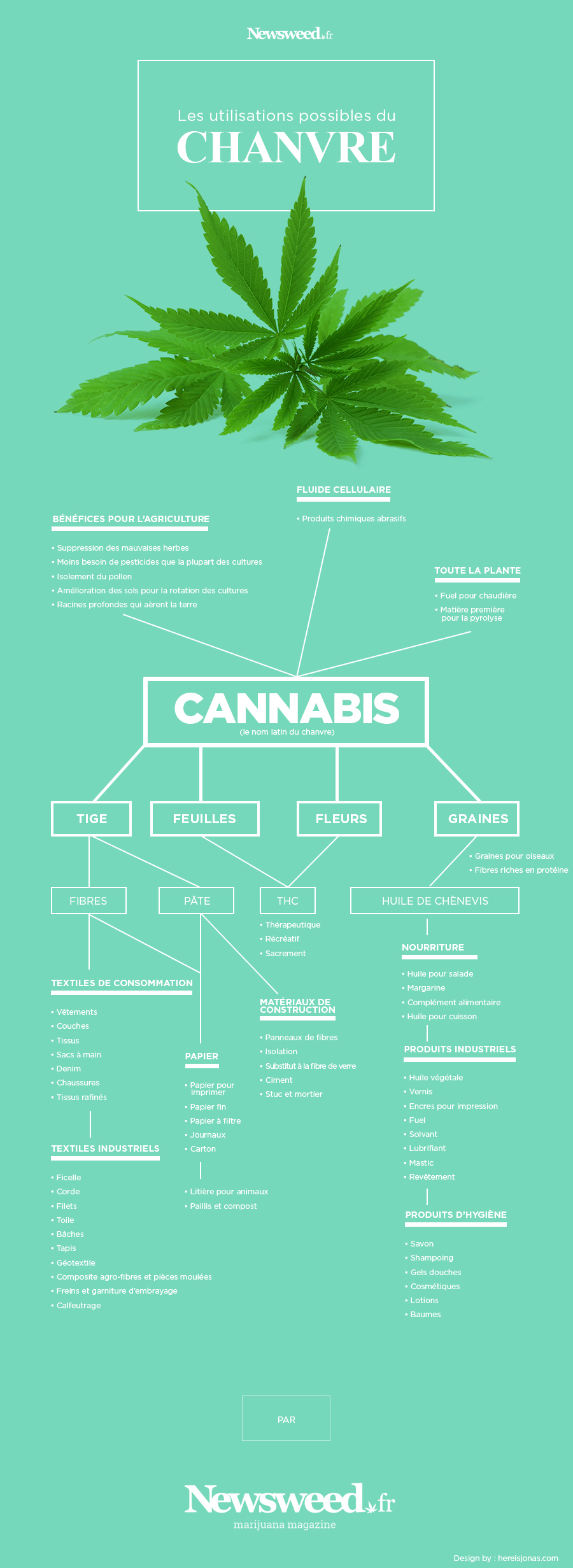
Possible uses for hemp
Possible uses for hemp
What can be done with hemp? Hemp can be used in a variety of ways, some authors like Jack Herer counting 25,000.
| Plant part | Main applications |
|---|---|
| Fibers (outer stem) | Textiles, rope, paper, insulation, building materials (chanvricrete) |
| Chenevotte (inner stem) | Hemp concrete, animal bedding, mulching |
| Seeds (hemp seeds) | Food and feed, edible oil, flour, proteins |
| Seed oil | Cosmetics (skin, hair), food, biofuels |
| Flowers / tops | CBD extraction, aromatherapy, infusions |
| Roots | Phytoremediation, traditional medicine |
| Whole plant | Biofuel (ethanol), compost, phytoremediation |
Housing and living in hemp
70% of the total weight of the cannabis plant is made up of the fibrous or woody inner core. This part of the plant is devoid of THC and is used in construction. Hemp fiber combined with lime forms a chemical bond similar to cement that is both fireproof and waterproof.
Hemp-based food
Hemp can also be grown as an organic food crop, in particular for its seeds, which are also THC-free. Both the complete protein and the oils contained in hemp seeds (rich in lanolin and linolenic acids) are in ideal proportions for human nutrition, and can form the basis of delicious and healthy food and hemp products! This same oil is also excellent for skin and hair.
Hemp fibers
Until its rediscovery in the late 1980s, the use of hemp for fiber production had declined sharply in recent decades, but hemp still held an important place among natural fibers because it is strong, durable and unaffected by water. The main uses for hemp fiber were inrope, sacking, carpeting, netting and webbing. A hemp clothing industry emerged in the West in 1988, and hemp is increasingly used in papermaking. The cellulose content is around 70%.
Hemp stalk
Small plots are usually harvested by hand. The plants are cut 2 to 3 cm above ground level and left on the ground to dry. Mechanical harvesting is now commonplace, using specially adapted binder knives or simpler knives.
The cut hemp is placed in windrows to dry for up to four days. This was traditionally followed by retting, either a water retting whereby the bundled hemp floats in water, or a dew retting whereby the hemp remains on the ground and is affected by dew moisture, as well as by mold and bacterial action. Modern processes use steam and machinery to separate the fiber, a process known as thermomechanical pulping.
Biofuel from hemp
Fuel can be a by-product of hemp cultivation. One fuel would be biodiesel from the oils present in the hemp seeds and stalks, another would be biofuel from the fibrous stalks.








Medical Cannabis in Germany: THC Prices Vary by a Factor of 12

France already has 3,000 cannabis retail outlets. None of them are legal.

Morocco's exports of legal cannabis have expanded to 15 countries

Aurora Cannabis Doubles Its Production Capacity in Germany

Tilray is accelerating its operations in Europe thanks to a license in Portugal

Boston will host the 10th annual State of the Cannabis Industry Conference on October 26

A DEA report confirms that there are no fatal cannabis overdoses

A British patient is challenging the NHS's refusal to reimburse medical cannabis

October 2026 CBD Highlights: 10 Strains and Hash to Discover from 5 French Producers

