France already has 3,000 cannabis retail outlets. None of them are legal.

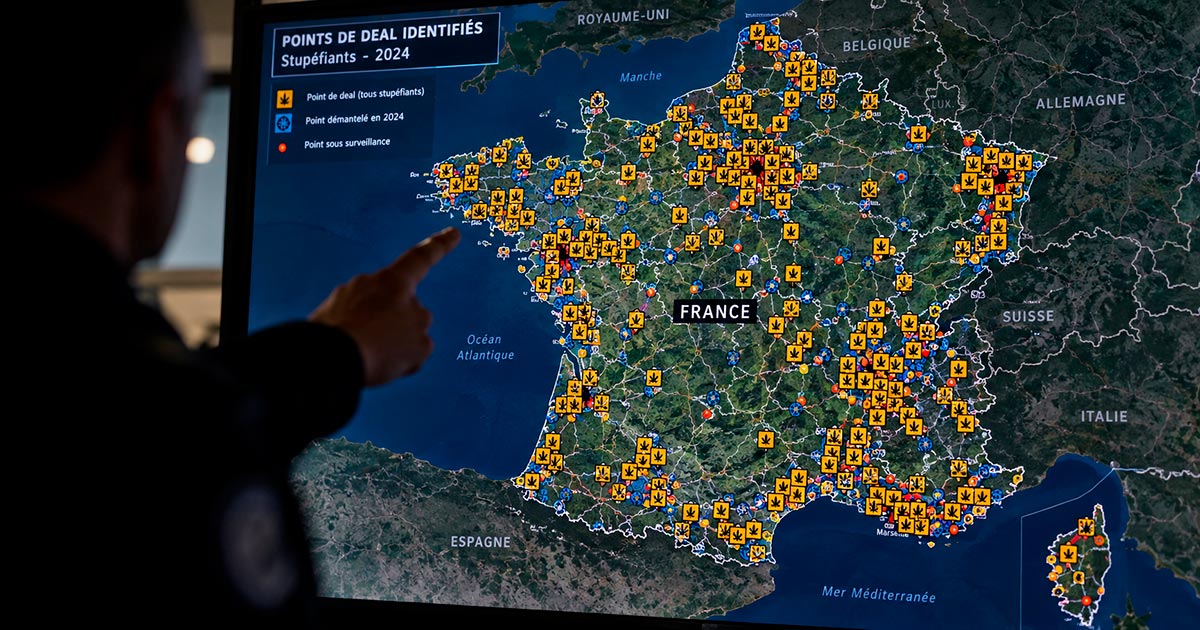
France has thousands of drug dealing spots, five million annual cannabis users, and a market worth several billion euros. Yet the sale of cannabis to adults remains illegal. This paradox is reflected in the official figures.
According to the Mapping of the Drug Trade in France in 2024 According to government data, there were approximately 3,000 points of sale across the country. This figure includes all types of narcotics, not just cannabis, but it gives an idea of the scale of the distribution networks.
According to OFAST, the number of recorded deal locations has since risen to 2,543 as of June 30, 2026. This increase does not necessarily indicate a corresponding decline in the market, given the growth in home deliveries and sales via social media have expanded significantly.
Five million potential customers
According to the latest reference data from the’French Observatory on Drugs and Addiction Trends (OFDT), five million French people used cannabis in 2023, including about 900,000 who used it daily. In total, 18 million adults report having used it at least once in their lives.
France therefore already has a substantial customer base, supply chains, distribution networks, and market prices. In 2023, a gram of weed sold for around 10 euros, compared to 8 euros for resin. These prices have remained unchanged to this day, indicating a certain resilience in the market. compared to quadruple XL operations from the various ministries of the interior.
The OFDT estimated the French cannabis market at 1.2 billion euros as early as 2017. This somewhat outdated estimate illustrates the economic significance of a product whose sale remains prohibited. On our end, the figure was actually somewhere between 2.3 and 4 billion euros.
And unlike a regulated market, this activity is not subject to traditional commercial taxation, quality controls, or rules governing sales to minors, among other things.
A market that didn't wait for legalization
The French debate on the legalization of cannabis is often based on the idea that allowing its sale would amount to creating a new market. The numbers, however, show that this market already exists, complete with its consumers, suppliers, distributors, profit margins, promotional offers, and brands.
Prohibition did not prevent its growth but shifted a large part of its distribution to underground networks, along with the violence and criminal economies that can accompany them.
Legalization would obviously not automatically and completely eliminate trafficking. International Experiences show that price, taxation, product availability, and restrictions imposed on retailers play a decisive role in the ability of a legal market to compete with the illicit supply.
A regulated framework, however, would make it possible to implement health inspections, age restrictions, product traceability, and tax revenue. It would also raise public health issues, particularly regarding the prevention of problematic use and the protection of minors.

























France already has 3,000 cannabis retail outlets. None of them are legal.

Morocco's exports of legal cannabis have expanded to 15 countries

Aurora Cannabis Doubles Its Production Capacity in Germany

Tilray is accelerating its operations in Europe thanks to a license in Portugal

Boston will host the 10th annual State of the Cannabis Industry Conference on October 26

A DEA report confirms that there are no fatal cannabis overdoses

A British patient is challenging the NHS's refusal to reimburse medical cannabis

October 2026 CBD Highlights: 10 Strains and Hash to Discover from 5 French Producers

CBD in France: Traceability, Retail Stores, THC and Driving… What the New Bill Proposes

Organigram Enters the Race for Aurora Cannabis
-
 Business2 weeks ago
The legal cannabis market in New York exceeds 4 billion $ in revenue
-

 Cannabis in France3 weeks ago
Which countries legalized medical cannabis before France?
-
Business3 weeks ago
South Korea is preparing to begin local production of medical cannabis to meet rising demand
-
Cannabis in Thailand3 weeks ago
From the boom in dispensaries to a purely medical approach: Thailand is revising its cannabis policy
-
Cannabis and driving3 weeks ago
Medical Cannabis and Driving: New South Wales Ends Automatic Penalties for THC
-
Cannabis in Argentina4 weeks ago
Argentina Opens Its Market to Hemp Flowers Containing 1% of THC
-
Autism3 weeks ago
Autism and Cannabis: Results from the First Placebo-Controlled Trial of NTI164
-
Cannabis in France2 weeks ago
France’s Drug Policy Chief Defends Cannabis Prohibition... and Runs Into the Facts













You must be logged in to post a comment Login