
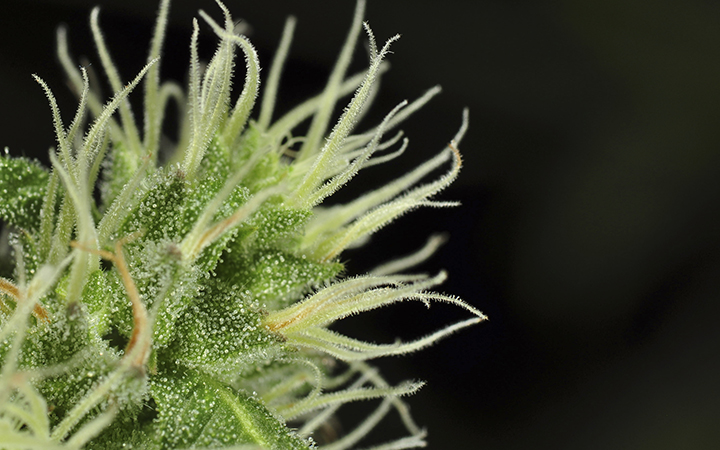
Cannabis pistils: role, colors and harvest indicator
Cannabis pistils are the coloured filaments - often white at first, then orange, russet or brown - that emerge from female flowers. They are the plant's sexual organs: biologically, their role is to capture the plant's genetic material. pollen diffused by the male plants to enable fertilization and seed production. In a sinsemilla - unpollinated female plants - the pistils never perform this reproductive function, but continue to grow abundantly throughout flowering.
Anatomy: the pistil in the female flower
To understand the pistil, we need to understand its place in the floral structure of cannabis. The female flower is organized around the chalice - a teardrop-shaped envelope which surrounds the ovary - itself protected by the bracts. It is from these structures that the pistils emerge.
A pistil is composed of three distinct elements: the stigma, the style and theovary.
The stigma is the sticky, slightly hairy tip at the end of the visible filament - it's this that captures the pollen. Its sticky surface is designed to hold pollen grains carried by wind or insects. The style is the long stalk that connects the stigma to the ovary, acting as a conduit for pollen to the female sex cells. L’ovary, located at the base of the pistil, contains the ovules which, if fertilized, turn into seeds.
Botanically, the female cannabis flower contains two carpels fused into a single pistil, giving rise to two visible stigmas per calyx - which is why there are always two filaments emerging from each calyx of the plant.
The role of pistils in sinsemilla cultivation
In a consumer-oriented cannabis garden, pollination is undesirable. Unpollinated female plants redirect all their energy - instead of devoting it to the formation of seeds - towards the production of resin and cannabinoids in the trichomes which line the bracts and calyxes.
Pistils persist and continue to develop throughout flowering, even without pollination. Their chromatic evolution - from white to orange, red or brown - reflects the plant's maturation progress, and is one of the visual indicators most used by growers to assess flowering stage.
Pistil colors: a reading guide for growers
The color of the pistils changes gradually over the weeks of flowering, following a relatively predictable pattern that nevertheless varies according to genetics and growing conditions.
White pistils - early and mid-flowering. White pistils indicate that the plant is in full resin production. The vast majority of white pistils indicate a plant that has not yet reached maturity. It is also the first visible sign of distinguishing a female from a male plant The appearance of white pistils at the nodes confirms female sex.
Yellow to orange pistils - beginning of the harvest window. When the pistils begin to turn rusty orange, the plant enters the final phase of ripening. At this stage, between 40% and 70% of pistils have changed color, and the concentration of THC is generally at its peak. This is the window favored by growers looking for a euphoric, cerebral effect.
Brown to dark red pistils - advanced maturation. When more than 70% of the pistils are brown and start to curl up on themselves, the THC begins to break down into CBN (cannabinol), a cannabinoid with more sedative and sleep-inducing effects. Consumers looking for a full-body, relaxing effect sometimes wait for this advanced stage.
Purple or red pistils - some varieties, notably those from anthocyanin-pigmented genetics, develop dark purple or bright red pistils. This phenomenon is genetic and/or linked to low night-time temperatures at the end of flowering. It does not indicate any particular maturity - always cross-check with other indicators.
| Pistil color | % approximately changed | Signal |
|---|---|---|
| White | 0–30% | Active flowering, not yet ripe |
| Yellow | 30–50% | Approach to maturity |
| Orange | 50–70% | THC peak, optimal harvest window |
| Reddish brown | 70–90% | THC degrades, more sedative effect |
| Dark brown / curled up | 90–100% | Late harvest, high CBN content |
Pistils vs trichomes: which indicator to choose?
This is the most important practical question for growers. The answer is clear: trichomes are the most reliable indicator of maturity, Pistils are only a complementary and approximate indicator.
Pistils may turn brown prematurely for reasons independent of ripeness: mechanical rubbing, excessive humidity, accidental light fertilization, or simply the genetics of the variety. Conversely, some varieties maintain white pistils until harvest, even when the trichomes are fully ripe. Pistil color gives a general indication of flowering progress, but is not sufficient on its own to decide when to cut.
Observing trichomes with a magnifying glass (60x-100x minimum) remains the reference method: translucent trichomes indicate an immature plant, milky/opaque trichomes signal peak THC, and amber trichomes indicate the start of CBN degradation.
In practice, experienced growers use both indicators together: pistils to monitor overall progress week by week, trichomes to make the final harvest decision.
The second cycle of pistils at the end of flowering
A phenomenon observed in certain varieties at the end of flowering is worth mentioning: the plant re-launches a new wave of white pistils when the first ones are already brown and curled up. This «second cycle» can be confusing for novice growers.
This should not be interpreted as a sign that the plant is not mature - it is often a normal genetic behavior of some long-flowering varieties, or a signal of mild environmental stress. Growers who so wish can let this second cycle mature to maximize yield, but the quality of the heads already formed will not improve significantly. The decision depends on the time available and the variety grown.




What if CBD enhanced the effects of THC? A comprehensive analysis challenges a common misconception

Medical cannabis: A U.S. study finds a 6.9% reduction in absences from work

Andorra Paves the Way for Medical Cannabis Cultivation

Aurora Rejects Curaleaf's Hostile Bid and Opens the Door to Other Suitors

Cannabis in Quebec: The 21-Year-Old Age Requirement in the Spotlight

Drought: Could Hemp Become the New Hope for French Farmers?

United States: Congress Rejects Ban on THC Derived from Hemp

Quick Hit August 2026: What We Missed in Recent Weeks

U.S. Congress Comes to the Rescue of THC-Infused Beverages
