How can you tell male and female cannabis plants apart?
Cannabis is a plant mainly used for dioecious male and female individuals grow separately, unlike most plants, which are hermaphroditic. This feature is fundamental for any grower: only plants females produce flowers (heads) rich in cannabinoids and in trichomes. Identifying and eliminating males in time is one of the basic skills of cannabis cultivation.
Male, female, hermaphrodite: the three sexes of cannabis
| Male | Female | Hermaphrodite | |
|---|---|---|---|
| Organs | Pollen bags (balls) | Pistils (white hairs), calyxes | Both simultaneously |
| THC/CBD | Very low | High (unfertilized flowers) | Variable |
| Cultural interest | Breeding only | Flower production | Eliminate (unwanted pollination) |
| Risk | Pollinates females | None if isolated | Pollinates even isolated females |
When and how to identify a plant's sex
Early signs in vegetation (advanced method)
Even before flowering, signs appear at the junction between the main stem and the branches: this is called the node. Careful observation with a magnifying glass, from the 4th-6th week of vegetation :
- A female develops tiny pre-flowers teardrop-shaped with two fine white hairs emerging - the pistils early onset.
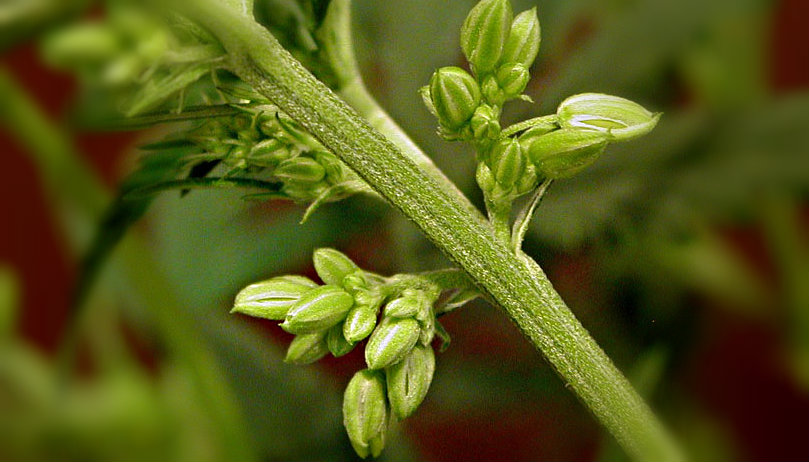
- A male develops small round excrescences ball-shaped, often grouped in pairs, with no visible hairs.
These signs are subtle and require experience - many growers wait until flowering to be sure.
Identification in bloom (reliable method)
As soon as the plant receives 12h of light / 12h of darkness (or naturally in autumn outdoors), the differences become clear in 1 to 2 weeks:
Female plant for pistils white filaments emerge at the nodes between the branches and the main stem. These filaments herald the formation of calyxes, then buds and heads. An unfertilized female concentrates all her energy on the production of resin. sinsemilla (seedless), ideal for production.
Male plant small green balls or white pollen sacs) appear in the same places, grouped together in clusters. When mature, the pollen sacs open and release a cloud of yellow pollen - enough to pollinate all the females in the growing area, and even those in neighboring gardens if outdoors.
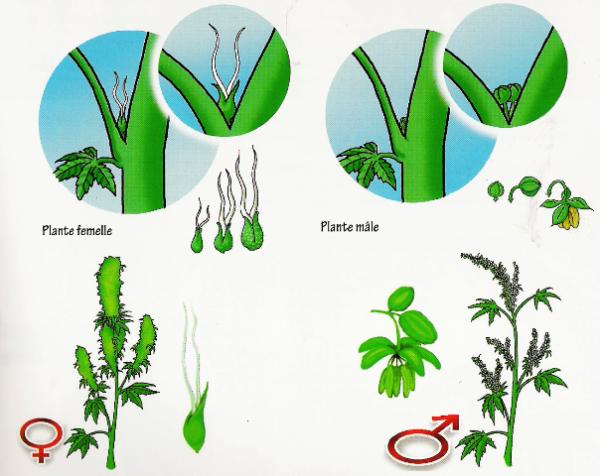
Differences between females and males during flowering. Source : AlchimiaWeb.com
Why eliminate males so quickly?
A single male plant can ruin an entire plantation. One fertilized female :
- Devotes its energy to the production of seeds rather than resin
- See its THC and its aromas significantly reduced
- Can produce over 300 seeds - interesting for breeding, catastrophic for flower production
As soon as male attributes are identifiable - before the pollen sacs open - the males must be removed or isolated. The window can be short: some early males start releasing pollen as early as the 2nd week of flowering.
Hermaphroditic plants: the silent threat
A hermaphroditic plant develops both male and female organs. It is a risk that is often underestimated, as it is less visible than an obvious male.
Main causes Intense environmental stress (sudden variation in photoperiod, excessive heat, injury, lack of water), unstable genetics, excessive aging of the plant during flowering.
Two shapes :
- True hermaphrodite« pollen sacs and pistils developed simultaneously on the same plant
- Bananas (nananes): banana-shaped male structures that grow directly in the female calyxes without a protective sac - the most dangerous because they release pollen immediately without warning.
What to do Eliminate immediately or isolate. Unlike males, which can be tolerated if kept strictly separate, a hermaphrodite in a cultivation area is almost impossible to manage without the risk of fertilization.
Use of male plants
Although useless for flower production, males have their uses:
Breeding the breeders select males with outstanding genetics to cross with elite females and create new varieties. Half of a variety's genetic heritage comes from the male parent.
Fibers Male industrial hemp plants produce finer, softer fibers than females, which are prized for high-quality textiles.
Light medicinal use Leaves and stems contain small amounts of cannabinoids - enough for a lightly relaxing infusion or topical preparations.
Compost the simplest and often the most relevant for a hobby grower.
Feminized seeds: avoiding the problem at source
The most practical solution for growers who are not specialized in breeding is to use feminized seeds, seeds produced to give almost exclusively female plants (99%+). They eliminate the anxiety of sexing and considerably simplify crop management.
Another option: the clones from female mother plants, guaranteeing 100% females without any genetic variability.





Medical Cannabis in Germany: THC Prices Vary by a Factor of 12

France already has 3,000 cannabis retail outlets. None of them are legal.

Morocco's exports of legal cannabis have expanded to 15 countries

Aurora Cannabis Doubles Its Production Capacity in Germany

Tilray is accelerating its operations in Europe thanks to a license in Portugal

Boston will host the 10th annual State of the Cannabis Industry Conference on October 26

A DEA report confirms that there are no fatal cannabis overdoses

A British patient is challenging the NHS's refusal to reimburse medical cannabis

October 2026 CBD Highlights: 10 Strains and Hash to Discover from 5 French Producers

