
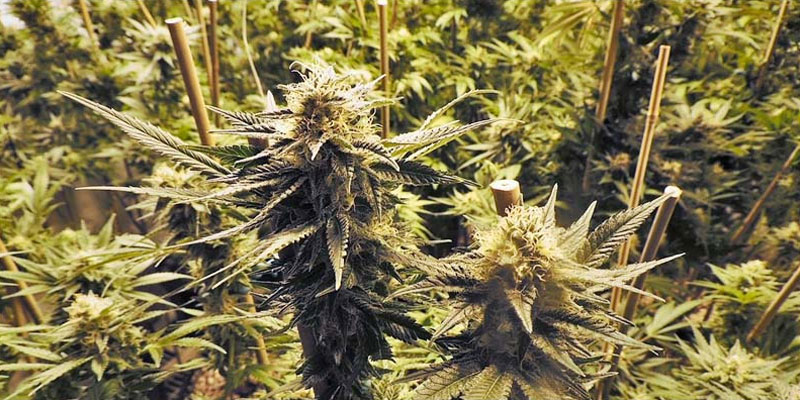
What is Cannabis Ruderalis?
You're probably already familiar with differences between indica and sativa cannabis varieties. But have you ever heard of Cannabis Ruderalis?
According to Jorge Cervantes, professional grower and author of numerous books on cannabis cultivation, «botanists disagree on whether Cannabis Ruderalis is a separate species or a subspecies» of cannabis. What is certain, however, is that ruderalis is at the root of all the autoflowering varieties and that its genetics have profoundly transformed the breeding contemporary.
Origins of Cannabis Ruderalis
The term ruderalis comes from the Latin word rudus (rubble) - ruderal species are those that grow spontaneously on disturbed land, roadsides or wasteland. Cannabis Ruderalis is originally a wild variety that may have descended from the shoots of industrial hemp having grown on the bangs of crops and adapted over generations to the extreme conditions of the cold regions of Central Asia and Eastern Europe.
It was first classified in 1924 by the Russian botanist D.E. Janischewsky, who noted that these plants differed morphologically and in their flowering cycle from known hemp varieties - and located them in Central and Eastern Europe, notably Russia. More recently, a study by K.W. Hillig (2004) identified the Cannabis ruderalis as originating from Central Asia, with strong genetic similarities to the Cannabis sativa from the same region.
These two locations are not incompatible: ruderalis probably appeared in Central Asia before migrating to Eastern Europe over the centuries, gradually adapting to increasingly northerly latitudes.
Physical characteristics of Cannabis Ruderalis
Ruderalis is visually distinguished from other cannabis subspecies by several specific traits.
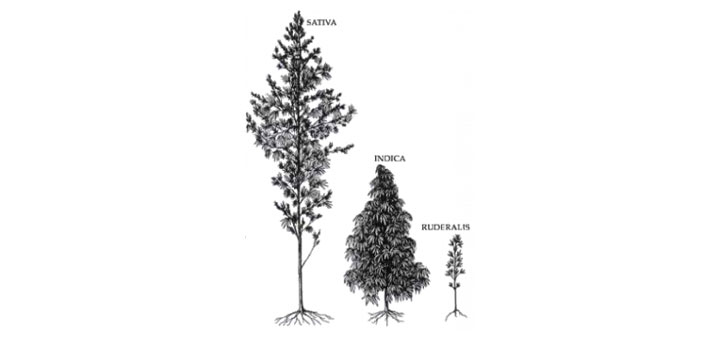
Compact size Plants rarely exceed 60 cm in height, compared with 60-120 cm for an indica and up to 300 cm for some sativas. This reduced stature is an adaptation to the short seasons and winds of the regions of origin.
Characteristic leaves ruderalis leaves have three main leaflets and two very small secondary leaflets, slightly lighter than those of indicas. They are wider and less indented than sativa leaves.
Small but dense flowers ruderalis heads tend to be small but well-stocked, with thick, sturdy stems.
Robustness Ruderalis: adapted to extreme environments (frost, poor soils, variations in humidity), ruderalis plants are naturally resistant to parasites and disease.
The automatic flowering cycle: what makes ruderalis unique
What fundamentally distinguishes Cannabis Ruderalis from other subspecies is its photoperiod-independent flowering cycle. Where indicas and sativas require a 12 hr light/12 hr dark transition to start flowering, ruderalis starts flowering automatically. 20 to 40 days after germination, regardless of the number of hours of light received.
This mechanism is an evolutionary adaptation to the short seasons of the regions of origin: in the steppes of Central Asia or Siberia, waiting for a change in photoperiod to flower would be fatal - frost would arrive before maturity. Ruderalis has therefore developed an internal biological clock that is independent of light.
Modern hybrids derived from crosses with ruderalis generally start flowering in 20 to 30 days and are ready for harvest between 49 and 77 days after germination.
Cannabinoid content
The cannabinoid profile of wild ruderalis differs significantly from that of cultivated varieties.
Low THC Pure ruderalis plants contain around 3% of THC - enough not to be equated with industrial hemp (< 0.3%), but far below modern hybrids (15-30%). In its pure state, ruderalis produces practically no significant psychoactive effects and is not consumed as such.
Moderate to high CBD Ruderalis has a relatively high CBD content compared with sativas, making it an interesting starting material for the development of high-CBD medical varieties.
Ruderalis should not be confused with industrial hemp: although both have a low THC content, ruderalis remains a cannabis plant in its own right, with its own genetic and morphological characteristics.
Comparison: Ruderalis, Indica, Sativa
| Ruderalis | Indica | Sativa | |
|---|---|---|---|
| Flowering | Automatic (age) | Photoperiodic | Photoperiodic |
| Size | 30-60 cm | 60-120 cm | 120-300 cm |
| Leaves | 3 broad, light-coloured leaflets | 7 broad, dark green leaflets | 9 narrow leaflets, light green |
| Total cycle | 49-77 days | 14-22 weeks | 20-32 weeks |
| Natural THC | ~3% | Medium to high | High |
| Natural CBD | Moderate | Low to moderate | Low |
| Robustness | Very high | Average | Low |
| Main use | Breeding autos | Consumer, medical | Consumer, medical |
Ruderalis breeding benefits
This is where the commercial value of ruderalis lies. On its own, it is of little interest to the consumer - too small, too low in THC. However, its autoflowering genes are a goldmine for growers. breeders.
By crossing ruderalis with indicas or sativas quality, it's possible to create hybrids that combine the autoflowering of Ruderalis with the potency, aroma and yield of modern varieties. The resulting hybrid inherits the autoflowering gene while expressing the terpene profile, THC potency and morphology of its genetic partner.
These hybrids - commonly known as «autos» or «autoflowering» - now account for a major share of the market for cannabis seeds. Varieties such as Northern Lights Automatic, Gorilla Glue Auto or Amnesia Haze Auto are all direct descendants of ruderalis crosses. To find out everything you need to know about their cultivation, consult our autoflowering varieties.
Advantages of Cannabis Ruderalis for growers
Autoflowering - no need for photoperiod management. Autos from ruderalis flower regardless of the light program, which considerably simplifies management in indoor cultivation and allows several harvests per season outdoors.
Short cycle - from germination to harvest in 7 to 11 weeks for modern hybrids, compared with 4 to 7 months for a photoperiodic grown outdoors.
Climate resistance - ruderalis heritage gives cars superior tolerance to temperature variations, humidity and parasites.
High CBD content - Ruderalis crosses are often used to develop medical varieties with high CBD and low THC, particularly useful for patients who want to avoid psychoactive effects.







CBD is said to promote athletic recovery, without improving performance

294 cannabis clubs in Chile: a booming movement with uneven distribution

Chronic Sciatica: New York Approves First Clinical Trial of a THC-Based Medication

United States: The DEA is accelerating the integration of medical cannabis at the federal level

Florida is nearing one million patients using medical cannabis

Uruguay Revives Its Plan to Allow Tourists to Legally Access Cannabis

In Brazil, researchers are developing an innovative CBD eye drop

Autism: Medical Cannabis Is Linked to Reduced Anxiety

The $28 billion U.S. hemp market remains under threat

