Democratic senators are reviving a bill to legalize cannabis at the federal level in the United States

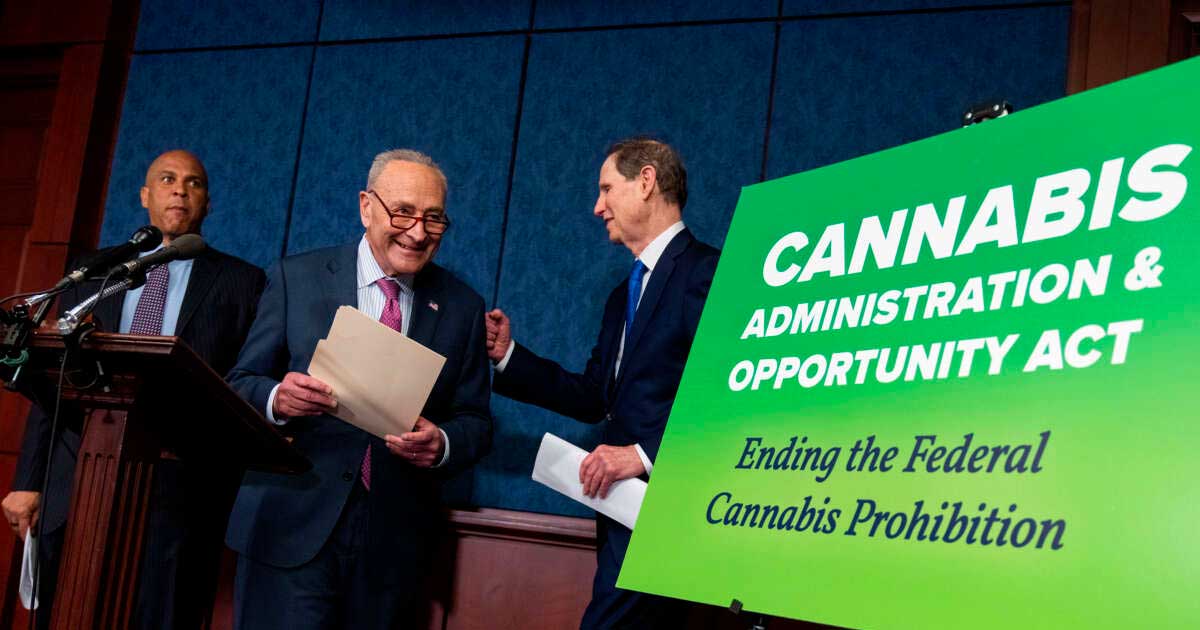
A group of Democratic senators once again presented the « Cannabis Administration and Opportunity Act » (CAOA), a far-reaching proposal that would end the federal ban on cannabis in the United States. Led by Cory Booker, Ron Wyden and the Democratic leader in the Senate Chuck Schumer, this bill aims to remove cannabis from the Controlled Substances Act, thereby allowing each state to regulate this plant without being subject to the federal ban.
This proposal, first introduced in 2021, resurfaces as the’Trump administration continues to consider a more limited reform, based on reclassifying cannabis rather than removing it entirely from federal drug laws. In contrast, the CAOA would fully decriminalize cannabis, making it one of the most comprehensive reform initiatives ever introduced in Congress.
At present, 24 U.S. states have legalized cannabis for recreational use by adults, while 35 states have adopted medical cannabis programs, highlighting the growing gap between state laws and federal law.
A Federal Framework for the Cannabis Industry
Beyond the lifting of the federal ban, the Cannabis Administration and Opportunities Act (Cannabis Administration and Opportunity Act) would establish a national regulatory framework for the legal cannabis sector. The bill proposes that oversight of the industry be transferred to the Alcohol and Tobacco Tax and Trade Bureau (TTB), while the Food and Drug Administration (FDA) would be responsible for establishing product standards, including labeling requirements regarding potency, dosage, serving sizes, manufacturing information, and instructions for use.
The bill would also establish a federal excise tax on cannabis products. Under the proposal, this tax would initially be set at 10%, before gradually increasing to 25% over a five-year period. The bill also includes measures to preserve competition by protecting independent producers, wholesalers, and retailers from anti-competitive practices.
Another notable addition in this latest version concerns psychoactive cannabinoids derived from hemp. The proposal would prevent the planned federal ban of certain products made from Hemp-derived THC, which is expected to take effect later this year.
Social justice remains a central goal
As in previous versions, the restorative justice remains one of the cornerstones of the legislation. The bill would expunge certain prior convictions for minor cannabis-related offenses and establish mechanisms to improve access to employment, housing, and other civil rights for those affected by past prohibition policies.
Revenue generated by the federal cannabis tax would fund initiatives designed to support communities that are disproportionately affected by the war on drugs. The proposed measures include vocational training, legal aid, reintegration programs, and efforts to reduce barriers to obtaining commercial cannabis licenses.
In a statement accompanying the bill, Cory Booker said: «For decades, generations have suffered unjustly as a result of the failed «war on drugs» and flawed cannabis laws that have primarily harmed people of color. It is high time we stood up for them.»
Ron Wyden also defended the proposal, stating: «The only «" reefer madness »What I see is that the federal ban on cannabis remains in place.»
Uncertain Outlook in Congress
The latest version of the CAOA has garnered the support of 17 Democratic senators, including Elizabeth Warren, John Fetterman and Michael Bennet. Organizations advocating for pro-cannabis policies, including NORML, also welcomed this proposal, arguing that federal law no longer reflects either public opinion or the reality of state-level regulations.
Despite this support, the bill faces a difficult path through the legislature. The House of Representatives With the Republican Party in control, full federal legalization is unlikely to move forward easily. Opposition to complete decriminalization also remains stronger than opposition to the more limited approach of reclassification. currently being considered by the federal government.
























Medical Cannabis in Germany: THC Prices Vary by a Factor of 12

France already has 3,000 cannabis retail outlets. None of them are legal.

Morocco's exports of legal cannabis have expanded to 15 countries

Aurora Cannabis Doubles Its Production Capacity in Germany

Tilray is accelerating its operations in Europe thanks to a license in Portugal

Boston will host the 10th annual State of the Cannabis Industry Conference on October 26

A DEA report confirms that there are no fatal cannabis overdoses

A British patient is challenging the NHS's refusal to reimburse medical cannabis

October 2026 CBD Highlights: 10 Strains and Hash to Discover from 5 French Producers

CBD in France: Traceability, Retail Stores, THC and Driving… What the New Bill Proposes
-
 Business2 weeks ago
The legal cannabis market in New York exceeds 4 billion $ in revenue
-

 Cannabis in France3 weeks ago
Which countries legalized medical cannabis before France?
-
Business3 weeks ago
South Korea is preparing to begin local production of medical cannabis to meet rising demand
-
Cannabis in Thailand3 weeks ago
From the boom in dispensaries to a purely medical approach: Thailand is revising its cannabis policy
-
Cannabis and driving3 weeks ago
Medical Cannabis and Driving: New South Wales Ends Automatic Penalties for THC
-
Cannabis in Argentina4 weeks ago
Argentina Opens Its Market to Hemp Flowers Containing 1% of THC
-
Autism3 weeks ago
Autism and Cannabis: Results from the First Placebo-Controlled Trial of NTI164
-
Cannabis in France2 weeks ago
France’s Drug Policy Chief Defends Cannabis Prohibition... and Runs Into the Facts

















You must be logged in to post a comment Login