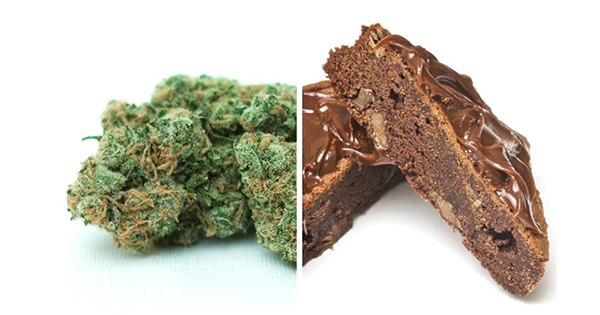
11-Hydroxy-THC: the molecule behind the space cake effect
Those who have already tested space cakes or cannabis edibles like to share their story of an incredible brownie that made them feel good for 4 hours, or one that made them feel bad for just as long. What these two stories have in common is that the effect of an edible is unpredictable, delayed and far more intense than that of a joint of the same potency. THC.
To understand why, we need to look at fundamental differences between smoking and eating cannabis and one molecule in particular: the 11-hydroxy-THC.
What is 11-hydroxy-THC?
11-hydroxy-THC (11-OH-THC) is a primary metabolite of delta-9-THC, is a molecule produced by the body when it processes THC. It is neither a phytocannabinoid (produced by the plant), nor an endocannabinoid (produced naturally by the body): it is exclusively a product of human metabolism.
The route begins in the trichomes cannabis, where THC is first present in its acid form: the THCA. During the decarboxylation, When THCA is burned, vaporized or cooked, it loses its carboxyl group and is transformed into active delta-9-THC. It is this THC that then enters the bloodstream and reaches the brain.
But that's not the end of the journey. Once in the body, the liver converts some delta-9-THC into 11-hydroxy-THC via cytochrome P450 enzymes. This metabolite then continues to break down into 11-nor-9-carboxy-THC (THC-COOH), an inert metabolite that is stored in body fat and which the screening tests to detect cannabis use.
Why is 11-hydroxy-THC more potent than THC?
11-hydroxy-THC has two characteristics that make it more potent than delta-9-THC:
It crosses the blood-brain barrier more efficiently. The blood-brain barrier is the filter that protects the brain from most substances circulating in the blood. 11-OH-THC, due to its slightly different chemical structure, crosses this barrier more easily and rapidly than delta-9-THC, enabling it to reach the CB1 receptors of the central nervous system in higher concentrations.
It has a higher affinity for CB1 receptors. Studies suggest that 11-OH-THC binds to cannabinoid receptors with an affinity equal to or greater than that of delta-9-THC, producing more intense psychoactive effects at equivalent concentrations.
The combination of these two factors explains why edibles users often describe significantly stronger, more bodily and longer-lasting effects than those obtained by inhalation, even with the same dose of THC on paper.
Why do edibles produce 10 times more 11-OH-THC than smoke?
It's the key to everything: the mode of administration determines the amount of 11-OH-THC produced, and therefore the intensity of the effect.
When inhaling (joint, vaporizer), THC passes directly from the lungs into the bloodstream, initially bypassing the liver. It reaches the brain in a matter of seconds to minutes, before being metabolized to 11-OH-THC during a subsequent passage through the liver. Conversion to 11-OH-THC is therefore limited, and most of the effect is produced directly by delta-9-THC.
When ingested (space cake, capsule, swallowed oil), THC follows a radically different path. It is first absorbed in the small intestine, and then passes directly into the portal vein to the liver before entering general circulation. This phenomenon is called’hepatic first-pass effect. The liver metabolizes a significant proportion of THC to 11-OH-THC on this first pass. The remaining THC, once in circulation, passes through the liver a second time, creating a new wave of conversion.
As a result, the body produces about 10 times more 11-OH-THC when ingested than when inhaled. This ratio explains why a space cake can have a far greater effect than a joint containing the same amount of THC.
Why are the effects of edibles so delayed and unpredictable?
Two additional factors complicate the equation.
Digestive absorption time. Unlike inhalation, where the effects are felt in a matter of seconds, ingested THC must pass through the stomach and intestine before reaching the liver and then the brain. This process generally takes between 30 minutes and 2 hours, The amount of edible food consumed depends on whether the stomach is full or empty, the speed of digestive transit and the product formulation (fat, emulsification). This is the main reason why inexperienced consumers reconsume too soon, thinking that edible «doesn't work» and then end up with a double or triple dose.
Individual variability in hepatic metabolism. The amount of 11-OH-THC produced depends on the cytochrome P450 enzymes CYP2C9 and CYP3A4, whose activity varies considerably from person to person, depending on genetics, health status, concomitant medications and the consumption of alcohol or other substances. Two people eating the same space cake can have radically different experiences.
Duration of effects is also longer: while the effects of a joint generally last 1 to 3 hours, an edible can produce effects for up to three hours. 4 to 8 hours, This is due to the gradual release of 11-OH-THC and its longer half-life.
Comparison table: inhalation vs. ingestion
| Inhalation | Ingestion | |
|---|---|---|
| Main molecule | Delta-9-THC | 11-Hydroxy-THC |
| Delay of effect | A few seconds to 5 min | 30 min to 2 hours |
| Peak effect | 15 to 30 min | 1 to 3 hours |
| Total duration | 1 to 3 hours | 4 to 8 hours |
| Intensity | Moderate, controllable | More intense, less predictable |
| Production of 11-OH-THC | Low | 10x higher |
| Cerebral penetration | Fast (THC direct) | More intense (11-OH-THC) |
How to consume edibles without a bad experience?
Understanding 11-OH-THC is directly useful for tackling edibles more safely.
Start low, go slow. The universal rule for edibles is to start from a low dose, 5 mg of THC is a good starting point for a beginner, 2.5 mg if you are very sensitive, and from a high to a low dose.’wait at least 2 hours before considering a second dose. The most common mistake is to reconsume after 45 minutes «because nothing's happening yet».
The state of the stomach changes everything. An empty stomach accelerates absorption and intensifies the effects. A fatty meal before or with the edible slows absorption but may also increase THC bioavailability, as THC is fat-soluble. Eating after the edible does not cancel the effects, but may delay them slightly.
If you make your own edibles, You can precisely dose your cannabis butter by knowing the THC concentration of your raw material. A butter made with cannabis at 20% THC is very different from one made with trim at 5%. Halve recipes if you're unsure of potency, and consume a small test portion before committing to a full serving.
If the effect is too strong, Remember that 11-OH-THC will eventually be metabolized. Stay in a safe and comfortable environment, stay hydrated, and if possible have some CBD CBD can moderate the anxiety-inducing effects of THC by partially modulating CB1 receptors. Avoid alcohol, which amplifies the effects.
Drugs and interactions. Cytochrome P450 inhibitors, including certain antifungals, antibiotics, antiepileptics and grapefruit juice, can slow THC metabolism and considerably increase 11-OH-THC accumulation. If you are taking regular medication, consult a health professional before consuming edibles.
11-OH-THC and screening tests
11-OH-THC is a metabolic intermediate, rapidly converted to THC-COOH. The standard screening tests (urine, blood) are not specifically looking for 11-OH-THC but for THC-COOH, its breakdown product. Consumption of edibles produces more THC-COOH than smoking, which means that traces in the urine can be very high. more abundant and potentially detectable for longer after consuming edibles than after inhaling an equivalent dose.






CBD in France: Traceability, Retail Stores, THC and Driving… What the New Bill Proposes

Organigram Enters the Race for Aurora Cannabis

Medical Cannabis: Augur Associates’ latest report provides an update ahead of the publication of the decrees

Golden Buds is relaunching its Nova High vape pens with a cannabinoid formula that’s out of the ordinary

Cannabis is now Canada's fifth-largest commercial crop

Bedrocan Finally Declared Bankrupt

After CBD, Can Wellness Exist Without Cannabinoids?

Uganda Launches a Cooperative Dedicated to Medical Cannabis

Ukraine: First Cancer Patient Prescribed Medical Cannabis

