THCA (tetrahydrocannabinolic acid): definition, effects and legality
THCA, for tetrahydrocannabinolic acid, is the most abundant cannabinoid in fresh, unheated cannabis plants. Non-intoxicating in its raw state, it transforms into THC psychoactive under the heat by a process called decarboxylation. Understanding THCA is understanding the fundamental chemistry of cannabis and why chewing a fresh leaf produces no psychoactive effect.
What is THCA?
THCA is produced in the trichomes, the tiny resinous glands that coat cannabis flowers and leaves. This is where biosynthesis takes place cannabinoids enzymes trigger a series of chemical reactions to assemble complex molecules from simple precursors.
The central precursor to all major cannabinoids is CBGA (cannabigerolic acid). The enzyme THCA synthase converts CBGA into THCA. The same logic applies to other acidic cannabinoids: CBDA synthase produces the CBDA, CBCA synthase produces CBCA. Most cannabinoids therefore exist in their acidic form first upon harvest (THCA, CBDA, CBGA) before transforming into their neutral forms (THC, CBD, CBG) under the effect of heat or time.
THCA vs THC: What's the difference?
The fundamental difference between THCA and THC is the presence of a carboxyl group (-COOH) attached to the THCA molecule. This carboxyl group alters the molecule's three-dimensional shape, preventing it from fitting into the binding pocket of the CB1 receptor in the brain. Without this interaction, there is no intoxicating effect.
When THCA is exposed to heat (smoking, vaporization, cooking) or time (aging, prolonged drying), it loses this carboxyl group as CO₂: this is decarboxylation. The resulting molecule, THC, adopts a shape compatible with the CB1 receptor and produces the known psychoactive effects.
This is also why The conversion difference between THCA and THC is 0.877. : One molecule of THCA yields 87.71% of its weight in THC after decarboxylation, with the remainder lost as CO₂. This factor is used to calculate the total potential THC of cannabis from its analyzed THCA content.
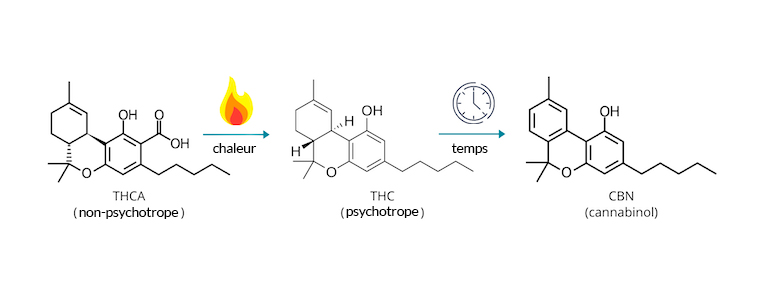
Degradation of THCA into THC and then into CBN under the effect of heat and time
The THCA decarboxylates at what temperature?
Decarboxylation of THCA occurs gradually from 80-100°C, but it is complete and rapid from 110-120°C. In practice:
- Smoke / joint The combustion exceeds 800°C, decarboxylation is almost instantaneous and total, but a portion of the THC is destroyed by the excessive heat.
- Vaporization Between 170°C and 230°C, optimal decarboxylation with terpene preservation.
- Four edibles 110-120°C for 30 to 45 minutes is sufficient to decarboxylate the majority of THCA.
- Room temperature aging THCA decarboxylates very slowly over several months, which is why dried and aged cannabis contains more free THC than freshly harvested cannabis.
Effects and medicinal properties of THCA
While not intoxicating, THCA is not without biological activity. Research indicates several potential therapeutic properties, largely distinct from those of THC.
Anti-inflammatory THCA inhibits the cyclooxygenase enzymes COX-1 and COX-2, which are involved in inflammatory responses, a mechanism similar to that of non-steroidal anti-inflammatory drugs (NSAIDs).
Neuroprotective Animal model studies suggest that THCA activates the PPAR-γ (peroxisome proliferator-activated receptor gamma) pathway, which is involved in neuronal protection. Preliminary research associates it with a protective effect against neurodegenerative diseases such as Huntington's and Parkinson's disease.
Antiemetic THCA shows antiemetic (anti-nausea) activity via distinct receptor pathways from CB1, making it an interesting candidate for patients who want the benefits without the intoxication.
Immunoregulator THCA modulates immune activity by interacting with TNF-alpha proteins and the cytokine IL-10, two key players in inflammatory regulation.
Antitumor in vitro studies suggest that THCA, combined with other non-psychoactive cannabinoids, may inhibit the growth of certain cancer cell lines, including prostate cancer, although these results remain very preliminary.
It should be noted that THCA is a chemically unstable compound: it gradually converts to THC at room temperature, making its study and preservation delicate.
THCA and drug tests
This is a common and important question: Does THCA trigger a positive cannabis test?
Standard screening tests (urine, blood, saliva) primarily look for THC and its main metabolite, THC-COOH. THCA itself is not directly searched for. However, two mechanisms can lead to a positive result:
- Partial conversion Even when consumed raw or as an unheated product, THCA can partially convert to THC during digestion or due to body heat.
- Residual contamination THCA products almost always contain trace amounts of THC, which are enough to trigger a positive test.
In practice, Consuming THCA, regardless of the form, presents a real risk of testing positive., especially for sensitive urine tests. This is directly related to the article on How long does THC stay in the body.
Is THCA legal in France?
In France, THCA is not explicitly named in the texts classifying narcotics, but in practice, it is considered to fall under the same restrictions as THC for two reasons:
- It is the direct precursor to THC and easily converts to THC.
- French cannabis regulations target delta-9-THC but also apply to analogous or precursor substances capable of producing similar effects.
The case of «THCA flowers» deserves special attention. Since 2022–2023, a market has emerged in the United States for cannabis flowers with very high THCA content (sometimes 20–30%) that are marketed as «legal» because their delta-9-THC content prior to decarboxylation is below the legal threshold of 0.3%. The argument is that THCA is not THC, but it becomes THC as soon as it is smoked or heated. The U.S. DEA clarified in 2023 that these flowers must be assessed based on their total potential THC content (including converted THCA), generally making them illegal at the federal level.
In France, there is no legal basis for this THCA flower market: any cannabis flower containing significant levels of THCA (more than 0.341%) is considered illegal cannabis, regardless of its measured THC content prior to heating.
The different forms of THCA products
Raw cannabis and cannabis juice
Fresh, unheated cannabis plants primarily contain THCA, not THC. Some «raw cannabis» enthusiasts consume fresh leaves in smoothies or salads to benefit from THCA's anti-inflammatory and immunoregulatory properties without intoxicating effects. Fresh cannabis juice is the purest form for ingesting un-decarboxylated THCA.
Tea and infusions
Cannabis tea brewed at temperatures below 100°C only initiates partial decarboxylation of THCA, resulting in a drink that is slightly or non-intoxicating depending on the temperature and steeping time.
Topical products
The topical THCA (creams, balms, massage oils) allow for local absorption without going through the systemic route. Non-intoxicating in topical use, they are used for their local anti-inflammatory properties.
THCA oil
THCA extraction must be performed at room temperature or cold to prevent decarboxylation. THCA oils are available on legal markets (Canada, certain U.S. states) and can be taken sublingually. Warning: Over time and with heat, the THCA in these oils gradually converts to THC; refrigeration is essential.
THCA crystals and diamonds
The most concentrated and purest form of THCA is that of THCA diamonds, nearly pure crystals (95–99% THCA) obtained through extraction and crystallization. When consumed as is (dabbing, vaporizing), they decarboxylate instantly into THC upon contact with heat and produce very powerful effects. They are often embedded in a liquid terpene sauce to form what is known as «sauce and diamonds.».
THCA vs. CBD: A Quick Comparison
| THCA | CBD | |
|---|---|---|
| Intoxicating | No (raw) / Yes (decarboxylated) | No |
| A pioneer of | THC | — |
| Anti-inflammatory | Yes | Yes |
| Neuroprotective | Yes (preliminary studies) | Yes |
| Legal Status (FR) | Restricted like THC | Legal (< 0.31% THC) |
| Positive test | High risk | Low risk (isolate) |









Dr. Pascal Douek, a tireless advocate for medical cannabis in France, has died

Kentucky now has 26 medical cannabis dispensaries

«Vincy Gold»: Humboldt Seed Company on the Hunt for Saint Vincent Sativas

Cronos Completes the Acquisition of CanAdelaar for 57.5 million euros

Cannabis with a "bloody" twist: Discover Sensi True Blood and Sensi Sangria, the two new strains from Sensi Seeds

Hemp: The Council of the EU Takes a Stand on New Production and Marketing Rules

Missouri's legal cannabis market accounts for 93 % of consumer spending

THC Gummies: How to Read a Certificate of Analysis Before Buying

British patients now have access to THCV-rich cannabis flowers

