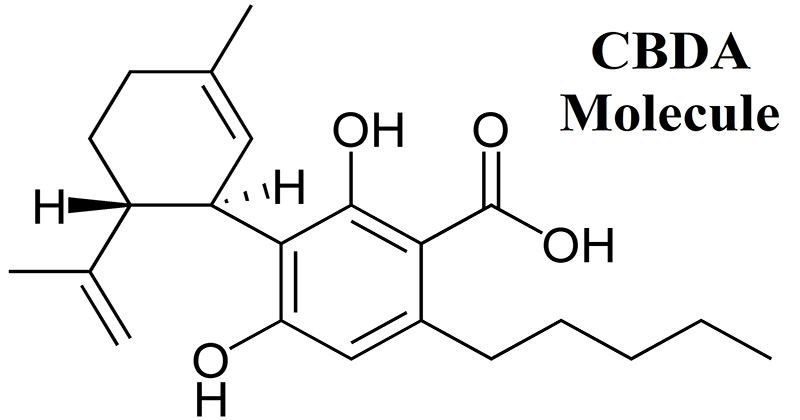
What is cannabidiolic acid (CBDA)?
L’cannabidiolic acid (CBDA) is the acid form of CBD, CBD is the precursor cannabinoid present in abundance in the fresh, living cannabis plant, before any exposure to heat. CBDA is transformed into CBD by decarboxylation, CBDA undergoes a transformation process, the loss of a carboxyl group (-COOH) under the effect of heat or time. Without this transformation, CBDA remains in its acid form.
Biosynthesis: how CBDA is formed in plants
The cannabis plant does not directly synthesize CBD or THC: it first produces acid cannabinoids. The process starts with the CBG (cannabigerol), considered the «mother cannabinoid» from which all the others are derived. The enzyme CBDA synthase converts CBGA to CBDA in the trichomes of the plant. Similarly, the THCA synthase enzyme converts CBGA into THCA.
In a fresh, unheated flower, CBDA therefore accounts for almost all the cannabidiolic content, with «active» CBD appearing only after decarboxylation by heat (combustion, vaporization, cooking) or very slowly through natural drying.
CBDA vs CBD: what are the differences?
| CBDA | CBD | |
|---|---|---|
| Shape | Acid (non-decarboxylated) | Neutral (decarboxylated) |
| Presence in the plant | Fresh and raw cannabis | After heating or drying |
| Psychoactive | No | No |
| Oral bioavailability | Potentially superior | Standard |
| Stability | Low (converts to CBD) | High |
| Search available | Limited but promising | Well documented |
| Consumption modes | Raw juice, cold tinctures | Oils, sprays, edibles |
Therapeutic properties of CBDA
Research on CBDA is still emerging, less documented than that on CBD, but several avenues are promising:
Anti-inflammatory CBDA inhibits COX-2, an enzyme involved in inflammatory processes, the same mechanism as many non-steroidal anti-inflammatory drugs (ibuprofen, aspirin). A study published in Drug Metabolism and Disposition has documented this inhibition, suggesting significant anti-inflammatory potential.
Antiemetic (anti-nausea) : a study published in British Journal of Pharmacology showed that CBDA was more effective than CBD in reducing anticipatory nausea and vomiting in rats, by activating serotonin 5-HT1A receptors in the brainstem. This property is of particular interest to chemotherapy patients.
Anticancer agents (preliminary) Two studies (2012 and 2014) have shown that CBDA may inhibit the migration of human breast cancer cells by reducing COX-2 expression and blocking the mechanism of metastasis. These results are obtained in vitro (on cells alone, outside the organism) and remain preliminary. Human clinical studies are required before any conclusions can be drawn.
Anxiolytic Preliminary data suggest that CBDA may be more potent than CBD on certain anxiety-related receptors, at equivalent doses.
How to use CBDA
As CBDA is destroyed by heat, consumption methods are specific:
Raw cannabis juice The most direct method: mix fresh, unheated leaves and flowers. Rich in CBDA and THCA, with no psychoactive effects. A niche method, but one that's developing in the medical cannabis community.
Cold dyes Alcohol maceration without prior heating (no decarboxylation). Preserves CBDA in its acid form. Some producers offer specific CBDA tinctures.
CBDA oils Extracted at low temperatures to avoid decarboxylation. Rarer than conventional CBD oils, but available from certain specialized producers.
Fresh CBD flowers CBD flowers contain more CBDA than CBD. curing gradually convert part of the CBDA into CBD.












France already has 3,000 cannabis retail outlets. None of them are legal.

Morocco's exports of legal cannabis have expanded to 15 countries

Aurora Cannabis Doubles Its Production Capacity in Germany

Tilray is accelerating its operations in Europe thanks to a license in Portugal

Boston will host the 10th annual State of the Cannabis Industry Conference on October 26

A DEA report confirms that there are no fatal cannabis overdoses

A British patient is challenging the NHS's refusal to reimburse medical cannabis

October 2026 CBD Highlights: 10 Strains and Hash to Discover from 5 French Producers

CBD in France: Traceability, Retail Stores, THC and Driving… What the New Bill Proposes

