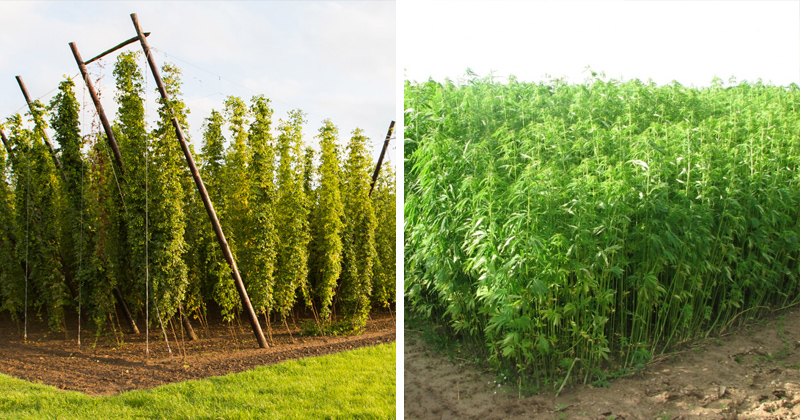
Hops and cannabis: commonalities, shared terpenes and differences
Cannabis and hops share much more than a vague olfactory resemblance. Both plants belong to the same botanical family, produce terpenes in common and are victims of the same pathogens, including the dreaded HpLVd. Here's why your hoppy beer and your joint sometimes smell the same.
The same botanical family: Cannabinaceae
Hops (Humulus lupulus) and cannabis (Cannabis sativa) both belong to the Cannabinaceae (or Cannabaceae), a group of flowering plants that also includes elm, hackberry and a few other genera.
Early botanists grouped them on the basis of their morphology: both plants produce palmate leaves, divided into leaflets reminiscent of the fingers of a hand, and feature a similar climbing plant structure. Hops are lianas that can climb up to 8 meters, while cannabis grows as an upright shrub.
This morphological classification was confirmed and deepened in the years 1990-2000 with the advent of molecular biology. DNA tests revealed much deeper molecular structural similarities between the two genera than expected, definitively validating their kinship in the Cannabinaceae family.
Terpenes: the chemical reason for odor similarities
It's the answer to the question asked by anyone who has ever smelled a very hoppy IPA beer and wondered why it reminded them of something: the terpenes.
Terpenes are volatile aromatic compounds produced by many plants. Sharing a common evolutionary origin, hops and cannabis synthesize several identical terpenes from the same molecular precursors (isoprene). The result: largely overlapping aromatic profiles.
| Terpene | Present in hops | Present in cannabis | Aroma |
|---|---|---|---|
| Myrcene | ✅ Majority | ✅ Very common | Earthy, fruity, mango |
| Humulene (α-humulene) | ✅ Characteristic | ✅ Current | Woody, spicy, hoppy |
| Beta-pinene | ✅ Present | ✅ Present | Pine, freshness |
| Caryophyllene | ✅ Present | ✅ Very common | Pepper, spicy |
| Linalool | ✅ Traces | ✅ Current | Floral, lavender |
| Geraniol | ✅ Present | ✅ Present | Pink, floral |
The myrcene deserves a special mention: it's the most abundant terpene in hops, and one of the most common in cannabis. It is primarily responsible for the «herbaceous» character of both plants, and is found in IPA-style beers (India Pale Ale) with a strong floral bitterness.
L’humulene, whose name comes precisely from’Humulus, a terpene with documented anti-inflammatory properties, is present in both plants. Its woody, spicy aroma profile contributes to the distinctive character of many indica cannabis varieties.
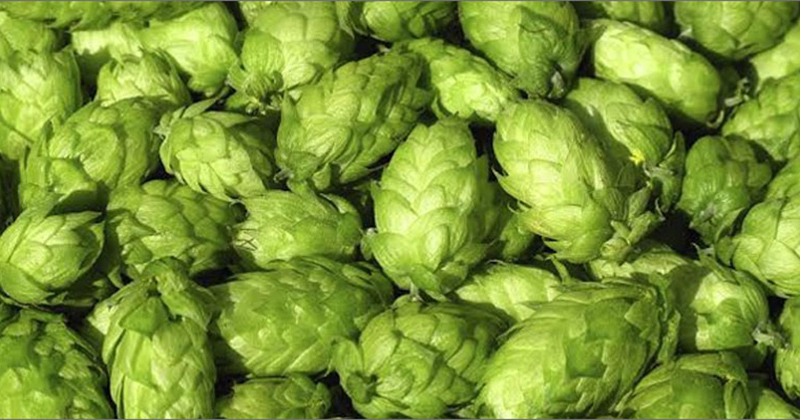
Hop flowers
Important differences between hops and cannabis
Despite their similarity, the two plants have some fundamental differences.
| Hops | Cannabis | |
|---|---|---|
| Type | Humulus | Cannabis |
| Cannabinoids | Absent (traces of methyl-butenol) | Present (THC, CBD, etc.) |
| Trichomes | Lupulins (cone resin glands) | Captive trichomes with stem |
| Main use | Beer flavouring | Consumer, medical, textile |
| Psychoactive effects | No | Yes (via THC) |
| Sexual dimorphism | Dioic (separate male/female) | Dioic (separate male/female) |
| Flowering | Photoperiodic | Photoperiodic (except autoflos) |
Hops do not produce no cannabinoids, or THC, nor CBD in the strictest sense. What is sometimes marketed as« CBD from hops »In fact, "cannabidiol" refers to an extract of terpenes and phenolic compounds from hops, with no direct chemical relationship to cannabidiol.
Both plants are equally dioecious, they exist as separate male and female individuals, unlike most flowering plants, which are hermaphroditic.
A common enemy: HpLVd
The botanical relationship between hops and cannabis has a concrete and worrying health consequence: the two plants share the same pathogens.
The HpLVd (Hop latent viroid, latent hop viroid) was historically a problem exclusive to hop growers. Its transition to cannabis was confirmed in 2019, and it is now considered the most serious health threat to cannabis growers in North America. The genetic proximity between the two plants enables the viroid to exploit similar cellular mechanisms in both hosts.
To find out all you need to know about this pathogen and prevention protocols, read our full article on HpLVd.
Hops and cannabis: intersecting uses
For some years now, craft brewing and cannabis have shared a community of enthusiasts interested in both worlds. It's no coincidence: fans of highly hopped IPA beers (with high myrcene and humulene content) are often sensitive to the same aromatic profiles in cannabis.
Experiments with cannabis beers (infused with terpenes or CBD) exist on the legal market, playing on this chemical proximity. Apart from these niche products, the cross-fertilization of the two crops remains mainly aromatic, with terpenes acting as a bridge between two plant worlds that are closer than they seem.









Medical Cannabis in Germany: THC Prices Vary by a Factor of 12

France already has 3,000 cannabis retail outlets. None of them are legal.

Morocco's exports of legal cannabis have expanded to 15 countries

Aurora Cannabis Doubles Its Production Capacity in Germany

Tilray is accelerating its operations in Europe thanks to a license in Portugal

Boston will host the 10th annual State of the Cannabis Industry Conference on October 26

A DEA report confirms that there are no fatal cannabis overdoses

A British patient is challenging the NHS's refusal to reimburse medical cannabis

October 2026 CBD Highlights: 10 Strains and Hash to Discover from 5 French Producers

