
Bang (water pipe): definition, types, history and use
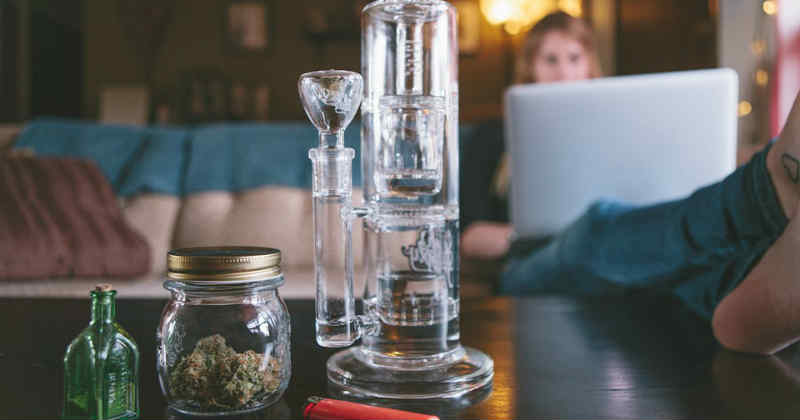
A water pipe generally used for smoking cannabis. The bowl is the part of the bong where the cannabis flowers are contained and heated. The smoke is filtered through the water via the stem, a cylindrical piece of glass pierced with holes that connects the bowl to the bong. The smoke passes through the neck and rises to the mouthpiece where users inhale.
What is a bang?
The word bang is adapted from the Thai word baung (บ้อง), which refers to a wooden cylinder or pipe cut from bamboo and used for smoking. Whether manufactured or handcrafted, the device as we know it remains essentially faithful to this definition of the bong. The central shape that identifies it - the cylindrical neck - reflects the sturdy cylinder of a bamboo stem.
The neck, container or tube of the bong is connected to the base where the water is located. Bongs are often custom or homemade, and are available in a wide variety of shapes, sizes and modifications, such as neck clamps or gravity chambers. Some bangs consist of a simple straight tube connected to the mouthpiece. Others have a wide base (usually in the shape of a beaker or sphere) which connects to the tube.
The only other essential parts of a bong are the bowl and stem. Although most professionally-made bongs are made of glass, homemade bongs can be built from any air- and watertight container by adding a rod, bowl and carburetor.
The different types of bangs
Straight Bang The simplest - a vertical tube with a base. Easy to clean, robust, affordable entry-level.
Bang beaker A flared, beaker-shaped base that holds more water and offers greater stability. The most popular format.
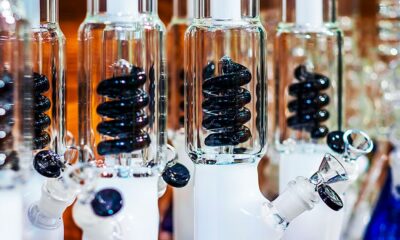
Bang with percolator The new percolator: incorporates one or more percolators - devices that divide the smoke into fine bubbles to maximize contact with the water. Improved filtration, cooler, softer smoke. Several types are available: tree perc, honeycomb, showerhead, inline.
Bang recycler two chambers linked in a closed circuit. Water is continuously recycled during inhalation for maximum cooling. Prized by connoisseurs for the smoothness of the smoke.
Dab rig specialized bang for concentrates, equipped with a banger instead of the bowl. Smaller water chamber to preserve the aromas of concentrates. See our article on dabbing.
Mini bubbler A compact cross between a pipe and a bong. Integrated but portable water chamber. Good filtration in a discreet format.
What's a bong for?
Benefits of bangs
A major reason for the bong's popularity is its ease of use. The best bongs offer the simplicity and immediacy of a dry flower pipe while facilitating a smoother hit by eliminating dry, hard smoke through water filtration. Bangs deliver particularly fresh hits when ice is added to the water.
Some bangs have an ice pinch that helps cool the cannabis smoke, resulting in a sweeter flavor.
It's generally easier to learn how to use a bong than other popular smoking devices. Bangs require less preparation work than a joint and generally offer a stronger hit than a dry flower spray. Small bowls always provide a fresh hit and, unlike a joint, they don't start to taste bad due to tar build-up.
Do bangs filter smoke?
Studies on tobacco and cannabis have shown that water pipes can filter out carcinogens and other toxic substances produced by cannabis combustion, especially if equipped with a diffuser or percolator. Passing cannabis or tobacco smoke through water has been shown to eliminate the presence of the cytotoxins acrolein and acetaldehyde. These cytotoxins are present in both cannabis and tobacco, and are harmful to the lungs' main defense cells.
Disadvantages of bangs
The main purpose of a bong is to cool and filter the smoke through water filtration. However, while this makes for a smoother smoke, it can also filter out some of the THC and other psychoactive compounds. In fact, water pipes filter out more cannabinoids than tar. And filtering cannabinoids means the user has to smoke more to get the desired effect.
Most of the best bangs also require a higher initial cost than a blunt or a seal. When you know how to use it, a well-made and well-maintained bong can last a lifetime, but it can also be very expensive to buy. The price of bongs can vary from €10 to thousands of euros for a handcrafted piece.
And while bangs require less preparation work than a joint, they demand much more maintenance and upkeep. If you don't change the water regularly, As a result, a bong can become increasingly difficult to clean. New bong users should also be aware that bong water has a foul odor. The smell of bong water isn't necessarily a drawback that affects its function, but the smell is generally unpleasant for cannabis users.
| Bang | Seal | Spray | |
|---|---|---|---|
| Combustion | Yes | Yes | No |
| Smoke filtration | Partial (water) | No | — |
| Filtered THC | Yes (water also filters cannabinoids) | No | No |
| Smoke | Cooler, softer | Hot, dry | Soft steam |
| Preparation | Fast | Slow (rolling) | Average |
| Maintenance | High (regular cleaning) | No | Medium |
| Price | 10-multiple thousands of euros | A few cents | 80-500€ |
| Discretion | Low | Low | Good |
History of the Bang
The exact origin and evolution of the bong remain somewhat obscure. Cannabis originated in Central Asia, so archaeologists assumed that the bong shared this point of origin and descended from the hookah. However, archaeological discoveries made over several decades suggest that the bong originated in Africa.
Archaeologist J.C. Dombrowski excavated the oldest known water pipes in Ethiopia in 1971, dating them to between 1100 and 1400 BC. In 1924, Arthur Dunhill noted in a study of African water pipes that the absence of smoking apparatus in Europe is a clear indicator of its origin. According to Dunhill, the San people of South Africa created a tubular pipe with a bowl at the top and a round water chamber at the bottom, connected by a curved tube. Dunhill's theory that this is the birth of the water bong is in relative competition with Dombrowski's findings, but both provide further evidence of the bong's African origins.
It was long thought that African pipes were used exclusively for smoking tobacco, which also contributed to the dominant Asian origin story. But traces of cannabis residue reveal that Dombrowski's early African water bongs were indeed used for smoking cannabis. Several theories about the origin of the bong, as well as how it spread around the world, remain in competition, so a fixed place and date for the first bong continues to be obscure. However, the most recent and plausible research suggests that these early African water bongs are the world's first.
Bangs may not have originated in Central Asia, but they certainly gained popularity in China in the 16th century, at the end of the Ming dynasty. Popular theory suggests that these water pipes spread to Europe, the Middle East and East Asia along the Silk Road. As cannabis gained popularity around the world, so did water bongs and other smoking accessories. Time shaped the evolution of the bong, as manufacturers began experimenting with different materials, shapes and sizes.
The rebirth of the bong
The glass industry flourished in the USA during the 19th century, giving rise to the 20th-century bong boom of the 1960s and 1970s. Bob Snodgrass, called the godfather of the bong renaissance, designed glass bongs across the U.S. while touring with the Grateful Dead.
Snodgrass eventually settled in Eugene, Oregon, and began teaching artisan bong making. He also discovered «fuming», the use of gold and silver to color borosilicate glass. From there, his students multiplied, just as pipe-head stores were appearing in every major U.S. metropolis in the '90s.
Today, the best bongs are used for more than just smoking. In the Snodgrass tradition, glassblowers have created an art form around bong making. Thanks to the ingenuity of the cannabis community, water bongs are now highly functional, interactive pieces of art.
Are bangs illegal?
No.
How to use a bong
Trying a new or unfamiliar method of smoking can be overwhelming and confusing for new users. Bangs may be easy to use, but newcomers may still find them intimidating. If you're not sure how to use a bong, or if you're worried about smoking with a bong for the first time, follow these steps until you've had enough practice to perfect your routine:
- Fill the bong with water. Pour it directly into the nozzle. When the water bong is full, the downstem must not be submerged more than one inch inside the bong. If you add water, you risk inhaling liquid while trying to smoke. Prepare your cannabis. Grind your cannabis and fill the bowl loosely. Make sure there's room for air to pass through. Hold the bong in your non-dominant hand and the lighter in your dominant hand.
- Take a few deep breaths to circulate oxygen so that it's easier to inhale large quantities of bong smoke.
- Finally, place your mouth over the mouthpiece. Create a watertight seal by placing your lips completely inside with the edge of the mouthpiece.
- Light the bowl. Light your lighter, tilt it over the bowl and inhale slowly to draw smoke up the tube. Once you've drawn enough smoke into the tube, remove the bowl from the mouthpiece and inhale the smoke. Hold the smoke for two or three seconds, then exhale.
Why do bangs hit harder?
A bong's large chamber and water filtration system allow you to get a bigger hit of fresher smoke in larger quantities than with a pipe or joint. At first, it can be difficult to know how to use a bong without inhaling too much and coughing. It's best to start with slow, careful draws, then adjust your inhalation once you've mastered the process.
Main components
The bang shape follows its function. A minimal set of simple, functional and essential components makes the bong instantly identifiable, whatever the ornamental details, minimal or elaborate.
The essential components found in almost all water bongs are as follows:
The tube: Also known as a container or neck, the tube is the cylinder that carries smoke and air into the user's mouth. There are generally three different types of tube: straight, bent and customized.
The basis: The chamber that fills with water. The base is the lower part of the bong and usually the largest and widest. Bongs are often categorized by their base type; usually a straight, beaker or round base. The straight-tube bong is the classic model, consisting of a single cylinder as the main body. Beaker bongs have a conical or beak-shaped base. Round bases have a spherical base and a flat bottom. Beyond possible changes in airflow, there's not much difference between the smoking mechanisms of the three types.
Downstem: A related piece of glass that is inserted through the base and into the water. This is the part that initiates filtration. The two most popular types of pipe are conventional and diffused. A classic pipe is a solid cylinder, while a diffused pipe features additional holes or slots that diffuse and cool the smoke while providing a gentler draft. The downstem, like the bowl, can be either male or female. If the downstem is male, the bowl is considered female, and vice versa.
Bowl: The bowl supports the grass on the descending stem. Bowls usually come in three sizes: 10 mm (small), 14 mm (medium), 19 mm (large). The descending stems also come in these sizes. For male bowls, the size corresponds to the outer circumference of the end of the fitting. For females, it's the inside circumference.
Advanced models and stemless bangs
The culture of custom bong making has led to the development of several advanced bong models. A gravity bong has a glass percolator at the base of the bong where smoke is diffused through its multiple arms. Multi-chamber bongs offer more chambers, usually in the tube or base, to filter and cool the smoke. Rodless bongs connect directly to the base, usually at a 90-degree angle, improving diffusion while making the whole bong an elegant, flowing piece.
Accessories
Most water bong accessories are advanced filtration designs that can enhance a person's smoking experience and improve the overall function of a water pipe.
Percolator : a diffuser that softens and cools the smoke, generally located in the tube. The most common types of percolator are :
Honeycomb: a disc filled with small holes that breaks down the bubbles. Turbine: cut-out disks that line the tube and cause diffusion with a vortex effect.Sintered disks: a glass disk that allows optimal diffusion thanks to its porous surface. Shaft: generally composed of several diffusion arms in the form of a descending rod with slots at the end. Carb: a hole generally located between the neck and the base of the bong used to control the entry of air and smoke. Smokers place their thumb over the carb hole while they light the herb, then withdraw their thumb to release all the smoke and allow air to fill the neck of the bong. Not all bongs have built-in carburetors, but most pipes do.
Rubber seal : Circular rubber piece that rests in the hole where the descending rod passes through the bong. Some bongs do not have a rubber grommet, but a glass support attached to the opening for the downrod to pass through. Generally, the two parts of a glass-to-glass connection are sandblasted to facilitate separation of the two parts.
Ice tongs : A series of glass indentations, usually three, that are large enough to hold the ice in the bong neck without interfering with or blocking the smoke.
Splash guard : A dome that retains water while allowing smoke to pass through.
Materials
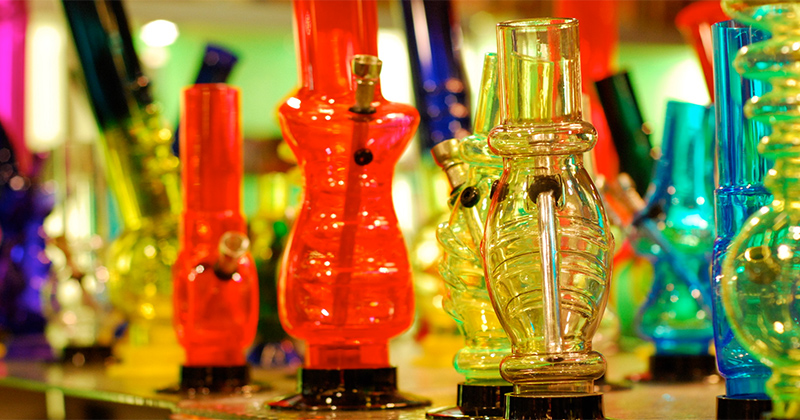
Even the best bongs can be made from different materials. For those who love art, a glass bong is the best choice. Glass blowing has been a tried-and-tested method of creating smoking accessories for decades. If you're looking for something a little more durable - we've all got that one friend who drops everything - try plastic or silicone. The material you choose depends more on the intended use than on the quality of the material itself.
Glass
Glass bongs are undeniably the most popular, highly appreciated for the way they preserve the taste and purity of cannabis smoke. The transparency of glass also gives users a better idea of where and when their water bong needs cleaning. Glass bongs are generally the most expensive. They are also fragile, and therefore more difficult to transport.
Bamboo or wood
Bamboo or wooden bangs are exceptionally sturdy and much less expensive than glass bangs. With proper care and maintenance, they can last a lifetime. Unfortunately, they are also difficult to clean.
Plastic
Plastic bangs are the cheapest bangs on the market. And they'll last an incredibly long time for a relatively small investment. They're also easy to pass around among friends.
Silicone
Silicone bangs have gained a lot of ground in recent years. They're much more durable than glass bongs, and they're easy to clean. One drawback of a silicone bong, however, is the slight plastic taste you'll inevitably get with most hits.
Ceramics
Ceramic bangs are fragile, like glass, and generally heavy. They're also inexpensive, which makes their fragility less of a problem, and perfect for displaying creative designs. They are much easier to replace than glass bangs.
How to clean and maintain a bong
Why do bangs get dirty?
To know how to use a bong, you need to know how to clean it. Keeping your bong clean will not only keep it looking good, it will also give you a clearer, purer flavor when you smoke. Without regular and proper cleaning, the water in the bong can accumulate ash that is drawn through the bowl, as well as bacteria and resin inside the base and tube.
To clean your bong after a heavy smoking session, the simplest method is to combine alcohol and salt. Retailers often offer cleaners specifically designed for use on cannabis accessories.
Remove the bowl and stem if possible, add alcohol (90 % isopropyl alcohol or rubbing alcohol is recommended) and shake. The alcohol should break down any remaining resin. If not, add salt and shake again. If any residue remains, you may need to leave the alcohol to soak for 24 hours. When you've drained the alcohol, rinse the bong thoroughly with hot water.
Once you've cleaned your bong with alcohol, place it near the window to allow the sun to heat it. This will help the alcohol further break down the resin. For bongs with hard-to-reach areas, try using pipe cleaners or cotton buds. Be sure to rinse each piece thoroughly with water.
If your bong needs intensive cleaning, try pre-soaking it in hot water. If you're working with particularly dirty stains, add dishwashing soap to your pre-soak, but only in small quantities. Too much may leave you with a soapy aftertaste in future sessions.
Maintaining a bong doesn't require much more than following a few good practices.
Change the water after each use. Use filtered water to avoid water spots. Empty the ashes from your bowl frequently to prevent them from being sucked out during use. This will also prevent you from getting resin drips in your bong. If you're a heavy bong user, clean it as regularly as possible. How to make your own bong at home
How to make a watermelon and carrot bong?
To make a bong from a watermelon and a carrot, follow these steps:
- Make three holes in the watermelon: one large hole for the tip, one small hole for the carburetor cap, and one for the sprue (bowl and stem).
- Use a drill bit or screwdriver to make a hole in the core.
- Form one end into a bowl.
- Press the carrot into the watermelon.
- Fill the core with cannabis and smoke.
- Some users may be more interested in popular variations on the watermelon and carrot concept. Using a bell pepper and a carrot, for example, is a popular alternative.
The major difference between the bell pepper bang and the watermelon bang is that you need to add water to the bell pepper. The advantage of this method is that the bell pepper can easily be used several times. Using a pineapple and a carrot is also popular, although more difficult to achieve due to the pineapple's hard, dense texture.
Does drinking bong water get you high?
No, drinking bong water won't get you high. Visit cannabinoids are not water-soluble, which means they do not bind to water. THC's solubility in water is about two micrograms per milliliter of water. That's not enough to get you high, and certainly not worth the taste of bong water or the risk of upsetting your stomach.
Can you smoke a bong without water?
Yes, but that defeats the purpose of smoking with a bong. Water in a bong helps filter the smoke for a smoother hit.
Can you smoke a bong with a liquid other than water?
Yes, but it's not recommended.
Do the bangs get any better?
A study carried out in 2000 by NORML has shown that bangs don't make you soar any more than pipes. However, bangs allow you to take a bigger hit than other consumption methods, such as pipes or joints. By taking bigger hits, you can get high fast, but the degree of high you get depends on a variety of factors, including the potency of the herb and the composition of your endocannabinoid system.
How much do bangs cost?
The price of bongs ranges from 20 to 20,000 euros. Various factors play a part in the cost of a bong, including material, style and glassblower. Different types of glass have different prices. Before buying a bong, it's best to set your budget and look for options in your price range.
For a combustion-free method, see our comparison vaping vs. smoking and our guide how to use cannabis.











CBD is said to promote athletic recovery, without improving performance

294 cannabis clubs in Chile: a booming movement with uneven distribution

Chronic Sciatica: New York Approves First Clinical Trial of a THC-Based Medication

United States: The DEA is accelerating the integration of medical cannabis at the federal level

Florida is nearing one million patients using medical cannabis

Uruguay Revives Its Plan to Allow Tourists to Legally Access Cannabis

In Brazil, researchers are developing an innovative CBD eye drop

Autism: Medical Cannabis Is Linked to Reduced Anxiety

The $28 billion U.S. hemp market remains under threat

