Trump reclassifies cannabis as medicine, a historic turning point in American politics

The United States have taken the most important step towards federal cannabis reform in more than five decades.
On April 23, the’Trump administration announced that certain cannabis-based products would henceforth be classified as "controlled substances". Appendix 3 (Schedule III) under the Controlled Substances Act (CSA), a change in historical classification from Appendix 1 (Schedule I) which lists the most dangerous substances with no recognized medical use, and which has included cannabis since 1970.
This decision, signed by the Acting Attorney General Todd Blanche, applies immediately to FDA-approved cannabis products and to cannabis produced by operators holding a licence. state license for medical cannabis. This measure does not legalize cannabis at federal level, nor does it apply to the adult-use market. But it does represent a symbolic and regulatory change: medical cannabis is now officially recognized again as a medicine at federal level.
«This reclassification enables research into the safety and efficacy of this substance, ultimately providing better care for patients and more reliable information for physicians,» said Blanche.
This announcement follows a decree signed in December by President Donald Trump, who ordered the Department of Justice to speed up the reclassification process.
A two-step approach: immediate change for medical cannabis, wider audience this summer
Rather than applying the reform universally, the Ministry of Justice has opted for a phased implementation.
Under Blanche's order, cannabis related to state medical systems immediately moves to Schedule 3. At the same time, adult-use recreational cannabis remains federally classified as Schedule 1, along with substances with «no recognized medical use».
In order to tackle a broader reform, the Ministry of Justice has also scheduled a new accelerated hearing from June 29 to examine a wider reclassification of cannabis. According to the dossier filed with the Federal Register, The hearing should be completed by July 15 at the latest.
The Justice Department is also ending the previous reclassification hearing process, which stalled near the end of the Biden administration after reform advocates challenged the process in court for alleged bias and inappropriate communications.
The DEA administrator, Terry Cole, said that the agency was «making rapid progress in the administrative hearing process, bringing consistency and control to an area sorely lacking in both».
For cannabis companies and reform advocates, the June hearing could be the decisive moment that determines whether reclassification will remain limited to medical markets or extend to the entire U.S. industry.
Trump highlights medical benefits: «the best of all alternatives»
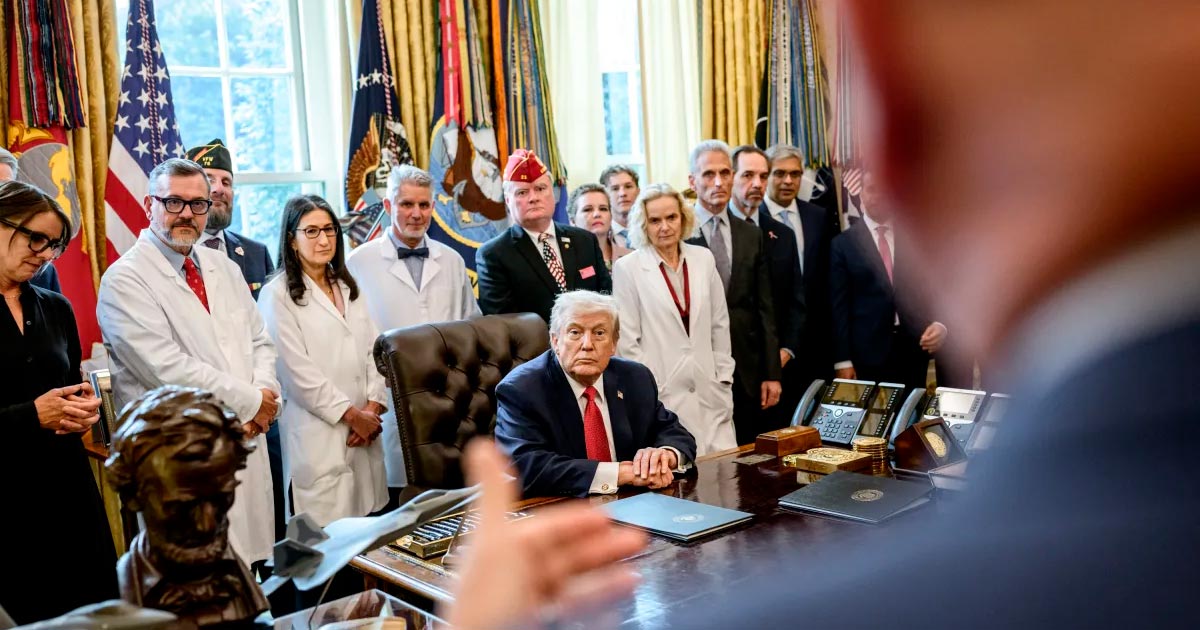
Hours after the Justice Department's announcement, Trump himself highlighted the medical case for cannabis in an address from the Oval Office.
«A lot of people are suffering from serious problems, and this seems to be the best solution,» Trump said. «They're very happy about it. So the reclassification begins, and this is a major step forward, this reclassification.»
Trump also brought up a personal anecdote about a friend, Howard Kessler, who allegedly turned to medical cannabis after having trouble with other medications.
«He had to try a lot of different drugs, and he said this one was much better than all the others,» Trump said. «So I hope you don't need it. But if you do need it, I've heard it's the best of all the alternatives.»
Chairman's comments mark a notable change in tone from a Republican leader historically associated with a repressive drug policy. Although Trump has not endorsed full legalization, this reclassification initiative appears to be one of the major achievements of his second-term cannabis policy.
White House presents reclassification as a research-led reform
At the same event in the Oval Office, Heidi Overton, Deputy Director of the White House Domestic Policy Council, presented the decision as a pragmatic measure to unblock scientific research rather than a step towards legalization.
«Today is another day a promise has been made and kept,» said Overton. «This is a giant step toward implementing your promise.»
She stressed that the reform «does not legalize marijuana», but rather facilitates research, particularly among populations that already use cannabis for medical purposes.
«We know that one in ten seniors have used cannabis for medical purposes in the past year, and they report that it really helps them, but we don't have the science or the knowledge to guide patients and doctors,» she said. «So patients and doctors are moving forward blindly.»
Ms. Overton also confirmed that additional federal measures are expected later this summer, in line with Mrs. White's scheduled June hearing.
What Annex 3 really changes for the cannabis industry
Although the status of Schedule 3 remains restrictive, reserved for substances considered to have medical value but presenting a risk of abuse, it differs considerably from Schedule 1.
The most immediate benefit for state-licensed medical cannabis companies could be exemption from the’section 280E of the U.S. Internal Revenue Code, which currently prevents cannabis operators from benefiting from the usual tax deductions on their federal tax returns.
This tax rule has long been considered to be one of the heaviest burdens on the legal cannabis market, forcing businesses to pay abnormally high effective tax rates, even when they operate legally under state law.
Blanche's order explicitly addresses this issue, stating that medical licensees «will no longer be subject to the deduction prohibition imposed» by Section 280E. It also encourages the Treasury Department to consider retroactive relief.
However, the Department of Justice has also included a caveat: the ordinance itself does not determine tax liability, and companies are advised to consult a tax advisor.
This legal uncertainty is likely to be one of the most contentious aspects of the policy's implementation, particularly for multi-state operators running both recreational and medical outlets.
A blurred distinction between medical and recreational cannabis
The decision to treat medical cannabis differently from recreational cannabis is already causing concern throughout the industry. Under the new framework, a product sold under medical license could be classified as Schedule 3, while the same product sold in an adult-use circuit would remain classified as Schedule 1.
Mike Feldman, General Counsel of the distribution company Nabis, described this approach as unprecedented.
«Two people can consume cannabis together, the same product purchased from the same place, one labeled as medical marijuana and the other as intended for adults,» Feldman said.
«And now, one is classified in Schedule 1 and the other in Schedule 3, which is completely unprecedented and not how the Controlled Substances Act works.»
This «dual status» risks complicating compliance, accounting and commercial structuring for companies operating in several regulatory frameworks.
Cooperative federalism« expands federal oversight»
The DOJ argues that state medical cannabis systems have matured enough to be integrated into, rather than replaced by, federal oversight.
In her order, Blanche described state licensing regimes as increasingly robust, equipped with infrastructure for inspections, product safety, record-keeping and detour prevention. The DOJ said it would build on this existing system to minimize disruption while continuing to meet federal requirements.
This approach reflects what Blanche called «cooperative federalism», allowing states to remain the primary regulators of medical cannabis while the federal government sets up a parallel registration system.
To comply with Schedule 3 at federal level, the DOJ is also launching an «expedited review process» for medical licensees wishing to register with the DEA as manufacturers, distributors or dispensers.
This federal route could prove crucial if reclassification were to extend beyond the medical markets.
The strange bypass of the treaty: the government buys cannabis, then resells it
The new policy establishes a mechanism designed to bring the United States into line with its obligations. under international treaties, in particular the Single Convention on Narcotic Drugs.
To meet the treaty requirement that a government agency act as the exclusive purchaser of cannabis production, the DOJ is setting up a system in which the federal government will technically purchase cannabis crops from licensed producers, then sell them back to them.
«All manufacturers registered under this subsection must set a nominal price for the purchase of their marijuana harvests,» says Blanche's filing. The government would then purchase the crop and resell it «at the same price, plus administrative fees.».
The process also requires manufacturers to store crops in DEA-accessible facilities until the transaction is finalized.
Although largely symbolic, this workaround demonstrates the complexity of modernizing cannabis policy while remaining compliant with international drug control agreements.
A major breakthrough for scientific cannabis research in the United States
Beyond taxes, many experts believe that the most significant impact could be scientific. Schedule 1 classification has long restricted cannabis research in the U.S., forcing researchers to comply with tedious federal licensing procedures and often restricting access to actual products used by patients.
Under the new framework, researchers can now legally obtain cannabis products from state-licensed companies for study purposes, which was previously prohibited.
The Department of Justice has clarified that DEA-registered researchers will incur no civil or criminal liability for the use of cannabis from duly registered state operators.
For medical cannabis advocates, this could mark a turning point, allowing for more credible studies on safety, dosage, efficacy and interactions with other medications.
Cannabis businesses prepare for compliance, expansion and standardization
In the wake of the announcement, cannabis businesses expressed both optimism and caution. Operators told MJBizDaily that the change was pushing them towards expansion strategies, investment in research and preparation for stricter federal standards on quality and safety.
Kim Sanchez Rael, CEO and co-founder of the company Azuca, a New Mexico-based company, said the moment was less an occasion for celebration than for preparation.
«For us, this moment means staying focused on delivering reliable products, supporting our partners and continuing to build a more structured regulatory environment,» she said.
The CEO of True Terpenes, Daniel Cook, The company argued that tax relief was not the main opportunity.
«The biggest benefit of Schedule 3 classification is not taxation, but research,» said Cook.
On his side, Ashwin Raj, CEO of LeafLink, said the reclassification could be a major reinvestment opportunity, allowing companies to expand nationwide. Other companies, such as decontamination firm XRpure, The U.S. Food and Drug Administration (FDA) and the U.S. Food and Drug Administration (FDA) have indicated that they are preparing for stricter microbiological limits and testing standards that could result from a more centralized federal framework.
Not legalization, but the biggest federal change since 1970
Despite the headlines, the Justice Department's decision does not legalize cannabis nationwide. It does not open up interstate commerce, guarantee access to banking services or leave recreational market operators in a legal limbo.
Yet the measure is widely regarded as the most significant federal cannabis reform since the Controlled Substances Act classified cannabis as Schedule 1 over 50 years ago.
The question now is whether the June 29 hearing will extend the reclassification to the entire cannabis market, or whether the US will continue to operate under a fragmented system where medical cannabis enjoys federal recognition while recreational use remains federally prohibited.
For the’cannabis industry, worth $32 billion, This change represents a rare event in American cannabis policy: a genuine federal breakthrough, the major consequences of which are still to come.























«Vincy Gold»: Humboldt Seed Company on the Hunt for Saint Vincent Sativas

Cronos Completes the Acquisition of CanAdelaar for 57.5 million euros

Cannabis with a "bloody" twist: Discover Sensi True Blood and Sensi Sangria, the two new strains from Sensi Seeds

Hemp: The Council of the EU Takes a Stand on New Production and Marketing Rules

Missouri's legal cannabis market accounts for 93 % of consumer spending

THC Gummies: How to Read a Certificate of Analysis Before Buying

British patients now have access to THCV-rich cannabis flowers

Spain: Medical Cannabis Is Coming to About 50 Hospitals

JIHE 2026: Japan’s Largest Trade Show Dedicated to Hemp and CBD Returns to Tokyo with More Than 100 Industry Players

New Caledonia: The Courts Clear the Way for the Return of CBD
-
 Business3 weeks ago
The legal cannabis market in New York exceeds 4 billion $ in revenue
-

 Cannabis in France4 weeks ago
Which countries legalized medical cannabis before France?
-
Cannabis in France1 week ago
France already has 3,000 cannabis retail outlets. None of them are legal.
-
Business4 weeks ago
South Korea is preparing to begin local production of medical cannabis to meet rising demand
-
Cannabis in the U.S.1 week ago
A DEA report confirms that there are no fatal cannabis overdoses
-
Cannabis in Thailand4 weeks ago
From the boom in dispensaries to a purely medical approach: Thailand is revising its cannabis policy
-
Cannabis and driving4 weeks ago
Medical Cannabis and Driving: New South Wales Ends Automatic Penalties for THC
-
Cannabis in France3 weeks ago
France’s Drug Policy Chief Defends Cannabis Prohibition... and Runs Into the Facts
















You must be logged in to post a comment Login