Trump orders historic federal cannabis reclassification

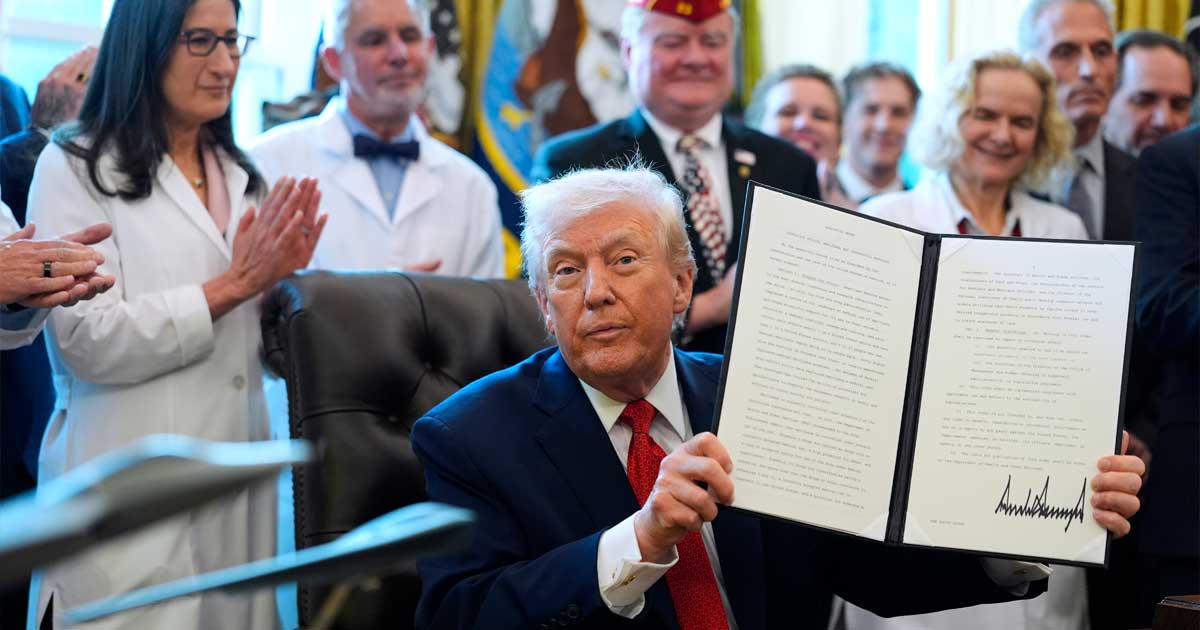
On December 18, 2025, President Donald Trump signed a decree reshaping the federal cannabis policy more profoundly than any other reform since the adoption of the Controlled Substances Act in 1970.
This directive initiates the long-awaited reclassification of cannabis into federal legislation, officially recognizing its medical value for the first time, while simultaneously launching a pilot program that could enable beneficiaries of Medicare free access to treatments based on CBD.
«This is really about common sense,» Trump said at the signing ceremony in the Oval Office. «I promised to be the common-sense president, and that's exactly what we're doing.»
The decree does not legalize cannabis or authorize its recreational use. But it does mark a structural change in the way the federal government approaches cannabinoid-related medical research, taxation and healthcare access.
Downgrading cannabis from category I to category III
At the heart of this decree is a directive addressed to the Ministry of Justice to complete the process of declassifying cannabis from the Category I to the category III under the Controlled Substances Act (CSA). Category I substances are defined as having no accepted medical use and a high abuse potential. Category III, on the other hand, recognizes medical usefulness while acknowledging abuse potential.
Trump ordered the Attorney General to «take all necessary steps» to finalize the reclassification «in the most expeditious manner possible, consistent with federal law». This decision is based on a scientific study in 2023 by the Department of Health and Human Services (HHS), which concluded that cannabis had «a currently accepted medical use in the United States».
«This measure was requested by American patients suffering from extreme pain, incurable diseases, aggressive cancers, seizure disorders, neurological problems and more, including many veterans with service-related injuries and elderly Americans living with chronic medical conditions,» Trump said.
However, the timetable remains uncertain. The Minister of Justice, Pam Bondi, must officially cancel the reclassification process launched under the Biden administration and publish a new final rule in the Federal Register. Legal challenges from opponents are widely expected, which could delay implementation.
What reclassification changes - and what it doesn't
Despite its symbolic weight, reclassification is not equivalent to legalization at federal level.
«This in no way legalizes marijuana or sanctions its use as a recreational drug,» he said.
The regulatory framework for cannabis at state level remains unchanged. Production, distribution and sale will continue to be governed by state legislation, with federal prohibition technically remaining in force. However, the practical implications for licensed operators are considerable.
In particular, Schedule III status would free up businesses in the cannabis sector application of the section 280E of the Internal Revenue Code, which currently prevents them from deducting their ordinary business expenses. This change promises immediate tax relief for a sector estimated at over 32 billion dollars per year.
«Today's historic announcement regarding the reclassification of cannabis marks an important milestone and a radical shift in policy,» said George Archos, CEO of Verano Holdings, adding that this could unlock investment, create jobs and stimulate economic growth.
This change could also encourage large institutional investors and encourage U.S. exchanges such as the NASDAQ to reconsider the listing of cannabis-related companies, even if the’access to banking services and the interstate commerce remain unresolved and would require Congressional action.
Barriers to research begin to fall
Another central objective of the decree is the expansion of the medical research. As a Category I substance, the cannabis has been severely restricted which discouraged universities, hospitals and federally-funded institutions from studying it.
«The president's intention... is to remove barriers to research,» a White House official said in a pre-signing briefing. «Many Americans use cannabis for medical purposes, but in most cases, the evidence is lacking.»
Nora Volkow, director of’National Institute on Drug Abuse, The Group's strategy, which is based on a combination of opportunities and caution, has been a success.
«It's very likely that cannabis has potential therapeutic applications,» she said. «But we also know very clearly that cannabis can be addictive.»
Category III substance status would allow research protocols to incorporate hard data, to improve dosing standards and assess long-term health effects, particularly for the elderly and vulnerable populations.
A lifeline for the hemp and CBD industry
In addition to reclassification, the decree directly addresses the turbulence in the’hemp industry, which was destabilized by a recent federal bill redefining legal hemp products as containing no more than 0.4 milligrams of THC per container.
This threshold, due to come into effect in November 2026, would effectively eliminate most of the full-spectrum CBD products currently on the market.
Trump's executive order directs senior White House officials to work with Congress to revise the definition of hemp and preserve access to full-spectrum CBD «while continuing to restrict the sale of and access to products that pose serious and potentially lethal health risks».
The Ministry of Health and Social Services is also tasked with developing research models to establish standards of care for hemp-derived cannabinoids, marking a shift towards regulated medical legitimacy rather than prohibition by default.
Medicare pilot program for CBD access
Although the decree itself does not go so far as to require insurance coverage, Mehmet Oz, director of Centers for Medicare & Medicaid Services (CMS), announced a parallel initiative with immediate implications.
CMS will launch a pilot program allowing Medicare beneficiaries to receive free CBD products derived from hemp on the recommendation of a physician.
Eligible patients could receive up to 500 a year, The program will be available to all participants, provided that the products meet strict safety, quality and third-party testing standards, and comply with federal and state laws. The program is scheduled to start as early as April 2026, and will include participants enrolled in the following plans Medicare Advantage.
«Howard Kessler, God bless you for giving us a hard time,» Oz said at the ceremony, referring to the advocate who got the issue on the administration's agenda.
Industry influence and political tensions
The announcement follows months of behind-the-scenes lobbying by industry leaders and advocacy groups. Trump reportedly met with cannabis industry leaders at Mar-a-Lago, including. Kim Rivers, CEO of Trulieve, and Howard Kessler, founder of The Commonwealth Project.
«President Trump's executive order has unleashed a radical upheaval in healthcare,» said Kessler. «While cannabis reclassification will make headlines, it's his revolutionary Medicare pilot program that brings immediate, life-changing relief.»
Yet reaction was far from unanimous. Share prices of major operators fell sharply after the announcement, reflecting investors' uncertainty in the face of legal risks and regulatory ambiguity.
Politically, the executive order drew criticism from both sides. Dozens of Republican lawmakers warned that the reclassification could harm public health, while several Democrats felt it didn't go far enough and accused Trump of playing symbolic politics.
A federal turning point, not a final chapter
A White House fact sheet described the executive order as correcting «the federal government's long delay in recognizing the medical use of marijuana,» while acknowledging the risks associated with addiction and youth exposure.
The reclassification process could take months, or even longer if the courts intervene. Banking reform, interstate commerce and overall regulation remain unchanged. But for the first time in more than five decades, the federal government is officially aligning cannabis policy with medical reality rather than ideological inertia.
«This has divided our country for many years,» said Robert F. Kennedy Jr., HHS secretary. «Both sides have valid arguments.»
What emerges from Trump's executive order is neither legalization nor prohibition, but a rebalancing that places medical research, patient access and regulatory pragmatism at the center of federal cannabis policy for the first time.
The sustainability of this rebalancing will now depend less on presidential authority than on the courts, Congress and the evidence generated by the searches the Executive Order aims to trigger.





















Medical Cannabis in Germany: THC Prices Vary by a Factor of 12

France already has 3,000 cannabis retail outlets. None of them are legal.

Morocco's exports of legal cannabis have expanded to 15 countries

Aurora Cannabis Doubles Its Production Capacity in Germany

Tilray is accelerating its operations in Europe thanks to a license in Portugal

Boston will host the 10th annual State of the Cannabis Industry Conference on October 26

A DEA report confirms that there are no fatal cannabis overdoses

A British patient is challenging the NHS's refusal to reimburse medical cannabis

October 2026 CBD Highlights: 10 Strains and Hash to Discover from 5 French Producers

CBD in France: Traceability, Retail Stores, THC and Driving… What the New Bill Proposes
-
 Business2 weeks ago
The legal cannabis market in New York exceeds 4 billion $ in revenue
-

 Cannabis in France3 weeks ago
Which countries legalized medical cannabis before France?
-
Business3 weeks ago
South Korea is preparing to begin local production of medical cannabis to meet rising demand
-
Cannabis in Thailand3 weeks ago
From the boom in dispensaries to a purely medical approach: Thailand is revising its cannabis policy
-
Cannabis and driving3 weeks ago
Medical Cannabis and Driving: New South Wales Ends Automatic Penalties for THC
-
Autism3 weeks ago
Autism and Cannabis: Results from the First Placebo-Controlled Trial of NTI164
-
Cannabis in France2 weeks ago
France’s Drug Policy Chief Defends Cannabis Prohibition... and Runs Into the Facts
-
CBD1 week ago
In Brazil, researchers are developing an innovative CBD eye drop

















cbdtech
December 20, 2025 at 8 h 56 min
A historic turning point at last! The move to category III is a major victory for science and patients alike. By officially recognizing the medical value of cannabis, the USA has broken a decades-old taboo. It's a powerful signal for the whole world, and a huge boost of credibility for us CBD players. The movement is irreversible!