
INCB considers many medical cannabis programs to be in breach of international treaties

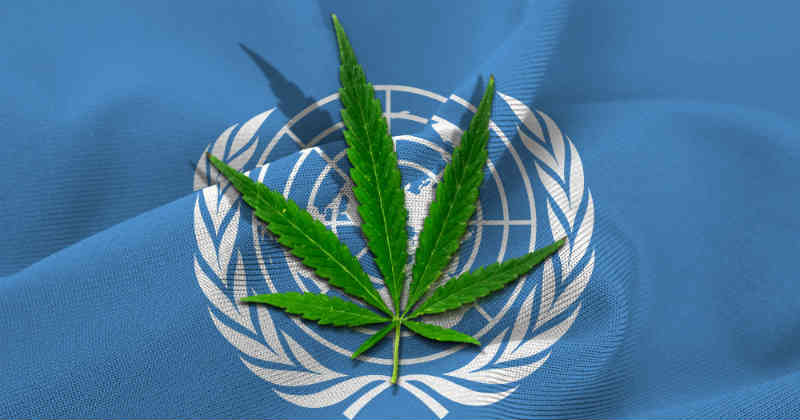
The International Narcotics Control Board (INCB), a UN agency responsible for ensuring compliance with international treaties on narcotics, has just published its annual report for 2018. In it, he points out that the legalization of recreational cannabis violates treaties, and emphasizes that some medical cannabis programs are in breach of them, basing his analysis on the current state of treaties despite recent WHO recommendations on cannabis.
The INCB report
International drug control treaties allow the legal and controlled use of cannabis, but only for medical and research purposes. On the other hand, they strictly prohibit the legalization of its recreational use. The report begins by reiterating this principle, pointing out that recreational legalization in certain countries (Canada, Uruguay) constitute a violation of international treaties. The report goes further, suggesting that they represent a threat to the integrity of the treaties by inciting other countries to legalize this use.
That the INCB should recall this principle is not surprising. What is more surprising, however, is that it accuses certain medical cannabis programs of also being in contradiction with the treaties. As the Marijuana Business Daily, The report criticizes certain states for overly permissive regulations which «fail to control the production and supply of medical cannabis, to ensure a quality medicine (transparent composition, indicated method of administration, accuracy of side effects) and rigorous medical monitoring».
The report's radar includes the authorization of cannabis in plant form. According to the INCB's interpretation, only pharmaceutical products containing a standardized cannabinoid formula and whose efficacy has been verified by clinical trials can be granted marketing authorization. The organization takes a clear stance against self-cultivation, smoked cannabis and, more broadly, the classification of cannabis as a medicinal plant.
In particular, the INCB criticizes the medical cannabis programs in Canada and some US states for allowing patients to purchase medical cannabis in commercial establishments. According to the organization, this system does not make it possible to verify the origin of the products, which may come from the black market. Some medical cannabis programs are also considered too lax in including conditions for which the efficacy of cannabis has not been scientifically proven.
For all these reasons, the INCB believes that international treaties are not being respected by certain states. The organization does not in itself have the power to sanction member states, and, according to Kenzi Riboulet Zemouli, Director of Research at the University of Geneva, it is not in a position to do so. FAAAT, It has stated that it wishes to adopt a flexible stance without imposing a standardized model. Nevertheless, its interpretation of the treaties is authoritative and binding. The report can therefore be used by member states to invoke sanctions against their counterparts. The UN Commission on Narcotic Drugs (CND) is due to meet soon, and it's a safe bet that conservative members will use the report against reformist states. Russia had already accused Canada of not respecting international treaties.
The eternal international status quo
The INCB report is based on the current state of international treaties, including the WHO has recommended a change to ease restrictions on cannabis and allow controlled use of the plant in medicine. As a result, the INCB's thinking is based on a version of the treaties considered outdated by the WHO and numerous member states and civil society organizations. The WHO recommendations on cannabis were due to be voted on at the CND meeting, but at the request of certain member states, the vote was postponed. These facts highlight the complex institutional landscape of the UN, which many criticize for its immobility and paralysis.
In addition to the interplay of different institutions, some also point to the fact that national policies differ too widely to achieve an international consensus in favor of reform. «The notion of a global consensus on the issue of drugs is untenable: even today, some people face the death penalty for possession of narcotics, while others are legally allowed to do so. in a press release co-signed by over 200 NGOs following the verdict of the 2016 UN General Assembly Special Session (UNGASS) on drug control policies.
Convened by the UN Secretary-General at the request of Guatemala, Colombia and Mexico, the 2016 session was the 3rd devoted to drug-related issues - the first two (1990 and 1998) simply reaffirmed the policies in force since 1970 and the objective of a «drug-free world». The 2016 session was an opportunity for member states and civil society organizations to call for the opening up of legal avenues for experimentation with drugs. alternative or regulatory policies.
According to these NGOs, it ended in failure: «By failing to engage in meaningful critique, with a different tone or new ideas, the final UNGASS document runs the risk of being no more than a costly backwash of previous agreements and conventions». In particular, the organizations had protested against the preparatory process for the session, which was the responsibility of the Commission on Narcotic Drugs (CND).
They also denounced a form of immobilism at UN level: «These Viennese institutions have actively sought to exclude innovative or avant-garde initiatives proposed by member states, other UN agencies or civil society, thus perpetuating the same paralysis and power struggles which, in Vienna, have drowned the debate on drug policies for decades». The question that follows is: is the international community fit to embark on cannabis policy reform?









CBD: Full-Spectrum Extracts Under Threat in Greece

Medical Cannabis and Back Pain: Opioid Use Has Dropped by 90 % in 10 Years

Cannabis: Wisconsin Could Finally Legalize It in 2027

Argentina Opens Its Market to Hemp Flowers Containing 1% of THC

The French Socialist Party still doesn't know how to approach the legalization of cannabis

Science in the City International: Paris at the Heart of Transatlantic Scientific and Medical Dialogue

Christine Fréchette is alienating Quebec’s cannabis industry

Rima Hassan: When «Drugs» Become a Political Weapon

From Marathons to Ultratrails: How Extreme Running Affects the Endocannabinoid System

Four days of THC may make breast cancer less aggressive, according to a new study
-
 Cannabis and driving2 weeks ago
Cannabis and CBD: French Drivers Can Now Lose Their License Even Without a Positive Test Result
-
Cannabis in France2 weeks ago
Cannabis Legalization: The LFI Bill Has a Major Problem—THC
-

 Cannabis in the Netherlands1 week ago
One year after the launch of the Dutch cannabis experiment, the first trends are emerging
-
Cannabis in France1 week ago
French medical cannabis remains stalled at the Ministry of Health
-
Cannabis in Argentina5 days ago
Argentina Opens Its Market to Hemp Flowers Containing 1% of THC
-
Business1 week ago
The United Kingdom Is Moving Closer to a Regulated CBD Market
-
Cannabis in Europe3 weeks ago
Andorra Paves the Way for Medical Cannabis Cultivation
-
Cannabis in France6 days ago
Rima Hassan: When «Drugs» Become a Political Weapon











You must be logged in to post a comment Login