
From the boom in dispensaries to a purely medical approach: Thailand is revising its cannabis policy

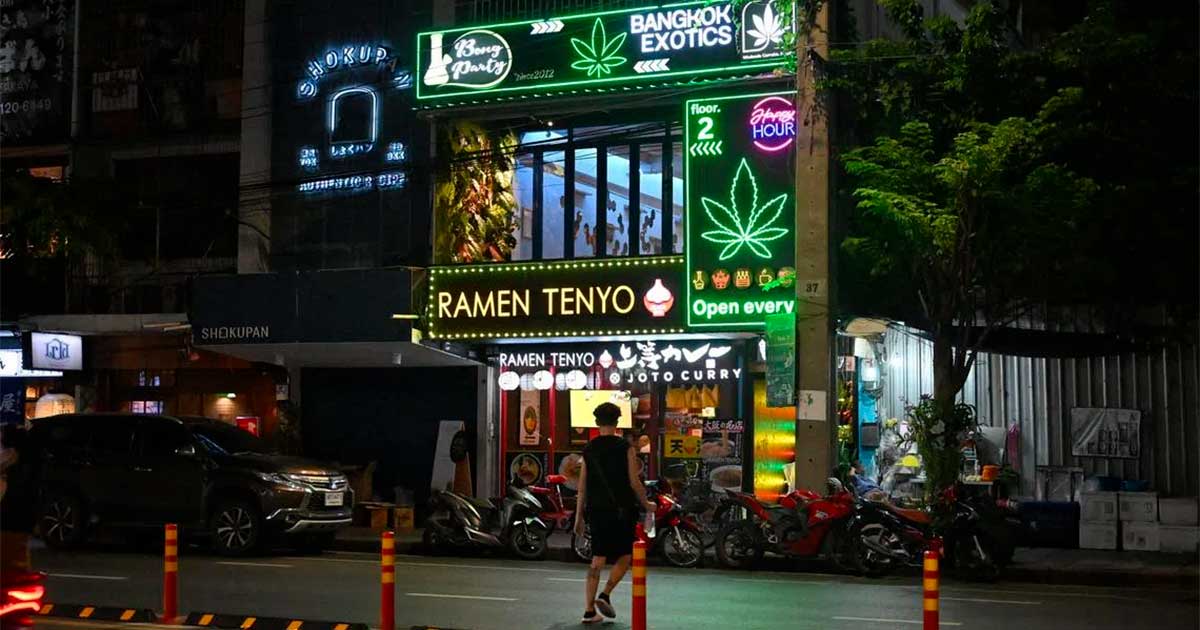
Four years after making unprecedented policy in Asia, Thailand is preparing to establish clearer regulations governing the permitted uses of cannabis in the country. The Thai government has approved a bill aimed at restrict its use to medical purposes and research, gradually phasing out the non-medical market that has developed since decriminalization in 2022.
The bill, which has yet to be reviewed by the House of Representatives, is primarily intended to address regulatory gaps that arose after cannabis was removed from the national list of controlled substances—a decision that led to the opening of thousands of dispensaries across the country.
Cannabis for Medical Use Only
Presented by the Minister of Public Health Pattana Promphat, the bill provides that cannabis and its extracts may be used for treatments supervised by authorized healthcare professionals, as well as for medical research.
The minister summarizes the bill’s philosophy with one principle: «Cannabis should be used for medical purposes and for health reasons, not for recreational purposes.»
According to the government, this new legislation is intended, in particular, to strengthen the protection of minors and limit uses considered abusive. Pattana Promphat states that the bill is the result of a regulatory impact assessment and public consultations.
A National Committee on Cannabis, chaired by the Minister of Public Health, would also be responsible for defining policies and implementing measures.
Three-year bachelor's degrees in the program
The reform introduces a system of three-year bachelor's degrees for the cultivation, production, import, export, and sale of cannabis flowers and extracts. Growers will also be required to register their sites so that authorities can identify and monitor them.
A different treatment is prescribed for certain parts of the plant. The roots, stems, branches, leaves and seeds could be sold without a license.
The sale would be prohibited to under 20 years old, as well as pregnant or breastfeeding women. Certain sensitive locations would also be excluded, including schools, places of worship, dormitories, public parks, zoos, and amusement parks.
The project also calls for a ban on advertising and promotion flowers, resins and related paraphernalia. Illegal production, importation, exportation, or sale of these substances may result in fines and imprisonment.
What does the future hold for Thailand's thousands of health clinics?
The regulatory change could profoundly transform the business landscape that has emerged since 2022. Businesses that are currently authorized may continue to operate under their existing licenses until 2028. Upon expiration, facilities that are not medical facilities will have to meet the new requirements in order to have their licenses renewed.
At the same time, the government plans to step up inspections. More than 10,000 businesses and cultural venues had already been incorporated into an official monitoring system. Pattana Promphat also estimated that there were still approximately 11,000 health clinics in the country and that their number could drop about 2,000 under the new system.
From the 2022 Decriminalization to Regulation
The current situation has its roots in June 2022, when the Cannabis has been removed from Thailand's list of narcotics under the leadership of’Anutin Charnvirakul, then Minister of Health and now Prime Minister.
Thailand thus became the first country in Asia to reach this milestone. But in the absence of a comprehensive legal framework governing production, distribution, and uses, a A vast commercial market quickly emerged formed.
During the first year following decriminalization, the sector is estimated to have generated approximately 28 billion baht, or nearly 735 million euros, according to estimates cited by Forbes.
Several governments have since attempted to enact stricter legislation, without being able to see their projects through to completion. The bill approved this week marks the third attempt to enact a comprehensive national law.
If it passes through the legislative process, it will mark a major shift in policy: rather than reversing the legal status of medical cannabis, authorized since 2018, Thailand is reportedly now seeking to make this the sole cornerstone of its regulatory framework.















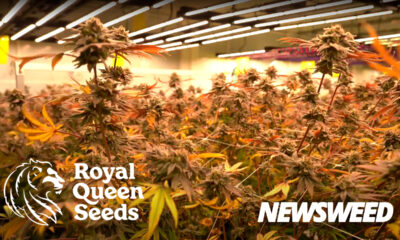




From the boom in dispensaries to a purely medical approach: Thailand is revising its cannabis policy

South Korea is preparing to begin local production of medical cannabis to meet rising demand

In the United States, cannabis use among high school students has reached an all-time low

Medical cannabis use surges by 64 % in Denmark

Canopy Growth Enters the U.K. Market with Four Canadian Strains

CBD: Full-Spectrum Extracts Under Threat in Greece

Medical Cannabis and Back Pain: Opioid Use Has Dropped by 90 % in 10 Years

Cannabis: Wisconsin Could Finally Legalize It in 2027

Argentina Opens Its Market to Hemp Flowers Containing 1% of THC

The French Socialist Party still doesn't know how to approach the legalization of cannabis
-
 Cannabis and driving2 weeks ago
Cannabis and CBD: French Drivers Can Now Lose Their License Even Without a Positive Test Result
-
Cannabis in France3 weeks ago
Cannabis Legalization: The LFI Bill Has a Major Problem—THC
-

 Cannabis in the Netherlands1 week ago
One year after the launch of the Dutch cannabis experiment, the first trends are emerging
-
Cannabis in France2 weeks ago
French medical cannabis remains stalled at the Ministry of Health
-
Cannabis in Argentina1 week ago
Argentina Opens Its Market to Hemp Flowers Containing 1% of THC
-
Business1 week ago
The United Kingdom Is Moving Closer to a Regulated CBD Market
-
Cannabis in Europe3 weeks ago
Andorra Paves the Way for Medical Cannabis Cultivation
-
Cannabis in France1 week ago
Rima Hassan: When «Drugs» Become a Political Weapon












You must be logged in to post a comment Login