

Rick Simpson Oil (RSO)
Rick Simpson Oil (RSO), also known as Phoenix Tears, is an unrefined raw cannabis extract produced by ethanol extraction. It is named after Canadian Rick Simpson, who claims to have cured his own skin cancer in 2003 with a homemade blend of cannabis oil. It's one of the best-known cannabis extracts in the world of medical cannabis, and one of the most controversial.
Who is Rick Simpson?
In 2003, Rick Simpson was diagnosed with basal cell carcinoma, a skin cancer. Already a user of medical cannabis to treat tinnitus and dizziness following a fall, he read a study by Journal of the National Cancer Institute showing that THC appeared to reduce tumor cell growth in mice. He decided to experiment.
According to his own account, he prepared a homemade extract, applied it to his cancerous moles and covered them with a bandage. Four days later, the growths had disappeared. He then began growing his own cannabis, perfecting his blend, creating the documentary Run From the Cure on YouTube and writes The Rick Simpson Story. Until 2009, he distributed his oil free of charge to thousands of patients. He was finally forced to stop for legal reasons.
RSO composition and characteristics
RSO is produced by extraction with’ethanol It's technically a EHO (Ethanol Hash Oil) in its crudest form. The plant material is soaked in alcohol to extract the cannabinoids, then the solvent is evaporated at low heat.
Heat applied during evaporation decarboxyl acid cannabinoids, the THCA turns into THC active, the CBDA in CBD. The RSO is therefore an extract activated and highly psychoactive, unlike some crude extracts.
Its THC content is typically greater than 60%, often between 60 and 90%, depending on the quality of the starting material. It also contains all the cannabinoids present in the plant (CBD, CBN, CBG, CBC...), but few terpenes - heat volatilizes most of them during the evaporation process.
It is this loss of terpenes that technically distinguishes RSO from a true full-spectrum extract (Full Spectrum Cannabis Oil or FSCO), which preserves all bioactive compounds including terpenes. RSO is therefore rich in cannabinoids but depleted in terpenes, which may limit the’entourage effect.
RSO vs CBD oil vs EHO: the differences
| RSO | CBD Oil | EHO refined | |
|---|---|---|---|
| Solvent | Ethanol | Variable (CO2, ethanol, carrier oil) | Ethanol (cryogenic) |
| THC | High (≥60%) | Low (≤0.3% legal) | Variable |
| CBD | Present | Dominant | Variable |
| Terpenes | Low (volatilized) | Variables | High if cryo |
| Decarboxylation | Yes (activated) | Variable | No (if gross EHO) |
| Psychoactivity | Strong | No | Variable |
| Main use | Medical / therapeutic | Wellness / Medical | Recreational/medical concentrate |
How is RSO consumed?
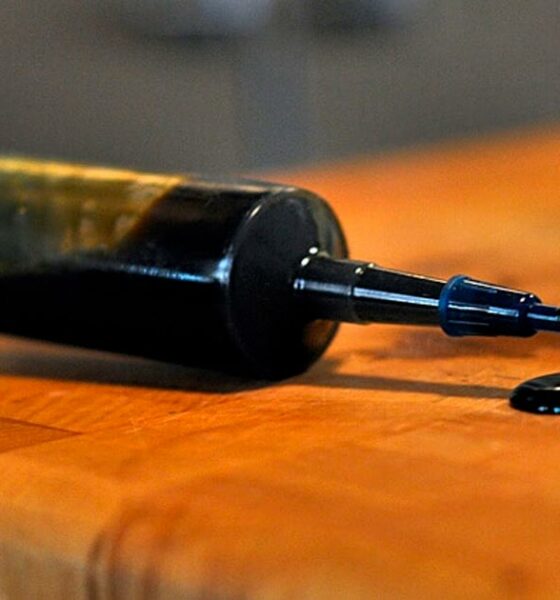
RSO is usually a thick, dark, viscous oil, packaged in syringes for easy dosage. It is not smoked,Its consistency and plant residue content make it unsuitable for direct inhalation.
The three main modes of consumption are application topical directly on the area to be treated (skin, joint, etc.). sublingual under the tongue for rapid absorption, and the oral capsule for slower but longer-lasting effects.
The Simpson protocol
On his website, Rick Simpson recommends a 90-day protocol using 60 grams of RSO in total, with a gradual increase in doses:
- Weeks 1 to 5 in increasing doses, starting from a very small quantity (about the size of half a grain of rice, three times a day)
- Weeks 5 to 12 up to 1 gram per day
He insists that the only way to be sure of the product's quality is to produce it yourself - he formally dissociates himself from all the online sellers who claim to market his oil.
What science says
The medical and scientific community remains cautious and skeptical to Rick Simpson's claims. To date, no controlled clinical trial has validated OSR as a cancer treatment.
What exists: preliminary in vitro studies showing that certain cannabinoids (THC, CBD) can inhibit the proliferation of certain cancer cells under laboratory conditions. Several studies on animal models have shown encouraging results. But the transition from laboratory results to human clinical trials remains a considerable leap, not yet achieved for OSR specifically.
Margaret Haney (Columbia University) and other researchers point to the total lack of double-blind clinical trials on OSR. Positive patient testimonials exist and are numerous, but they do not constitute scientific proof.
In France, RSO containing more than 0.3% THC is an illegal substance: its production, possession and distribution are subject to criminal prosecution. Patients seeking access to cannabinoid treatments should turn to legal medical cannabis channels.
Controversy and imitations
Simpson still has a community of advocates and patients who testify to positive results. He has also generated a wave of commercial imitations which he publicly repudiates - his website states that he no longer produces or supplies his oil and disassociates himself from any commercial vendor using his name.









CBD is said to promote athletic recovery, without improving performance

294 cannabis clubs in Chile: a booming movement with uneven distribution

Chronic Sciatica: New York Approves First Clinical Trial of a THC-Based Medication

United States: The DEA is accelerating the integration of medical cannabis at the federal level

Florida is nearing one million patients using medical cannabis

Uruguay Revives Its Plan to Allow Tourists to Legally Access Cannabis

In Brazil, researchers are developing an innovative CBD eye drop

Autism: Medical Cannabis Is Linked to Reduced Anxiety

The $28 billion U.S. hemp market remains under threat

