
Cannabis users, fuel for the politics of numbers


Security is a central theme in public debate. Often misused to paint a disturbing picture of France—a country plagued by crime and the ruling party’s lax approach—the subject is nevertheless rarely examined closely when it comes to assessing the actual effectiveness of the police, who have evolved from “guardians of the peace” to “law enforcement officers.” A slightly deeper look at crime statistics suggests that the logic of cost-effectiveness is diverting the police system from its original purpose—ensuring citizens’ safety—and instead focusing on minor offenses with a high likelihood of resolution, particularly the pursuit of petty criminals.
Cannabis Users on the Front Lines
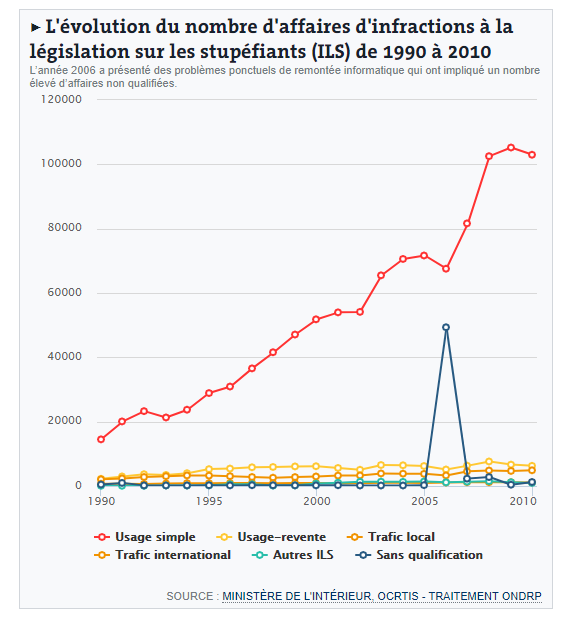
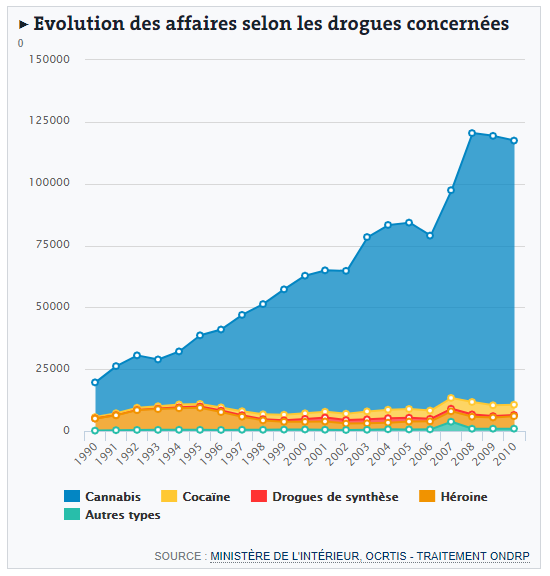
According to figures from the Ministry of the Interior, since 1990, offenses involving the mere use of narcotics have skyrocketed, while those related to drug trafficking have remained stagnant. The high rate of arrests thus primarily concerns cannabis use (90%), a minor offense with no victims or complainants, and one that has no impact on the resolution of drug trafficking investigations.
The lack of resources, which law enforcement agencies often complain about, therefore seems minimal given the amount of time spent checking ordinary users.
Furthermore, the enforcement of these offenses is not a deterrent, France is one of the European countries where people consume the most cannabis. Why, then, dwell unnecessarily on such violations?
The Policy of Numbers
As explained by in a post dated October 6 Bénédicte Desforges, a former police officer and author of the book *Flic: Chroniques de la police ordinaire*, argues that the primary flaw in the police system lies in setting quantitative targets—the so-called «policy of numbers.».
In her view, the police are effective when they provide security—defined as the absence of threats—which is therefore impossible to quantify. If, on the other hand, police effectiveness is measured in terms of threats eliminated, the solution lies in artificially creating threats to eliminate in order to appear more effective. It is therefore this perverse logic that lies behind the persecution of cannabis users. These types of offenses are then identified by the police themselves, rather than being reported as a result of a complaint. These offenses are thus cleared up as soon as they are identified, boosting clearance rates and creating an overall impression of effectiveness.
Bénédicte Desforges also reveals that police leadership is held financially accountable for the effectiveness of their departments. Every officer, commissioner, and director is accountable for the performance of their subordinates. Added to this are considerations of reputation, career advancement, and compensation.
Performance bonuses, known as responsibility and performance allowances, are substantial and are said to encourage police departments to inflate their statistics. The more arrests there are, the better the departments« statistical performance. However, between dismantling a drug trafficking ring—which can take months or even years—and making a dozen arrests a day for cannabis use, the choice is an easy one in terms of productivity. For a commander, the »responsibility” bonus can reach up to 9,912€ per year; for a commissioner, 25,000€; and for a department director, 58,104€. Added to this is a variable component that can amount to up to 40% of the fixed portion.
These bonuses, which are substantial, are part of a performance-based management strategy that, according to Bénédicte Desforges, would undermine the purpose of police work and reveal the lack of a long-term security strategy.
Putting an End to the "Numbers-First" Approach
By inflating crime statistics to create the illusion of effectiveness, the persecution of cannabis users lends weight to the security argument, despite police action being completely futile in terms of deterrence and public safety.
Would decriminalization then give the impression that the police are ineffective?
Even police officers acknowledge the futility of this system: Alexandre Langlois, police officer and general secretary of the Vigi union (formerly CGT-Police) recently stated Regarding a case of data manipulation in the Bouches-du-Rhône department: «The focus on numbers is destroying the meaning of our work (…) To earn their bonuses, managers are willing to do anything to produce the best statistical reports, at the expense of our colleagues» health.” In the same vein The Alliance union states: «We’ve always spoken out against this kind of approach. The race to the bottom leads to a real sense of unease within the departments.».
Manuel Valls had announced to put an end to «the frantic pursuit of numbers» by focusing instead on a citizen satisfaction index that prioritizes reported offenses that are the subject of complaints and are followed up with an investigation. However, little has been done. In an interview with *Le Monde*, Last February, Gérard Collomb promised to end the focus on statistics in the police force, but the announcement of his departure leaves the issue unresolved. Will his successor dare to tackle this thorny issue?














Contest: Win a trip to Quebec to experience the hemp harvest firsthand

Bedrocan on Hold Amid Uncertainty Over Medical Cannabis

Newsweed Launches Its Own AI

A new tax of 0.5% could disrupt the hemp industry in Canada

Medical Cannabis and Driving: New South Wales Ends Automatic Penalties for THC

China's Yongji Health Takes Control of Tasmanian Botanics

Autism and Cannabis: Results from the First Placebo-Controlled Trial of NTI164

Which countries legalized medical cannabis before France?

From the boom in dispensaries to a purely medical approach: Thailand is revising its cannabis policy

South Korea is preparing to begin local production of medical cannabis to meet rising demand
-
 Cannabis and driving3 weeks ago
Cannabis and CBD: French Drivers Can Now Lose Their License Even Without a Positive Test Result
-

 Cannabis in France5 days ago
Which countries legalized medical cannabis before France?
-
Cannabis in France3 weeks ago
Cannabis Legalization: The LFI Bill Has a Major Problem—THC
-
Cannabis in the Netherlands2 weeks ago
One year after the launch of the Dutch cannabis experiment, the first trends are emerging
-
Business5 days ago
South Korea is preparing to begin local production of medical cannabis to meet rising demand
-
Cannabis in Thailand5 days ago
From the boom in dispensaries to a purely medical approach: Thailand is revising its cannabis policy
-
Cannabis in Argentina2 weeks ago
Argentina Opens Its Market to Hemp Flowers Containing 1% of THC
-
Cannabis in France2 weeks ago
French medical cannabis remains stalled at the Ministry of Health














You must be logged in to post a comment Login