Will the UN change the status of cannabis in international treaties in 2019?

The WHO's last assessment of cannabis, in 1954, fuelled the prohibitionist movement that led to cannabis being banned worldwide. Today, its re-evaluation could, on the contrary, fuel the reformist movement. The results of the Independent Expert Committee's Critical Review were due to be presented by WHO to member states of the UN Commission on Narcotic Drugs on December 7, to inform their vote at the March 2019 plenary session. This vote in turn will determine the status of cannabis and other controlled substances in international treaties. However, the presentation of the Committee's findings has been postponed by the WHO. This is the first time that the timetable has not been respected. Let's take a look at what this means.
Too early to rule on cannabis?
At the International Cannabis Policy Conference organized by the FAAAT in Vienna, in parallel with the supposed publication of the results by the WHO, there was surprise and disappointment when the WHO spokesman announced that the results would not be published. However, the results had been released by the experts and made public to other substances evaluated.
So it's only cannabis that's being delayed, which isn't all that surprising given that it's still widely controversial. The WHO justified the postponement on the grounds that the clearance The process of re-reading and bringing the results into line was not yet complete, but for some, it was a political choice to keep the results quiet and modify them: «The decision not to reveal the results of the Cannabis Critical Review seems to be politically motivated,» explains Michael Krawitz, a consultant at the FAAAT.
Indeed, this postponement has the potential to push back the CND vote from March 2019 to March 2020, since, legally speaking, the presentation of results must take place during the previous CND session to give the states time to study the results. However, these sessions last from March to December, and a period of vacancy follows. The non-disclosure of the results of the Critical Review therefore puts the UN agenda on the re-evaluation of cannabis out of sync, and even if the results are disclosed between December and March, states are able to argue that they did not have enough time to study them before the vote.
However, according to Kenzi Riboulet Zemouli, Director of Research at FAAAT: «this is an unprecedented move and it's not impossible that the embargo on cannabis recommendations will be lifted in the coming weeks in an attempt to force through the vote in March 2019. It's unlikely but impossible to deny, given that we're in a para-protocol grey zone where anything is possible».
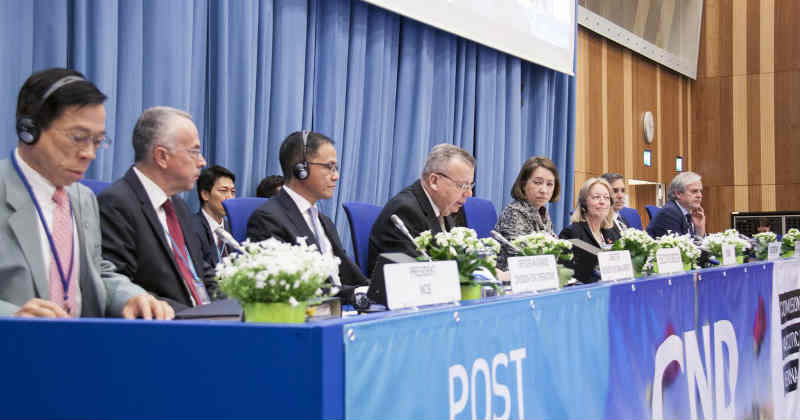
As the WHO's recommendations have no legal force of their own, we have to wait for the CND members to vote on the issue of cannabis before its status in international treaties changes. The CND vote is taken by a simple majority at the plenary session of the Commission, which brings together 53 member countries. Its composition changes from one session to the next - with a prevalence of countries particularly affected by drug trafficking.
The list of countries represented for the March 2019 vote is fairly positive in the direction of reform, as the majority of countries have already authorized some form of access to cannabis or its derivatives. It will be different in 2020, as 33 members will be replaced. In any case, the outcome of the vote remains uncertain because, as the FAAAT points out in the Crimson Digest volume 1(chapter 4), voting is articulated by regional groupings and geopolitical considerations can infiltrate the debate. The «consensus» behind Trump's anti-drug policy during his informal meeting at UN headquarters demonstrates this fact quite well.
The possible postponement of the CND vote may still help to solidify the consensus around the properties of cannabis, even though some states are currently are in the process of amending their legislation on this subject. During this time, the organizations that have made cannabis reform their domain will be able to develop tools to guide policymakers and shape the debate around cannabis regulation.
The postponement could therefore be an opportunity to launch an international debate and incorporate new issues such as sustainability. The FAAAT recently published a document entitled «Cannabis and Sustainable Development» as part of the UN's Sustainable Development Goals. This was also a central theme of the International Conference, which was a great success, attracting a large number of participants convinced by the innovative aspect of the issues addressed.








JIHE 2026: Japan’s Largest Trade Show Dedicated to Hemp and CBD Returns to Tokyo with More Than 100 Industry Players

New Caledonia: The Courts Clear the Way for the Return of CBD

The Brazilian medical cannabis market continues to grow

Morocco: Three Cannabis-Based Medications Approved for the Treatment of Epilepsy

Canopy Growth Receives New EU-GMP Certification to Strengthen Its Presence in Europe

Three years after legalizing medical cannabis, Albania continues to establish regulations for it

The first plant-based medical THC spray arrives in the United Kingdom

Medical Cannabis in Germany: THC Prices Vary by a Factor of 12

France already has 3,000 cannabis retail outlets. None of them are legal.

Morocco's exports of legal cannabis have expanded to 15 countries
-
 Business2 weeks ago
The legal cannabis market in New York exceeds 4 billion $ in revenue
-

 Cannabis in France4 weeks ago
Which countries legalized medical cannabis before France?
-
Business4 weeks ago
South Korea is preparing to begin local production of medical cannabis to meet rising demand
-
Cannabis in France4 days ago
France already has 3,000 cannabis retail outlets. None of them are legal.
-
Cannabis in Thailand4 weeks ago
From the boom in dispensaries to a purely medical approach: Thailand is revising its cannabis policy
-
Cannabis in the U.S.5 days ago
A DEA report confirms that there are no fatal cannabis overdoses
-
Cannabis and driving3 weeks ago
Medical Cannabis and Driving: New South Wales Ends Automatic Penalties for THC
-
Cannabis in France3 weeks ago
France’s Drug Policy Chief Defends Cannabis Prohibition... and Runs Into the Facts















You must be logged in to post a comment Login