
WHO recommends reclassification of cannabis in international treaties

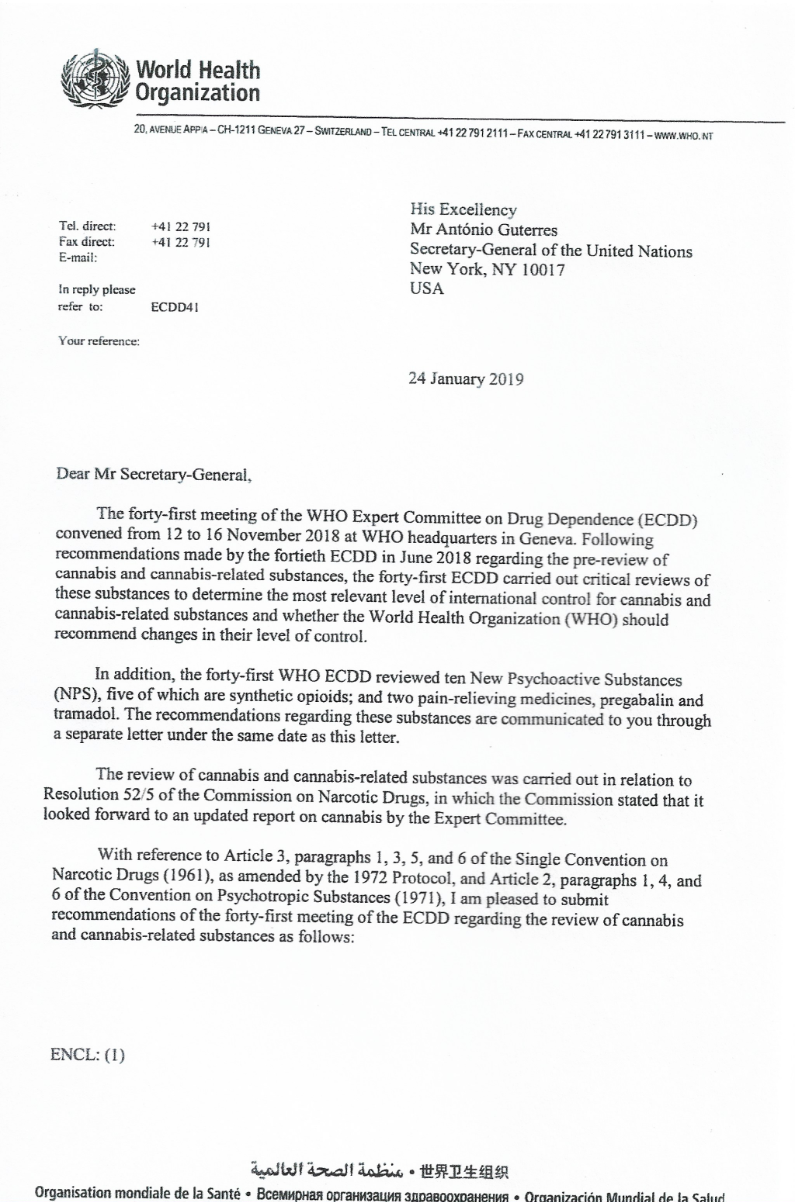
Until now, cannabis has always been classified in the most restrictive echelon of international treaties, a status that has enshrined its total prohibition and hampered scientific research. In 2016, however, the WHO launched a process to review the status of cannabis for the first time since 1961. To this end, the organization convened its Expert Committee on Drug Dependence four times. The committee's final findings have just been published by the WHO in the form of official recommendations.
International treaties
International treaties (the 1961 Single Convention on Narcotic Drugs and the Convention on Psychotropic Substances of 1971) classify substances according to their dangerousness and therapeutic value. This grading is decreasing in terms of abuse potential and increasing in terms of therapeutic value. Thus, substances classified in the most restrictive echelon are considered to have a high abuse potential and little or no therapeutic value. Until now, this has been the case for cannabis.
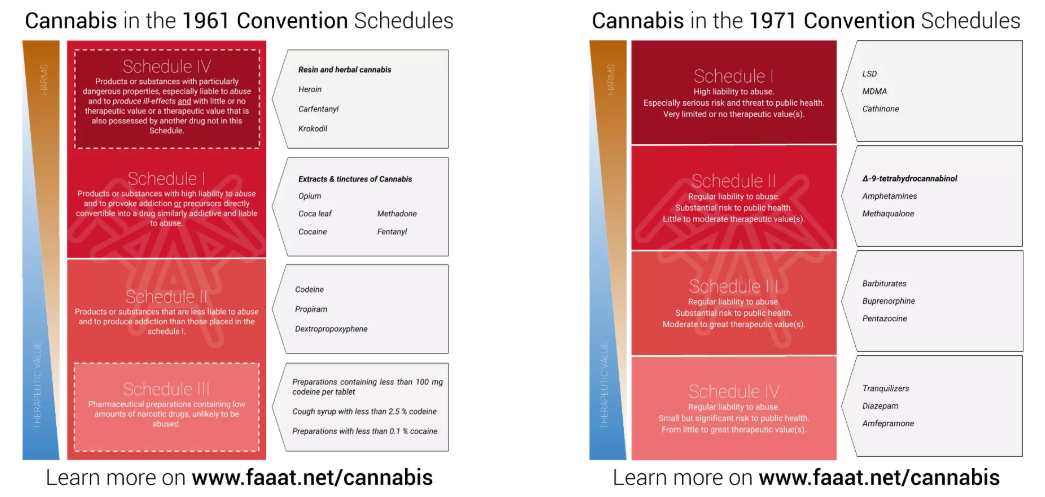
In 1954, the WHO's position on medical cannabis was that «efforts should be made to abolish cannabis from all legitimate medical practices». The classification of cannabis in these treaties effectively denies it any therapeutic value. Yet these treaties have been ratified by the vast majority of the world's countries, which have based their anti-drug policies on this classification. Revising this classification therefore has the potential to trigger a wave of reform in cannabis policies around the world.
WHO recommendations
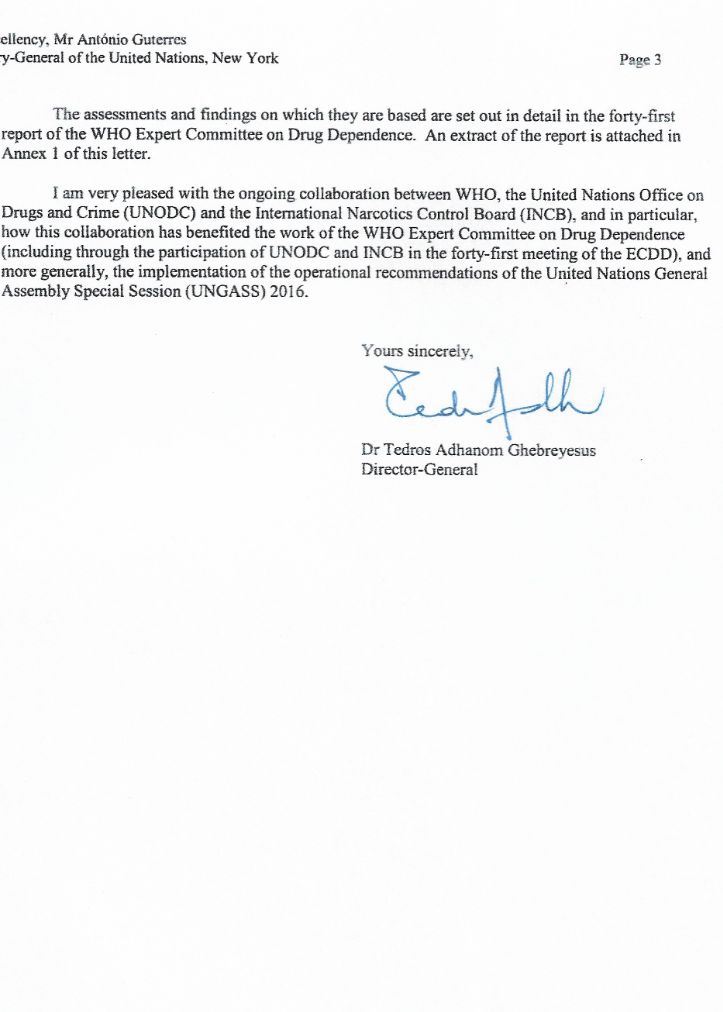
The plant and its derivatives
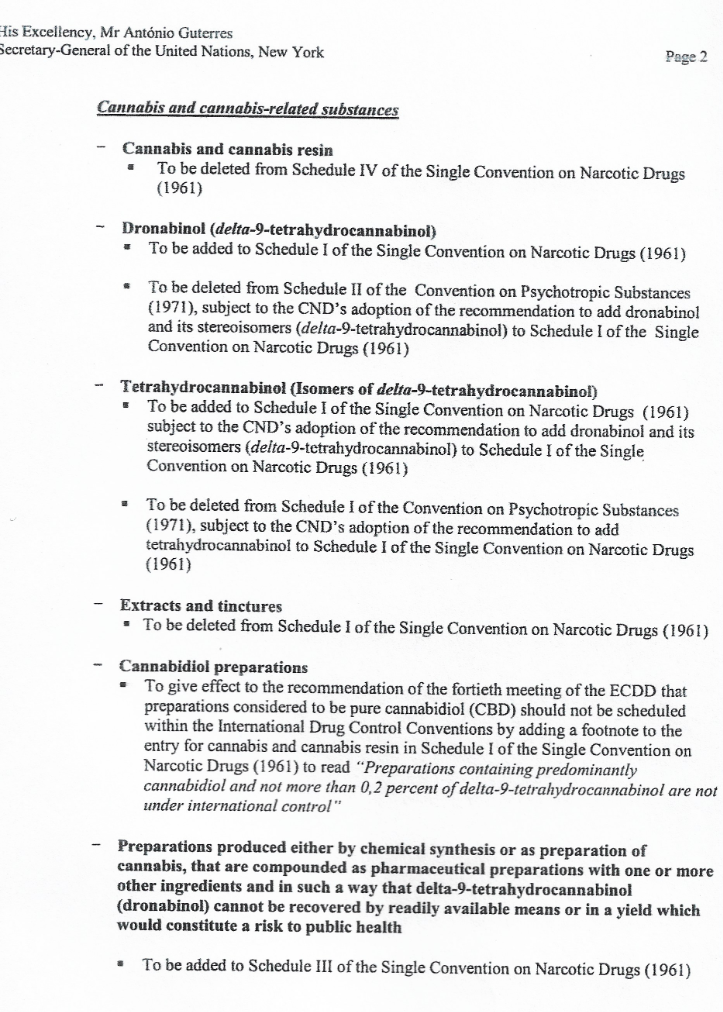
With regard to the plant and its derivatives, the WHO recommends :
- Remove the cannabis plant and its resin level IV (the most restrictive) of the 1961 Single Convention on Narcotic Drugs. Cannabis is not, however, totally exempt from international control. It is recommended that the cannabis plant and its resin, presumably on the basis of their THC content, be placed in tier I of the convention, which specifies that they still have a high potential for abuse, but can be directly converted into medicines in the same way as opium, for example.
- Remove cannabis extracts and tinctures of the same convention. The text specifies that cannabis preparations (whether based on cannabinoids synthetic or natural) that do not contain a significant proportion of THC (this proportion is not specified) should be placed in tier III. They would therefore be considered as pharmaceutical preparations containing a small quantity of narcotics and with a low abuse potential, like cough syrups containing codeine.
The molecules
Concerning the molecules present in or derived from cannabis, the WHO recommends :
- Place the Dronabinol (medication based on synthetic cannabinoids) into tier I of the 1961 Convention, at the same time removing it from tier II of the 1971 Convention on Psychotropic Substances. This move recognizes and facilitates its therapeutic use.
- Ditto for the THC originally classified in the first echelon of the 1971 convention, which recognized it as having no therapeutic value and considered it dangerous to public health. This reclassification opens up new prospects for its medicinal use.
- Concerning the CBD the WHO had already recommended not to classify it in international treaties. It now recommends the addition of a note to accompany the classification of the cannabis plant and its resin in Schedule I of the 1961 Convention, stipulating that preparations containing less than 0.2% THC do not fall under international control. This recommendation is fundamental, as it seems to adopt the european hemp legislation and directly contravenes the position of the French authorities who would like cannabis preparations to contain 0% of THC.
A new era for cannabis?
By declassifying cannabis and its derivatives, the WHO validates, facilitates and encourages the reform of national cannabis policies. States will also be better able to provide legal and safe access to medical cannabis and research into its benefits. For Kenzi Riboulet-Zemouli, Research Director at FAAAT: “This is the best outcome the WHO could possibly have brought about. It is the beginning of a new cycle of evidence-based, health-oriented international cannabis policies».
However, these recommendations are not directly effective. The International Narcotics Control Board (INCB) must now give its opinion on the matter, and will issue its report in February. According to Yann Bisiou, a lecturer in private law and criminal sciences and a specialist in drug law, this council is «renowned for having made its living from the war on drugs».
Finally, these recommendations must be approved by a simple majority of the 53 member countries of the Commission on Narcotic Drugs (CND). The vote was normally due to take place in March 2019, but the publication of the Committee's results having been delayed by the WHO, it could be postponed until the next CND session in March 2020. For more information on the vote, the procedure and the countries that will be voting, we recommend FAAAT website, a Think & Do tank specializing in alternative approaches to current drug policies.











CBD is said to promote athletic recovery, without improving performance

294 cannabis clubs in Chile: a booming movement with uneven distribution

Chronic Sciatica: New York Approves First Clinical Trial of a THC-Based Medication

United States: The DEA is accelerating the integration of medical cannabis at the federal level

Florida is nearing one million patients using medical cannabis

Uruguay Revives Its Plan to Allow Tourists to Legally Access Cannabis

In Brazil, researchers are developing an innovative CBD eye drop

Autism: Medical Cannabis Is Linked to Reduced Anxiety

The $28 billion U.S. hemp market remains under threat

Jamaica Eases Small Farmers' Access to the Cannabis Market
-
 Business6 days ago
The legal cannabis market in New York exceeds 4 billion $ in revenue
-

 Cannabis in France2 weeks ago
Which countries legalized medical cannabis before France?
-
Business2 weeks ago
South Korea is preparing to begin local production of medical cannabis to meet rising demand
-
Cannabis in the Netherlands4 weeks ago
One year after the launch of the Dutch cannabis experiment, the first trends are emerging
-
Cannabis in Thailand2 weeks ago
From the boom in dispensaries to a purely medical approach: Thailand is revising its cannabis policy
-
Cannabis in France4 weeks ago
French medical cannabis remains stalled at the Ministry of Health
-
Cannabis in Argentina3 weeks ago
Argentina Opens Its Market to Hemp Flowers Containing 1% of THC
-
Cannabis and driving2 weeks ago
Medical Cannabis and Driving: New South Wales Ends Automatic Penalties for THC














You must be logged in to post a comment Login