Trump's UN anti-drug meeting foreshadows a return to retrograde practices

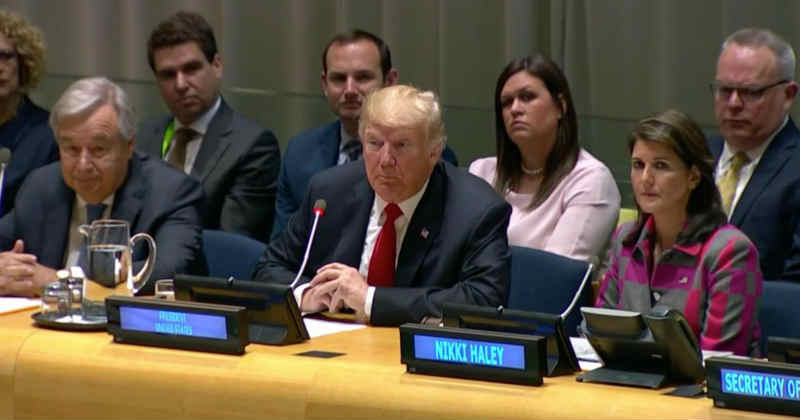
The meeting Global call to action on the world drug problem planned by Trump as part of the international fight against drugs, was held yesterday at UN headquarters. The 128 signatory countries and UN Secretary General Antonio Guterres attended, and listened to Trump spout the usual statistics on drug problems and the need to do something about them. While Antonio Guterres seemed satisfied, applauding the initiative and Trump for «focusing global attention on the world drug problem», there are serious doubts about the validity of the meeting.
One step forward, two steps back
Whereas the results of the 2016 UN General Assembly on Drugs represented a significant step forward in the fight against drugs, with an emphasis on respect for human rights, access to care and the recommendation of less repressive policies, yesterday's meeting seems to be moving in the complete opposite direction. Although the 2016 report is mentioned in the preparatory document for the meeting, the latter remains rather evasive on health and social issues, focusing instead on reducing demand and halting production and supply. Priorities that have all the hallmarks of a prohibitionist policy.
With a clear focus on the fight against drug trafficking, Trump is reaffirming his hitherto ineffective hard-line policy. The Office of the Special Inspector General for Afghanistan Reconstruction explains that the government has already spent $8.6 million since 2002 to stop drug trafficking in the country, yet it remains the world's leading opium producer.
Of the 193 UN members, 63 countries refused to sign the document. A number of countries have commented on this refusal, including the Prime Minister of New Zealand and the Norwegian Ministry of Foreign Affairs explained that the text did not give sufficient prominence to health issues and did not reflect the direction their respective governments wished to take.
Parallel to Trump's meeting was a much more progressive initiative in Mexico by the Global Commission on Drug Policies around’a report entitled Regulation: Responsible Drug Control. The meeting brought together former heads of state who testified to the ineffectiveness of prohibitionist policies. The report examines how to eliminate the black market through legal and controlled distribution channels, and calls for global reform of the international drug control system.
Questionable practices
The presence of many countries with extremely tough anti-drug policies confirms the direction of this meeting. Trump even went so far as to praise the efforts of Philippine President Rodrigo Duterte, a man who has nonetheless praised its police for killing 32 people (alleged traffickers) in one day. A position not so far removed from that of Trump, who had after all said it wanted to reintroduce the death penalty for drug dealers of drugs. Add to this the recent scandal of the secret White House committee charged with anti-cannabis propaganda, Trump's backward-looking orientation is now clear. In June, the Trump administration withdrew from the UN Human Rights Council.
Officially, the purpose of the meeting was to present a common position to the UN General Assembly, but in reality this non-negotiable, unofficial document simply represents the position of the United States. For them, it's a matter of reaffirming a position of diplomatic leadership. The meeting feigns consensus, but in reality, some are falling in line to avoid diplomatic complications. This runs completely counter to the UN's usual co-decision process. The problem is that by rallying everyone to its cause, albeit artificially, the USA has the power to choose the direction of the UN's international anti-drug fight, which will be revised in 2019.
This «with us or against us» policy is nothing new on the part of the United States, which has also declared that it is planning sanctions against Mexico, Colombia and Afghanistan if these states do not redouble their efforts to stop drug production and trafficking on their territory. These are rather hypocritical threats, since despite his apparent commitment, Trump has made major cuts in the anti-narcotics budget of the Department of the Interior and federal anti-drug-trafficking agencies, which have been forced to lay off staff, according to a report by the U.S. Department of Homeland Security. facts reported by CBS News.





Medical Cannabis in Germany: THC Prices Vary by a Factor of 12

France already has 3,000 cannabis retail outlets. None of them are legal.

Morocco's exports of legal cannabis have expanded to 15 countries

Aurora Cannabis Doubles Its Production Capacity in Germany

Tilray is accelerating its operations in Europe thanks to a license in Portugal

Boston will host the 10th annual State of the Cannabis Industry Conference on October 26

A DEA report confirms that there are no fatal cannabis overdoses

A British patient is challenging the NHS's refusal to reimburse medical cannabis

October 2026 CBD Highlights: 10 Strains and Hash to Discover from 5 French Producers

CBD in France: Traceability, Retail Stores, THC and Driving… What the New Bill Proposes
-
 Business2 weeks ago
The legal cannabis market in New York exceeds 4 billion $ in revenue
-

 Cannabis in France3 weeks ago
Which countries legalized medical cannabis before France?
-
Business3 weeks ago
South Korea is preparing to begin local production of medical cannabis to meet rising demand
-
Cannabis in Thailand3 weeks ago
From the boom in dispensaries to a purely medical approach: Thailand is revising its cannabis policy
-
Cannabis and driving3 weeks ago
Medical Cannabis and Driving: New South Wales Ends Automatic Penalties for THC
-
Cannabis in Argentina4 weeks ago
Argentina Opens Its Market to Hemp Flowers Containing 1% of THC
-
Autism3 weeks ago
Autism and Cannabis: Results from the First Placebo-Controlled Trial of NTI164
-
Cannabis in France2 weeks ago
France’s Drug Policy Chief Defends Cannabis Prohibition... and Runs Into the Facts
















You must be logged in to post a comment Login