The UN Commission on Narcotic Drugs vote on cannabis will not take place in March as planned

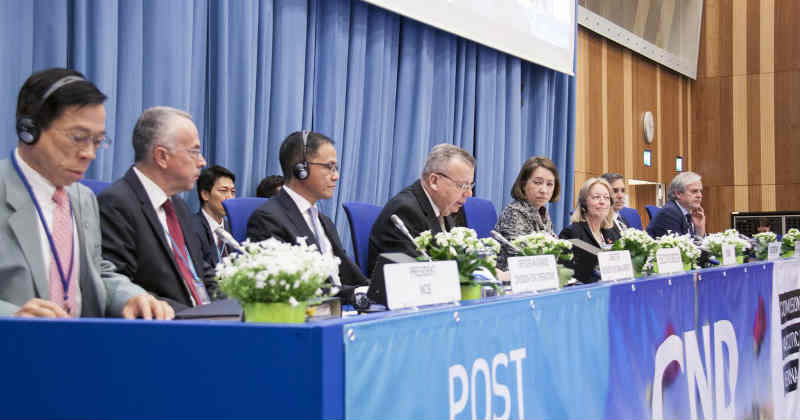
Like it was to be expected, The Commission on Narcotic Drugs' vote on cannabis has been postponed due to delays in the publication of the results of the 41st Expert Committee (ECDD) by the WHO. This is Monday, during the inter-session between the Commission's two annual sessions, that this decision was made official. The vote had been eagerly awaited, as it was to give concrete form to the WHO recommendations to reclassify cannabis and its derivatives within the less restrictive echelons of international treaties.
What was said at the inter-sessional meeting
Lack of time
The UN is required to give member states three months to inform their vote. However, the results of the 41 ECDD Committee and the associated WHO recommendations were only published at the end of January, instead of being made public at the interim session in December. As planned FAAAT, However, several States pointed to a lack of time to examine the recommendations, and therefore requested a postponement of the vote.
These include Japan, the USA, Germany and Russia. The latter even suggested a form of status quo: «many countries use cannabis and its components in pharmaceutical compositions and these are produced on an industrial scale, so what real limits exist in the current ranking?»
Japan, for its part, argued that the issue required careful consideration: «This implies the liberalization of current regulations, and we need to examine the issue and assess the possible impact». On the other hand, this suggests that Japan is ready to take the appropriate measures to adapt to the UN's recommendations.
An unjustified delay
The progressive states, for their part, are annoyed and are calling for a date to be set at the very least. «When will the vote take place? My delegation has expressed the wish that the vote should take place, not that it should be postponed indefinitely», said an impatient Norway. Uruguay was more moderate: «We can live with postponing the vote, but it would be nice to know when.
Uruguay, however, pointed out that the delay in publication by the WHO only concerned cannabis and not the other substances evaluated by the Committee (fentanyl and synthetic cannabinoids): «Why has this internal clarification taken so long? The same goes for Canada, which asks: »Why has the publication of the results been delayed? In fact, the process seems politicized, since the WHO has deviated from its timetable, whereas the Committee's results were delivered on time.
For its part, Mexico, which is to legalize recreational use, asked to clarify the issue of cannabis in food: »Every day we see more and more products containing cannabis components - given that we are moving towards an increasing use of these components, how do we address the challenges posed by their inclusion in food products?.
Conclusion
The meeting concluded with the postponement of the vote on cannabis, an outcome which demonstrates the political disagreements still surrounding the issue. No date was set for the postponement, with some member states suggesting the next CND intermediate session in December. Others proposed the regular session in March 2020. The Commission's rotation system means that not all member states will vote the same way next time.
Multilateralism or unilateralism?
As Sara Brittany Somerset of Forbes Member states can, in fact, parley and procrastinate indefinitely on cannabis, as they did with the WHO recommendation to reclassify Dronabinol«. The Dronabinol recommendation dates back to 2012, but member states have never voted on it. Dronabinol has been approved by the FDA and is even available in France via an ATU.
It is therefore technically possible that these recommendations will never be voted on, or that they will be postponed again and again, but the political and social stakes seem too high for the States to ignore this vote indefinitely. Conservative states, on the other hand, can play the institutional game and use the pretext of prudence to delay the decisive vote as long as possible. This is the strategy of the United States, for example, which has demanded the participation of other UN agencies (INCB, UNODC) in the debate.
On the other hand, some member states have already unilaterally embarked on particularly progressive cannabis reforms. Canada and Uruguay have even legalized recreational cannabis. According to Sara Britanny Somerset, the States should continue to make progress individually rather than wait for an answer from this collective vote, which risks being postponed eternally. The restrictions implied by international treaties have not and will not prevent reform. However, they continue to hinder scientific research into cannabis.











Medical Cannabis in Germany: THC Prices Vary by a Factor of 12

France already has 3,000 cannabis retail outlets. None of them are legal.

Morocco's exports of legal cannabis have expanded to 15 countries

Aurora Cannabis Doubles Its Production Capacity in Germany

Tilray is accelerating its operations in Europe thanks to a license in Portugal

Boston will host the 10th annual State of the Cannabis Industry Conference on October 26

A DEA report confirms that there are no fatal cannabis overdoses

A British patient is challenging the NHS's refusal to reimburse medical cannabis

October 2026 CBD Highlights: 10 Strains and Hash to Discover from 5 French Producers

CBD in France: Traceability, Retail Stores, THC and Driving… What the New Bill Proposes
-
 Business2 weeks ago
The legal cannabis market in New York exceeds 4 billion $ in revenue
-

 Cannabis in France3 weeks ago
Which countries legalized medical cannabis before France?
-
Business3 weeks ago
South Korea is preparing to begin local production of medical cannabis to meet rising demand
-
Cannabis in Thailand3 weeks ago
From the boom in dispensaries to a purely medical approach: Thailand is revising its cannabis policy
-
Cannabis and driving3 weeks ago
Medical Cannabis and Driving: New South Wales Ends Automatic Penalties for THC
-
Cannabis in Argentina4 weeks ago
Argentina Opens Its Market to Hemp Flowers Containing 1% of THC
-
Autism3 weeks ago
Autism and Cannabis: Results from the First Placebo-Controlled Trial of NTI164
-
Cannabis in France2 weeks ago
France’s Drug Policy Chief Defends Cannabis Prohibition... and Runs Into the Facts

















You must be logged in to post a comment Login