

Shatter cannabis: definition, texture, consumption and storage
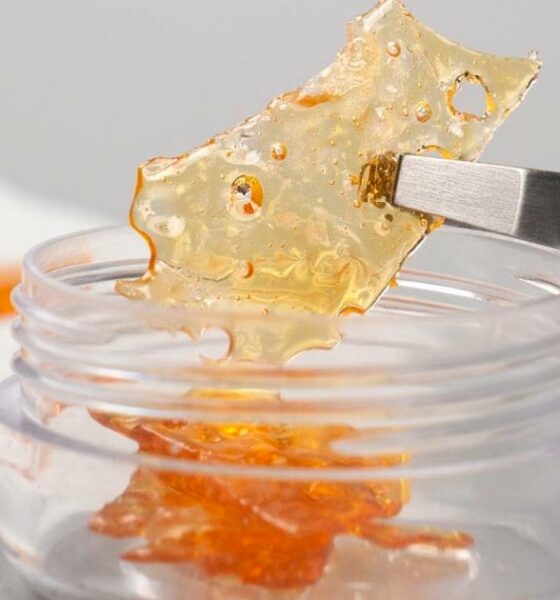
The shatter is a cannabis concentrate with a rigid and translucent texture, named for its tendency to shatter like glassto shatter (in English) when it's broken. Visual, powerful, and renowned for its apparent purity, it is one of the most concentrated dabbing the most recognizable on the market.
What is shatter?
Shatter is a cannabis extract produced using a solvent, usually butane (BHO), which is distinguished from other concentrates solely by its post-extraction technique : unlike budder or to crumble, the extract is not whipped or agitated after purging. It is left to rest flat, allowing the molecules to align into a quasi-crystalline structure giving it its characteristic rigidity and transparency.
Its color ranges from pale amber yellow to golden brown, depending on the quality of the starting material and purging conditions. High-quality shatter is translucent, uniform, and free of bubbles—bubbles indicate insufficient purging of residual solvents.
Its THC is generally between 70 and 90%, making it one of the most potent concentrates available.
Shatter vs. pull 'n' snap: what's the difference?
The texture of shatter varies depending on its cannabinoid composition, and this point deserves further explanation.
A high-potency shatter THCA (non-psychoactive acidic form of THC) will be more brittle and glassy, THCA is solid at room temperature, which gives the concentrate its characteristic rigidity.
A high-potency shatter Active THC will contain more residual oil, THC is a viscous liquid at room temperature, which results in a more flexible, stretchy concentrate that can be pulled without breaking. This is called Pull 'n' Snap : not really liquid like that budder, nor as rigid as pure shatter. Some classify it as a subcategory of shatter, others as a texture in its own right like Taffy.
Comparative table of concentrates
| Concentrate | Texture | THC approx. | Handling | Terpenes |
|---|---|---|---|---|
| Shatter | Stiff, brittle | 70–90% | Difficult (fragile) | Resources |
| Budder/Badder | Creamy, buttery | 60–90% | Very easy | Coupons |
| Crumble | Dry, crumbly | 60–80% | Easy (spoon) | Very good |
| Wax | Waxer | 60–85% | Easy | Coupons |
| Pull'n'snap | Flexible, elastic | 65–85% | Easy | Good means |
How do you use shatter?
In dabbing : it is the reference consumption method. Shatter breaks into small pieces using a dabber flat-tip or lancet. The shatter's rigidity allows for precise manipulation unlike softer concentrates. Apply the piece to a nail or banger in quartz heated to 300–400°C (low temp dab recommended to preserve aromas). A carb cap optimizes vaporization.
Sprinkled on flower small pieces of shatter can be placed in a bowl or crumbled into a joint to increase potency. Warning: shatter is not as easy to handle as crumble or kief In this context.
For concentrate vaporizers Certain concentrate-compatible vaporizers accept shatter, but its rigidity makes loading less convenient than with budder or crumble.
What is CBD shatter?
Although shatter is best known for its high content THC, manufacturers also produce CBD shatter,a high-concentration concentrate CBD and very low in THC. It has the same visual and textural characteristics as THC shatter, but without the psychoactive effects. It is primarily intended for consumers interested in the potential therapeutic benefits of CBD in a fast-bioavailability concentrate format.
How to store shatter?
Shatter degrades when exposed to heat, light, and humidity. At high ambient temperatures (>77°F), it softens and can lose its rigid structure, becoming pull 'n' snap, then wax, which does not affect its potency but changes its texture and can make it difficult to handle.
Preserve the shatter on the non-stick parchment paper (it is less sticky than glass or silicone) in an airtight container, away from light and at a cool temperature. In the refrigerator, it can be kept for several months with no noticeable degradation, provided it is allowed to return to room temperature before handling to prevent it from breaking into too small fragments due to thermal shock.
A Brief History of Shatter
Shatter is a relatively recent element in the history of cannabis concentrates. Its roots date back to the late 1990s, when Canadian manufacturer BudderKing began developing and marketing next-generation concentrates, including shatter and budder. Its products arrive on dispensary shelves in 2003, and the manufacturing techniques are published in Cannabis Culture in 2005. In the 2010s, shatter became the benchmark texture for dabbing, driven by the concentrates culture in legal US markets.







CBD is said to promote athletic recovery, without improving performance

294 cannabis clubs in Chile: a booming movement with uneven distribution

Chronic Sciatica: New York Approves First Clinical Trial of a THC-Based Medication

United States: The DEA is accelerating the integration of medical cannabis at the federal level

Florida is nearing one million patients using medical cannabis

Uruguay Revives Its Plan to Allow Tourists to Legally Access Cannabis

In Brazil, researchers are developing an innovative CBD eye drop

Autism: Medical Cannabis Is Linked to Reduced Anxiety

The $28 billion U.S. hemp market remains under threat

