Cannabis remains the (illegal) substance of choice in Europe


The European Drug Report 2024, published by the European Monitoring Center for Drugs and Drug Addiction (EMCDDA), provides an overview of drug use patterns and trends across Europe, based on data from 2023. The report highlights significant findings on the use of various illicit substances, with a particular focus on the cannabis, the most widely consumed in the region.
Cannabis Use and Trends
Cannabis remains the most commonly used illicit substance in Europe, with 22.8 million adults (8% of the population aged 15 to 64) having used it in the past year. Lifetime use figures are even higher, with 85.4 million people (29.9%) having used cannabis at some point in their lives. The level of cannabis use varies considerably from one country to another, reflecting diverse national trends and policies, and a in line with previous years.
The European cannabis market is undergoing significant changes, marked by high levels of availability and shifting trafficking routes. In 2022, Spain recorded a significant decline in cannabis resin seizures, likely due to supply routes adapting to anti-trafficking measures. Despite this, Spain remains a crucial transit and production hub for cannabis in Europe, accounting for a substantial proportion of seizures. In 2023, Spanish authorities seized 22 metric tons of cannabis resin concealed in fake tomato packaging, underscoring the ongoing challenges of intercepting cannabis trafficking.
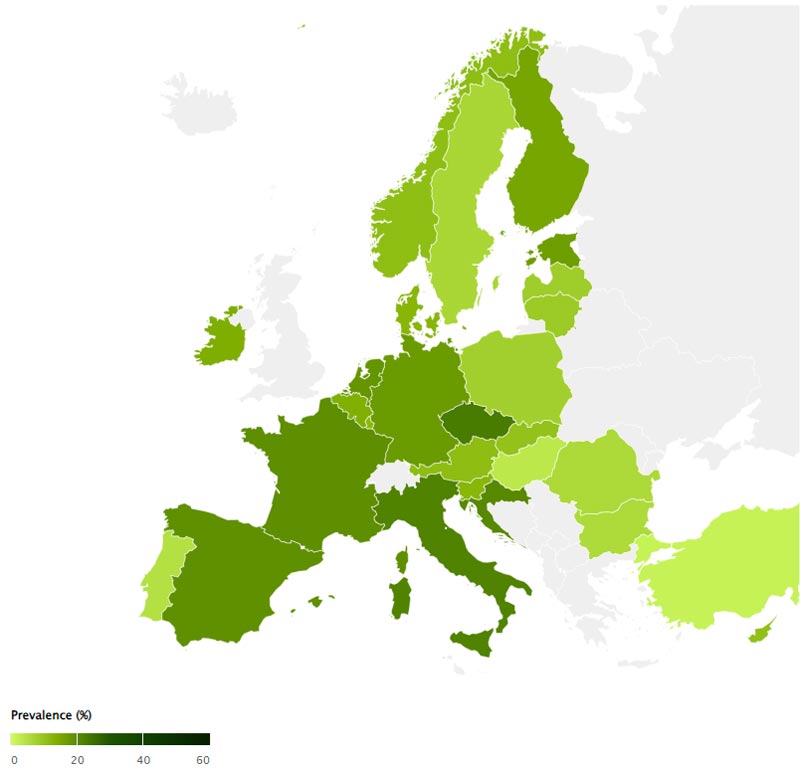
Prevalence of Cannabis Use in Europe
Other illicit drugs
In addition to cannabis, the report provides detailed information on the use of other illicit substances. Cocaine, the second most commonly used drug, was used by 4 million people (1.4 %) in the past year, and 15.4 million people (5.4 %) have used it at some point in their lives. The MDMA (ecstasy) was used by 2.9 million people (1 %), with 12.3 million (4.3 %) having used it at some point in their lives. The amphetamines were used by 2.3 million adults (0.8%) last year, with a lifetime prevalence of 10.3 million (3.6%).
L’heroin and other synthetic opioids, although less commonly used, pose significant public health challenges. Approximately 860,000 high-risk users were reported, and 513,000 people received opioid substitution treatment in 2022. Heroin and synthetic opioids were implicated in 74 % overdose deaths, underscoring the serious risks associated with their use.
The Cannabis Market and Policy Changes
The cannabis market in Europe is diverse, with cannabis flower and resin widely available. The potency of cannabis resin has increased, with average THC levels reaching just under 25%. Cannabis flower, on the other hand, has remained relatively stable, with a THC content of about 10%. The market is also seeing a variety of new products, including extracts and edibles.
Recent trends indicate that cannabis trafficking routes are diversifying, with seizures in places such as the Port of Antwerp, Belgium, revealing cannabis resin originating from the Pakistan. This diversification complicates enforcement efforts and suggests that the European cannabis market is becoming more complex.
Policy Responses and Regulatory Changes
European countries are adopting increasingly diverse approaches to cannabis regulation. Malta, the Luxembourg and theGermany have enacted legislation authorizing the cultivation of cannabis at home and its private use; nonprofit cannabis cultivation clubs are also permitted.
The The Czech Republic plans to implement a regulated and taxed distribution system. Non-EU countries like Switzerland are conducting sales and distribution trials, and the The Netherlands is testing a supply chain a closed cannabis market to address the problem of «coffeeshops» being supplied by the illegal market.
These policy changes reflect the ongoing debate over the best regulatory approach to cannabis use, balancing public health concerns with efforts to control the illicit market. The european report on drugs emphasizes the need for further research on the potential harms associated with different patterns of cannabis use and the implications for policy and practice.
Prevalence and Patterns of Use
Cannabis use among young Europeans (aged 15 to 34) remains high, with 15.1 million of them (15%) reporting that they had used cannabis in the past year. Among 15- to 24-year-olds, 18.6% (8.8 million) used cannabis in the past year, and 9.7% (4.6 million) used it in the past month. Daily or near-daily use is reported by 1.3% (3.7 million) adults, with the majority of users being men under 35 years of age.
National trends in cannabis use show mixed results. Some countries report higher rates of use, others show stable rates, and a few have seen declines since their last surveys.
The study is available at the EMCDDA website.
























France Is More Reluctant to Legalize Cannabis Than the EU Average, According to a New EUDA Survey

Scientists Create Cannabinoid-Free Hemp

MediPharm is preparing to launch its cannabis inhaler in Europe

Sensi Seeds and High Times are teaming up to launch five new cannabis strains

Brains Bioceutical is aiming for the Nasdaq with a valuation of $750 million

CBD in French Polynesia: Sublingual Oils Soon to Be Available Over the Counter

Cannabis legalization in Mexico returns to the Senate after five years of political deadlock

Massachusetts Gives the Green Light to Drive-Thru Cannabis Sales

Finland Wants to Legalize Cannabis Based on the German Model

Hemp-derived THC: U.S. Senators Are Divided Over the Ban
-
 Cannabis in Quebec4 weeks ago
Cannabis: What France Could Learn from Quebec, Eight Years After Legalization
-
Cannabis in New Zealand4 weeks ago
Chronic Pain: New Zealand Is Testing Cannabis to Improve Sleep
-
Cannabis in France4 weeks ago
Dr. Pascal Douek, a tireless advocate for medical cannabis in France, has died
-
Cannabis in France4 weeks ago
Medical cannabis: The Greens introduce two amendments to accelerate its widespread adoption
-
Cannabis in Canada4 weeks ago
A Canadian study reveals the pleasant psychotropic effects of high-dose CBD
-
Studies on cannabis4 weeks ago
More THC, barely any additional effects: A new study challenges common assumptions about the potency of cannabis
-
Cannabis in Argentina4 weeks ago
The Argentine province of Chubut is creating its own framework for medical cannabis
-
Cannabis in France3 weeks ago
Medical Cannabis: Patients Issue a Formal Notice to the Government to Break the Deadlock

















You must be logged in to post a comment Login