
Cannabis remains the (illegal) substance of choice in Europe


The European Drug Report 2024, published by the European Monitoring Center for Drugs and Drug Addiction (EMCDDA), provides an overview of drug use patterns and trends across Europe, based on data from 2023. The report highlights significant findings on the use of various illicit substances, with a particular focus on the cannabis, the most widely consumed in the region.
Cannabis Use and Trends
Cannabis remains the most commonly used illicit substance in Europe, with 22.8 million adults (8% of the population aged 15 to 64) having used it in the past year. Lifetime use figures are even higher, with 85.4 million people (29.9%) having used cannabis at some point in their lives. The level of cannabis use varies considerably from one country to another, reflecting diverse national trends and policies, and a in line with previous years.
The European cannabis market is undergoing significant changes, marked by high levels of availability and shifting trafficking routes. In 2022, Spain recorded a significant decline in cannabis resin seizures, likely due to supply routes adapting to anti-trafficking measures. Despite this, Spain remains a crucial transit and production hub for cannabis in Europe, accounting for a substantial proportion of seizures. In 2023, Spanish authorities seized 22 metric tons of cannabis resin concealed in fake tomato packaging, underscoring the ongoing challenges of intercepting cannabis trafficking.
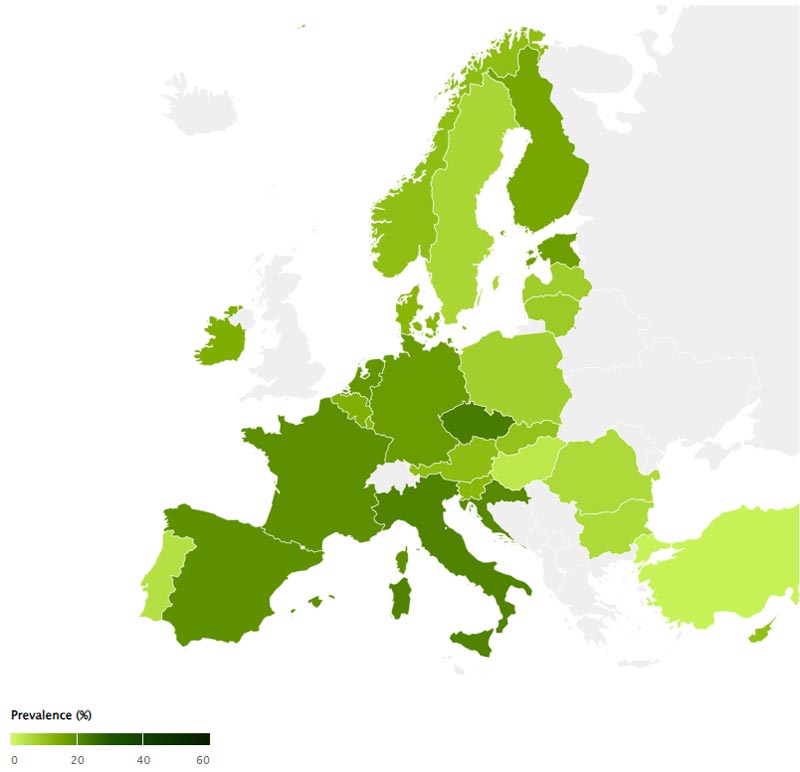
Prevalence of Cannabis Use in Europe
Other illicit drugs
In addition to cannabis, the report provides detailed information on the use of other illicit substances. Cocaine, the second most commonly used drug, was used by 4 million people (1.4 %) in the past year, and 15.4 million people (5.4 %) have used it at some point in their lives. The MDMA (ecstasy) was used by 2.9 million people (1 %), with 12.3 million (4.3 %) having used it at some point in their lives. The amphetamines were used by 2.3 million adults (0.8%) last year, with a lifetime prevalence of 10.3 million (3.6%).
L’heroin and other synthetic opioids, although less commonly used, pose significant public health challenges. Approximately 860,000 high-risk users were reported, and 513,000 people received opioid substitution treatment in 2022. Heroin and synthetic opioids were implicated in 74 % overdose deaths, underscoring the serious risks associated with their use.
The Cannabis Market and Policy Changes
The cannabis market in Europe is diverse, with cannabis flower and resin widely available. The potency of cannabis resin has increased, with average THC levels reaching just under 25%. Cannabis flower, on the other hand, has remained relatively stable, with a THC content of about 10%. The market is also seeing a variety of new products, including extracts and edibles.
Recent trends indicate that cannabis trafficking routes are diversifying, with seizures in places such as the Port of Antwerp, Belgium, revealing cannabis resin originating from the Pakistan. This diversification complicates enforcement efforts and suggests that the European cannabis market is becoming more complex.
Policy Responses and Regulatory Changes
European countries are adopting increasingly diverse approaches to cannabis regulation. Malta, the Luxembourg and theGermany have enacted legislation authorizing the cultivation of cannabis at home and its private use; nonprofit cannabis cultivation clubs are also permitted.
The The Czech Republic plans to implement a regulated and taxed distribution system. Non-EU countries like Switzerland are conducting sales and distribution trials, and the The Netherlands is testing a supply chain a closed cannabis market to address the problem of «coffeeshops» being supplied by the illegal market.
These policy changes reflect the ongoing debate over the best regulatory approach to cannabis use, balancing public health concerns with efforts to control the illicit market. The european report on drugs emphasizes the need for further research on the potential harms associated with different patterns of cannabis use and the implications for policy and practice.
Prevalence and Patterns of Use
Cannabis use among young Europeans (aged 15 to 34) remains high, with 15.1 million of them (15%) reporting that they had used cannabis in the past year. Among 15- to 24-year-olds, 18.6% (8.8 million) used cannabis in the past year, and 9.7% (4.6 million) used it in the past month. Daily or near-daily use is reported by 1.3% (3.7 million) adults, with the majority of users being men under 35 years of age.
National trends in cannabis use show mixed results. Some countries report higher rates of use, others show stable rates, and a few have seen declines since their last surveys.
The study is available at the EMCDDA website.























294 cannabis clubs in Chile: a booming movement with uneven distribution

Chronic Sciatica: New York Approves First Clinical Trial of a THC-Based Medication

United States: The DEA is accelerating the integration of medical cannabis at the federal level

Florida is nearing one million patients using medical cannabis

Uruguay Revives Its Plan to Allow Tourists to Legally Access Cannabis

In Brazil, researchers are developing an innovative CBD eye drop

Autism: Medical Cannabis Is Linked to Reduced Anxiety

The $28 billion U.S. hemp market remains under threat

Jamaica Eases Small Farmers' Access to the Cannabis Market

Faced with resistance from Aurora, Curaleaf raises its offer by 25%
-
 Business5 days ago
The legal cannabis market in New York exceeds 4 billion $ in revenue
-
Cannabis and driving4 weeks ago
Cannabis and CBD: French Drivers Can Now Lose Their License Even Without a Positive Test Result
-

 Cannabis in France2 weeks ago
Which countries legalized medical cannabis before France?
-
Business2 weeks ago
South Korea is preparing to begin local production of medical cannabis to meet rising demand
-
Cannabis in the Netherlands3 weeks ago
One year after the launch of the Dutch cannabis experiment, the first trends are emerging
-
Cannabis in Thailand2 weeks ago
From the boom in dispensaries to a purely medical approach: Thailand is revising its cannabis policy
-
Cannabis in France4 weeks ago
French medical cannabis remains stalled at the Ministry of Health
-
Cannabis in Argentina3 weeks ago
Argentina Opens Its Market to Hemp Flowers Containing 1% of THC

















You must be logged in to post a comment Login