11 alternatives to cannabis prohibition

The debate on cannabis often boils down to whether it should be prohibited or legalized, overlooking the fact that cannabis is an essential part of our everyday lives. legalization comes in a variety of models. Alternatives to cannabis prohibition However, there are many possibilities, listed and explained below.
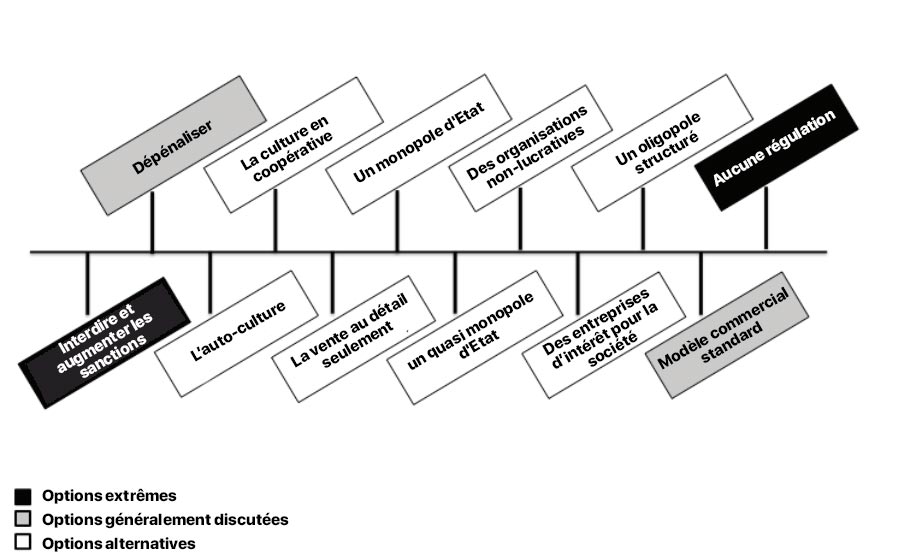
Alternatives to cannabis prohibition
1. Decriminalization
Hard-line prohibition has had certain perverse effects, for example in the United States, where it led to the disproportionate discrimination of certain ethnic communities for a simple conviction of cannabis possession. The decriminalization of cannabis is thus a moderate solution that maintains the plant's illegal status while eliminating repression of consumers. It generally translates into tolerance for the consumption and possession of small quantities of cannabis, but a certain rigor for its trade. In this way, police efforts are focused on combating trafficking rather than on consumers.
This solution has the advantage of reducing the costs associated with outright prohibition, such as financial, administrative, judicial and penitentiary costs, by significantly reducing arrests for minor cannabis-related offences. On the other hand, in the absence of a legal cannabis business and taxation, the government derives no financial benefit, which reverts entirely to the black market. For the time being, this is the choice made by a large number of countries.
2. Self-cultivation
This model is not very fashionable in its own right, as it brings no benefits to the state other than eliminating certain police expenses linked to the fight against cannabis. Self-cultivation is a model in which the consumer takes sole responsibility for his or her consumption, and for the quality and quantity of the product. The state generally imposes cultivation limits, but must provide police resources to ensure that they are respected. This is reputed to be an effective solution against the black market, but in reality, the immediate availability of cannabis on the black market is often more attractive than going through the long process of growing your own plants. This has little impact on the black market. On the contrary, this model is likely to fuel it. Self-growing is authorized or tolerated in a number of American states, such as Alaska and Washington DC, and is used as a complement to more traditional, state-regulated legalization. To date, Vermont is the only state to have legalized the cultivation and donation of cannabis.
3. Cooperative farming
The model of cultivation by citizen cooperatives resembles self-cultivation, but guarantees a more transparent framework: the organizations must guarantee a certain traceability of the product and their activities to the state and to their members. The organizations operate on the basis of internal rules that guarantee a certain ethic, and are not-for-profit associations. This is the Cannabis Social Clubs popular in Spain and the UK (although illegal in the latter). Consumers appreciate this responsible, community-based model, whose aim is not to accumulate profits. For the state, on the other hand, it's not very lucrative, although it can levy a tax.
However, these organizations suffer from a recurring problem of overproduction and are not allowed to sell the surplus. On the other hand, compared with simple self-cultivation, this method has the potential to significantly reduce the black market and confine production to artisanal techniques, while protecting against the possible misfortunes of a liberalized market prone to fluctuations. In terms of publicity and ’incentive«, Clubs are safe solutions, since exchange is restricted to members. In this way, they can control and prevent access to the product by minors.
4. Retail only
This model corresponds to the famous Dutch model, in which possession and consumption of cannabis are authorized, but the product can only be sold in specially designated stores that must meet certain criteria and comply with certain rules, such as quantity limits and a ban on advertising. The advantage of this model is that it eliminates the costs of prohibition, but it also presents certain inconsistencies: no quality control is carried out, and the merchandise comes from the black market and becomes legal once through the coffeeshop's magic door. This model therefore feeds illegal trafficking and brings no benefit to the state, which does not tax the industry, spends resources on inspecting regulations and, in the case of Holland, is faced with mass cannabis tourism.
5. A state monopoly
A state monopoly gives the state absolute control over the cannabis supply chain. It ensures that no segment of production feeds the black market, thus minimizing detour. It's also a reversible model suited to trial periods, as it's easy to switch to a private distribution model afterwards, the reverse being almost impossible. This is the model chosen by the province of Quebec in Canada. In the United States, this model is impossible as long as cannabis is banned at federal level.
The government does not have to constantly monitor private companies trying to circumvent the constraints of regulation. This model guarantees the absence of advertising and innovation that encourage consumption, even if advertising can also provide information to help consumers find the right product for them. In terms of customer service, we also have our reservations. This model is immune to market fluctuations and guarantees fixed prices. On the other hand, prices need to be competitive and production sufficiently diversified to meet customer needs and drive out the black market.
6. a quasi-state monopoly
The quasi-monopoly model is equivalent to a monopoly and brings the same benefits, but the state acts through a public authority, an agency, which would be the sole producer and supplier of cannabis. This agency would set prices, hire staff for sales and production, and so on. This solution spares the state the task of writing regulations and tax laws, issuing licenses, hiring tax collectors and regulators, while guaranteeing a degree of control. The question is: how dependent can this authority be on the state?
7. Non-profit organizations
Another solution might be to grant licenses only to non-profit organizations that operate in the public interest and not to maximize profit. The limit could possibly only apply to public health organizations that donate the profits from their business to patient treatment, prevention and education. This solution is no more costly than conventional ones, since it simply involves imposing a criterion on the type of organization eligible for a license.
This solution is generally used as a complement to another form of legalization. The problem is financing. Non-profit organizations operate on a donation or credit model, and have nothing to offer investors. In the United States, this is not a likely model, as banks refuse to extend credit to cannabis-related organizations.
8. Organizations of interest to society
An intermediate solution is to choose hybrid companies whose ambition is both to make a profit and to serve the common good. Certain types of company, in fact, include social objectives in their agenda and therefore have a special status. Unlike not-for-profit organizations, they can finance themselves through investments. This solution also seems more attractive than the conventional corporate option, which doesn't care about the influence of its advertising and politics as long as it makes the numbers.
9. A structured oligopoly
A model based solely on business and profit, on the other hand, must be subject to robust regulation to ensure that these companies do not act in contradiction with the public interest by serving their own self-interest. Regulators must have sufficient power to ensure that public health restrictions are respected.
One solution may be to restrict and judiciously select the number of businesses licensed to trade in cannabis. In this way, the state can apply whatever criteria it likes and receive an annual fee for these licenses. The rarer and more coveted they are, the higher these fees can be. It is therefore in the state's interest not to grant licenses indiscriminately. The action of regulatory inspectors is facilitated by the limited number of players involved. However, in this kind of model, the privileged companies are often the big shots who have the means to negotiate a license and benefit from preferential treatment due to their influence. Some American states have tried to favor small producers and minorities, but the pressure from the big groups is considerable.
10. Standard business model
Finally, the default solution in the absence of political reflection on possible alternatives is often to leave the production, distribution and trade of cannabis in the hands of private players competing in an open market. There are, of course, regulations and laws governing the market and even the product. Entrepreneurs will have to comply with standards of quality, packaging and structure, but the ultimate aim of the market is to maximize profit, and that means creating needs. In terms of public health and even morality, this approach can pose a number of problems, given that cannabis is not a product like any other and can lead to addiction.
Another shortcoming of this solution is that it is often accompanied by a monopoly situation. The big groups dominate the market, and their profits run into millions or even billions of dollars. Small local producers are crushed by competition as the industry globalizes. Whereas the cannabis market represented a new opportunity for a large number of small entrepreneurs, this model favors the enrichment of traditional industry barons who already have the funds needed for large-scale operations.
11. No regulation
The other extreme is to simply abolish prohibition without devising any regulations. In 2012, this solution was considered in Michigan, but failed to win the necessary number of signatures. Such a solution can quickly prove chaotic. It even authorizes consumption by minors by default. It brings no benefit to the state, and simply means unregulated anarchic trade and no consideration for public health.
A political calculation
Cannabis legalization is often the result of a cost-benefit analysis. There are, of course, costs associated with legalization: financial and administrative costs, in enforcing regulations for example, but also social and health costs, the problems of cannabis addiction are very real and should not be taken lightly. But the benefits are just as important: savings in means and money related to stopping the persecution of cannabis users, tax money, more social justice related to racial discrimination in the United States, etc.
So far, cannabis legalization has not made cannabis a commodity like any other. Depending on a state's political objectives and priorities, one form of legalization may be more appropriate than another. A report from the RAND Corporation, from which the above alternatives are taken, sheds some light on the subject, listing the sometimes conflicting objectives associated with legalization:
- Minimize public health, educational and social problems, especially those associated with cannabis use among adolescents
- Maximizing government revenues
- Minimize administrative costs
- Minimizing the black market
- Maximize the private freedom of adults, the convenience of consumers and the benefits of cannabis for non-addictive users, including the sick.












JIHE 2026: Japan’s Largest Trade Show Dedicated to Hemp and CBD Returns to Tokyo with More Than 100 Industry Players
New Caledonia: The Courts Clear the Way for the Return of CBD

The Brazilian medical cannabis market continues to grow

Morocco: Three Cannabis-Based Medications Approved for the Treatment of Epilepsy

Canopy Growth Receives New EU-GMP Certification to Strengthen Its Presence in Europe

Three years after legalizing medical cannabis, Albania continues to establish regulations for it

The first plant-based medical THC spray arrives in the United Kingdom

Medical Cannabis in Germany: THC Prices Vary by a Factor of 12

France already has 3,000 cannabis retail outlets. None of them are legal.

Morocco's exports of legal cannabis have expanded to 15 countries
-
 Business2 weeks ago
The legal cannabis market in New York exceeds 4 billion $ in revenue
-

 Cannabis in France4 weeks ago
Which countries legalized medical cannabis before France?
-
Business4 weeks ago
South Korea is preparing to begin local production of medical cannabis to meet rising demand
-
Cannabis in France4 days ago
France already has 3,000 cannabis retail outlets. None of them are legal.
-
Cannabis in Thailand4 weeks ago
From the boom in dispensaries to a purely medical approach: Thailand is revising its cannabis policy
-
Cannabis in the U.S.5 days ago
A DEA report confirms that there are no fatal cannabis overdoses
-
Cannabis and driving3 weeks ago
Medical Cannabis and Driving: New South Wales Ends Automatic Penalties for THC
-
Cannabis in France3 weeks ago
France’s Drug Policy Chief Defends Cannabis Prohibition... and Runs Into the Facts

















You must be logged in to post a comment Login