War on drugs undermines climate and environmental justice efforts, says new report from international coalition

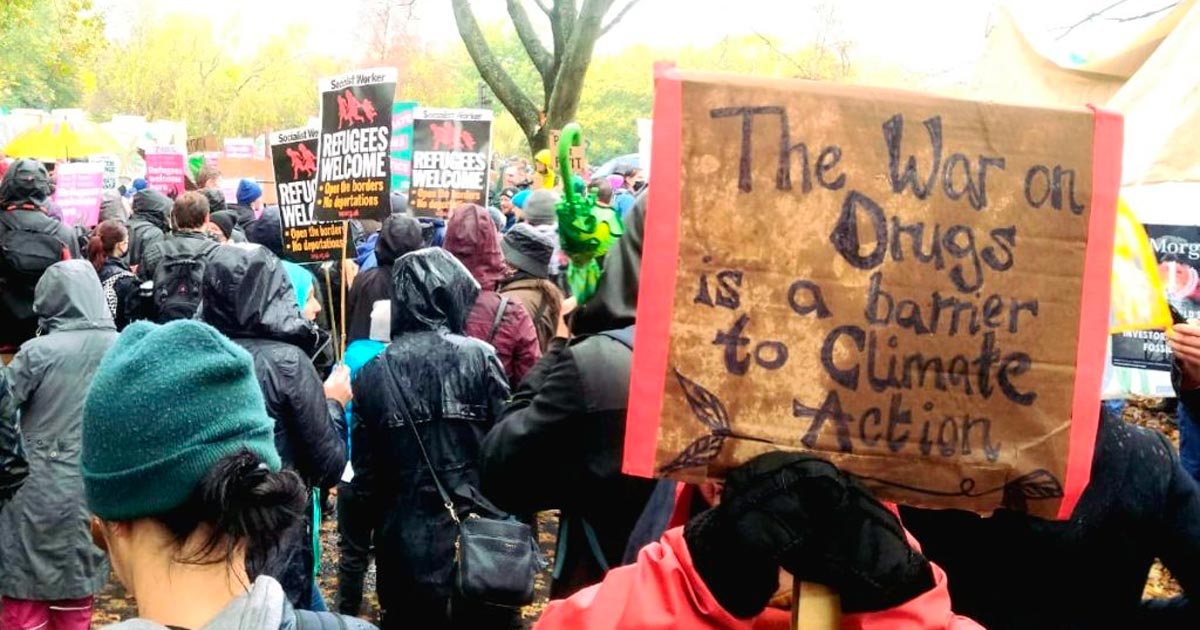
A new report from an international coalition of human rights groups claims that the worldwide drug prohibition has fuelled environmental destruction in some of the planet's most critical ecosystems, undermining efforts to tackle the climate crisis.
As policymakers, governments, NGOs and activists strive to develop urgent responses to protect tropical forests, which are among the planet's largest carbon sinks, the report states that «their efforts will fail as long as those dedicated to protecting the environment fail to recognize and tackle the elephant in the room», namely «the global system of criminal drug prohibition, known as the ‘war on drugs'».
The 63-page document was published on Thursday by the International Coalition for Drug Policy Reform and Environmental Justice, which describes itself as «made up of advocates, activists, artists and academics from both the drug policy reform movement and the environment and climate movement».
Affiliated organizations include Health Poverty Action, LEAP Europe, SOS Amazônia, the Transnational Institute (TNI) and the Washington Office on Latin America (WOLA). Members come from Bolivia, Brazil, Colombia, Myanmar, the Netherlands and the UK.
The authors describe drug policy as the «missing link» in climate justice, noting that prohibition has pushed drug production and trafficking to «key environmental frontiers» such as the Amazon rainforest and the jungles of Southeast Asia.
«Wherever smallholders grow drugs at the edge of forests, or traffickers transport their products through tropical forests, it's because the dynamics of drug law enforcement have driven them to do so,» says the report. «In fact, in the rare cases where opium, cannabis and coca are grown legally to supply the pharmaceutical and beverage industries, their cultivation takes place in conventional agricultural contexts.»
Profits from illegal drug activities also fuel a network of other criminal activities that cause environmental damage, write the report's authors. By way of example, the report cites illegal trade in «wildlife, tropical timber, archaeological artifacts, gold and other minerals, as well as investments in legal agribusinesses such as beef, palm oil, soybeans and avocados». Drug profits are also a source of capital for human trafficking.
The document includes case studies and photos showing how environmental damage stems from prohibitionist policies. One example links drug trafficking in Peru to illegal gold mining, while another links illicit money from the cocaine trade to the destruction of West Africa's critically endangered Upper Guinea forest.
The international community is increasingly recognizing the work of criminal actors who finance «land grabbing, deforestation, timber and wildlife trafficking, and socially and environmentally devastating mining», says the report, as well as government corruption. «Yet these analyses fail to identify the driving force behind these criminal activities.
«Rarely, if ever, is the system that underpins so many of these crimes and causes so much damage mentioned,» the report continues, asserting that 'it must be clearly recognized that current drug policies are one of the main drivers of this economic and institutional dysfunction.».
From the point of view of environmental and economic justice, the report states that the drug war perpetuates a cycle of poverty and persecution of society's most vulnerable.
«The drug trade can provide a decent income or a means of survival where there is no other,» says the report, which states that an estimated 200,000 families in Colombia make their living from coca cultivation.
«Even when these farmers are persecuted by the police or army, the pragmatic livelihood benefits of growing illegal drugs often compel them to return to the business despite the high risks.»
While small disadvantaged growers risk the eradication of their crops, In the face of arrest and incarceration, «those at the top of the business remain largely unscathed because their power, money or violence enable them to escape prosecution and influence the elites in policy-making».
To combat the harms of prohibition and ensure the effectiveness of climate initiatives, the report asserts that 'effective and responsible drug regulation is necessary». But it warns that reforms must be holistic and based on human rights, public health, sustainable development and environmental justice.
«The alternative,» the report warns: «Drug reforms co-opted by big business and powerful elites that replicate the evils of prohibition, while climate initiatives fail, missing the opportunity to avert climate catastrophe because they ignored one of its underlying causes.»
The report acknowledges that regulated drug markets raise difficult questions. Either we regulate the markets drug responsibly, or we continue to suffer the manifest failures of prohibition and cede control to destructive organized crime groups,» the report states. «There is no third option that would magically make them disappear or make the ‘war on drugs’ victorious.».
A recent report from Harm Reduction International revealed that rich countries have donated nearly a billion dollars to continue the global war on drugs.




















Medical Cannabis in Germany: THC Prices Vary by a Factor of 12

France already has 3,000 cannabis retail outlets. None of them are legal.

Morocco's exports of legal cannabis have expanded to 15 countries

Aurora Cannabis Doubles Its Production Capacity in Germany

Tilray is accelerating its operations in Europe thanks to a license in Portugal

Boston will host the 10th annual State of the Cannabis Industry Conference on October 26

A DEA report confirms that there are no fatal cannabis overdoses

A British patient is challenging the NHS's refusal to reimburse medical cannabis

October 2026 CBD Highlights: 10 Strains and Hash to Discover from 5 French Producers

CBD in France: Traceability, Retail Stores, THC and Driving… What the New Bill Proposes
-
 Business2 weeks ago
The legal cannabis market in New York exceeds 4 billion $ in revenue
-

 Cannabis in France3 weeks ago
Which countries legalized medical cannabis before France?
-
Business3 weeks ago
South Korea is preparing to begin local production of medical cannabis to meet rising demand
-
Cannabis in Thailand3 weeks ago
From the boom in dispensaries to a purely medical approach: Thailand is revising its cannabis policy
-
Cannabis and driving3 weeks ago
Medical Cannabis and Driving: New South Wales Ends Automatic Penalties for THC
-
Cannabis in Argentina4 weeks ago
Argentina Opens Its Market to Hemp Flowers Containing 1% of THC
-
Autism3 weeks ago
Autism and Cannabis: Results from the First Placebo-Controlled Trial of NTI164
-
Cannabis in France2 weeks ago
France’s Drug Policy Chief Defends Cannabis Prohibition... and Runs Into the Facts

















You must be logged in to post a comment Login