War on drugs: Latin America changes course

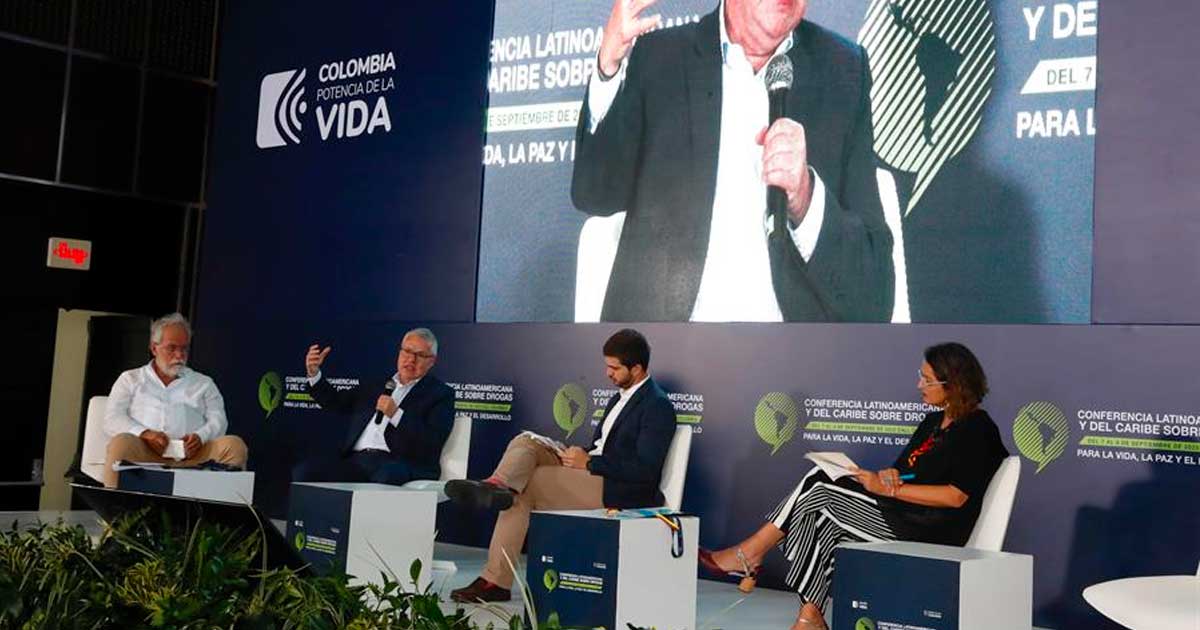
Last Friday, the Latin American and Caribbean Conference on Drugs reached a common agreement that the war on drugs is a failure and needs to be rethought, although there is no consensus on a new model for regulating drugs such as cocaine.
At the meeting held in the Colombian city of Cali, experts and government representatives - mainly from Colombia and Mexico - proposed a roadmap for a new approach to the global drug problem that would put aside, among other things, the persecution of peasant farmers.
«International leadership corresponds to our country, and I believe it is exercised responsibly,» assured Colombia's Minister of Justice, Néstor Osuna, at the first panel of the day.
And as part of this leadership, he added, Colombian President Gustavo Petro has pointed out to the international community, at various summits and countries, that prohibition was the wrong policy.
New drug policy
At the close of the conference, the Colombian president himself presented the new drug policy, an initiative that aims to stop attacking peasants who grow coca leaf and to focus on action against drug trafficking networks.
This «change of narrative» is an important step, according to organizations that work with peasants and have extensive knowledge of drugs, but experts such as María Alejandra Vélez, director of the Center for Security and Drug Studies (Cesed) at Bogotá's University of the Andes, consider Colombia to be «timid» when it comes to its «international leadership».
«I welcome the anti-drug policy, but I ask that we not be timid, at least in proposing what this regulated cocaine model could be, because if we remain in defense of the peasant producer without proposing alternatives on the other side, with a market of 21 million cocaine consumers, what is fixed on one side will explode on the other,» stressed the expert.
The Minister of Justice replied that he hoped «we would move towards a world without an illegal drug economy, with responsible and reasonable regulation of cocaine, heroin, opioids and cannabis», but stressed that it was currently difficult to achieve this with international laws.
That's why Colombia cannot act outside this international framework, But it will argue in international arenas «that we need a regulated market with reasonable use of cocaine, heroin, opioids, all these substances, and that prohibition and repression have not worked».
And the progress of alcohol, whose consumption was persecuted a century ago, could serve as a guideline, as could that of tobacco, whose consumption has fallen, not by «putting smokers in prison», but thanks to prevention and public health campaigns.
Putting an end to repression
The conference also addressed ways of putting an end to repression.
«It's a fantasy that doesn't correspond to reality to think that the big drug barons are in prison, it's not true, the prisons are full of poor people,» said the minister.
«Punitive approaches have limited results in all areas, and thinking that criminal law or a punitive approach or prison can deliver results beyond the limits of criminal sanction is a common mistake in our contemporary societies, fueled by the punitive phenomenon,» he added.
But «there is no room» for abandoning the punitive approach, and the Colombian government believes that prosecution efforts should focus on those most responsible for drug trafficking, not on the peasants. Part of the solution to the dependency of small farmers and regions is to bring in public goods and services and create legal economic alternatives. Destruction operations will thus focus on large-scale crops, or on those of small farmers who don't play the game and increase their production.
«What we're going to do is prioritize the punitive approach in the fight against cocaine, not against the coca leaf, not against the poor peasant who had no choice but to grow the coca leaf,» said Osuna.
To reach the major players in the drug trade, the text calls for the destruction of laboratories, an increase in seizures, control of the chemicals used to produce the drugs, the fight against money laundering and corruption, and the reinforcement of various police forces.
The plan is due to run until 2033.





















The Brazilian medical cannabis market continues to grow

Morocco: Three Cannabis-Based Medications Approved for the Treatment of Epilepsy

Canopy Growth Receives New EU-GMP Certification to Strengthen Its Presence in Europe

Three years after legalizing medical cannabis, Albania continues to establish regulations for it

The first plant-based medical THC spray arrives in the United Kingdom

Medical Cannabis in Germany: THC Prices Vary by a Factor of 12

France already has 3,000 cannabis retail outlets. None of them are legal.

Morocco's exports of legal cannabis have expanded to 15 countries

Aurora Cannabis Doubles Its Production Capacity in Germany

Tilray is accelerating its operations in Europe thanks to a license in Portugal
-
 Business2 weeks ago
The legal cannabis market in New York exceeds 4 billion $ in revenue
-

 Cannabis in France4 weeks ago
Which countries legalized medical cannabis before France?
-
Business4 weeks ago
South Korea is preparing to begin local production of medical cannabis to meet rising demand
-
Cannabis in France4 days ago
France already has 3,000 cannabis retail outlets. None of them are legal.
-
Cannabis in Thailand4 weeks ago
From the boom in dispensaries to a purely medical approach: Thailand is revising its cannabis policy
-
Cannabis in the U.S.5 days ago
A DEA report confirms that there are no fatal cannabis overdoses
-
Cannabis and driving3 weeks ago
Medical Cannabis and Driving: New South Wales Ends Automatic Penalties for THC
-
Cannabis in France3 weeks ago
France’s Drug Policy Chief Defends Cannabis Prohibition... and Runs Into the Facts

















You must be logged in to post a comment Login