Colombia's terroirs produce unique therapeutic cannabis profiles


Recent research into the cultivation of cannabis in Colombia has revealed the diversity of chemical composition of the plant, in particular the presence of unusual terpenes that could offer unique therapeutic benefits.
Published in Phytochemical Analysis, the study explores the «significant phytochemical diversity» of cannabis grown in different parts of the country, with the backdrop of Colombia's potential to become a leader in the global cannabis market.
The rich influence of Colombia's environment on cannabis growth
The diversity observed in Colombian cannabis plants is largely attributed to the wide range of environmental zones in the country, which includes tropical beaches, snow-capped volcanoes, deserts, grasslands and rainforests.
These varied environments offer ideal growing conditions for cannabis and produce plants with distinct chemical properties. As the authors of the study point out, «the large quantity of terpenes that are usually uncommon suggests that Colombian environments may have unique capabilities that allow the plant to express these compounds».
This diversity of environmental conditions also affects other Colombian agricultural products, such as coffee. Just as the Colombian environment enables coffee plants to develop unique aromas, it has a similar influence on the Cannabis sativa, leading to a rich phenotypic diversity and a variety of chemical compositions.
The research team collected 156 cannabis samples from 17 cultivation sites across seven provinces. They found that differences in cannabinoid and terpene profiles were partly due to the different environmental conditions in which the plants were grown.
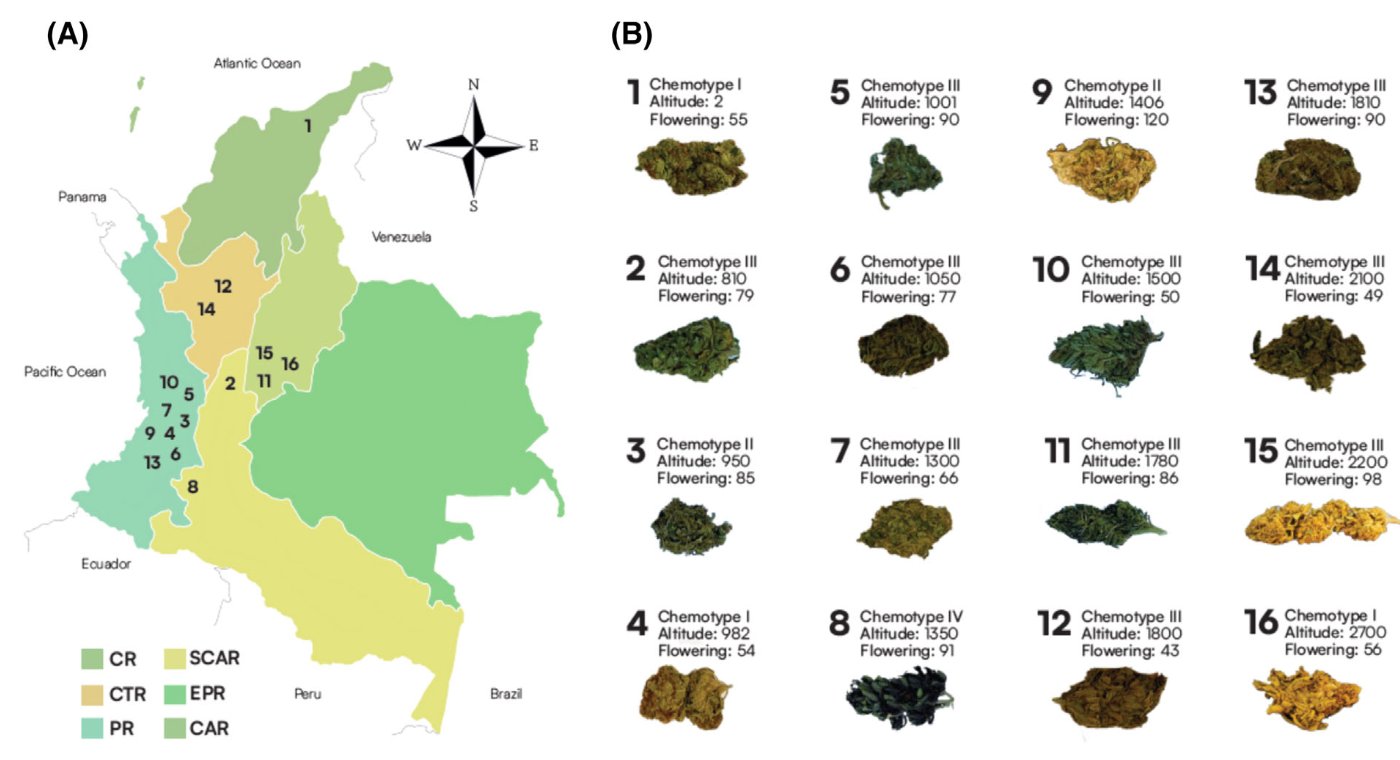
Different cannabis strain profiles in Colombia
Cannabinoid profiles differ from region to region
The research identified four cannabinoid chemotypes distinct in Colombian cannabis samples: the varieties THC-dominant (type I), CBD-dominant (type III), CBG-dominant (type IV) and varieties«balanced» (type II).
These chemotypes were not found exclusively in one region, although regional trends were observed. For example, cannabis grown in the Centre-Sud and Amazon regions showed the rate THC-A visit higher, region, while the Café Triangle produced the plants with the concentrations of CBD-A highest.
The Pacific and Caribbean regions had consistently high levels of CBD-A and THC-A.
The researchers also found that cannabis from the Centre-Sud and Amazon regions had higher levels of CBDV, of THCV and CBGA significantly higher than in other regions.
The importance of uncommon terpenes
The presence of unusual terpenes in Colombian cannabis is one of the most interesting findings of the study. Terpenes, which are responsible for the plant's aroma and flavour, also play an important role in the development of the plant's flavour. important role in its therapeutic effects.
The research team identified 23 different terpenes, the β-myrcene appearing most abundant in balanced, CBD-dominant varieties, while nerolidol 2 predominated in THC- and CBG-dominant samples.
As the study points out, «Colombian varieties can have unique terpene profiles».» that could offer not only resistance to parasites and pathogens, but also distinct medicinal properties, They can be used to treat conditions such as pain, inflammation, anxiety and many others.
Terpenes such as linalool, cis-nerolidol and trans-nerolidol, which have been found in large quantities in Colombian cannabis, are generally considered as minor terpenes in North American cannabis. However, their presence in such significant quantities in Colombian plants amplifies the country's potential to produce unique and therapeutically valuable cannabis strains.
The role of genetics and environment
Researchers attribute the chemical diversity Colombian cannabis not only to its genetics, but also to environmental conditions in which it is grown.
They note that «wide spectrum of colors, shapes and aromas».» of the cannabis samples reflects both their genetic origins and their adaptive responses to environmental factors such as altitude, humidity, precipitation, soil characteristics and exposure to sunlight.
This phenotypic plasticity allows cannabis plants to thrive in a wide range of conditions, further enhancing their potential for’medicinal applications.
In particular, most of the samples in the study were grown in greenhouses (71,8 %) or outdoors (28.2 %), and none were grown indoors.
This suggests that Colombia's natural environment is conducive to the production of high-quality cannabis without the need for controlled indoor conditions. In addition, almost half of the samples were local varieties, while others were hybrids between local and imported strains.
What impact for Colombia?
The results of this study have significant implications for both the food and beverage industries. medical marijuana and for the global cannabis market in general.
The «metabolic diversity» observed in Colombian cannabis suggests that the country could contribute to the overall chemical diversification of the plant, leading to the development of new medical products.
As the researchers conclude, «Colombian Cannabis sativa could contribute to the global chemical diversification of medical cannabis, facilitating new applications in medicinal chemistry».
The study also underlines the importance of further research, in particular the whole genome sequencing Colombian cannabis plants, to better understand the plant's genetics and how it interacts with environmental factors.
This research could lead to the development of new cannabis cultivars with specific therapeutic properties, adapted to the needs of medical patients worldwide.






















CBD in France: Traceability, Retail Stores, THC and Driving… What the New Bill Proposes

Organigram Enters the Race for Aurora Cannabis

Medical Cannabis: Augur Associates’ latest report provides an update ahead of the publication of the decrees

Golden Buds is relaunching its Nova High vape pens with a cannabinoid formula that’s out of the ordinary

Cannabis is now Canada's fifth-largest commercial crop

Bedrocan Finally Declared Bankrupt

After CBD, Can Wellness Exist Without Cannabinoids?

Uganda Launches a Cooperative Dedicated to Medical Cannabis

Ukraine: First Cancer Patient Prescribed Medical Cannabis

Cannabis Oil and Endometriosis: A Promising Study for Pain Relief
-
 Business1 week ago
The legal cannabis market in New York exceeds 4 billion $ in revenue
-

 Cannabis in France3 weeks ago
Which countries legalized medical cannabis before France?
-
Business3 weeks ago
South Korea is preparing to begin local production of medical cannabis to meet rising demand
-
Cannabis in the Netherlands4 weeks ago
One year after the launch of the Dutch cannabis experiment, the first trends are emerging
-
Cannabis in Thailand3 weeks ago
From the boom in dispensaries to a purely medical approach: Thailand is revising its cannabis policy
-
Cannabis and driving3 weeks ago
Medical Cannabis and Driving: New South Wales Ends Automatic Penalties for THC
-
Cannabis in Argentina4 weeks ago
Argentina Opens Its Market to Hemp Flowers Containing 1% of THC
-
Autism3 weeks ago
Autism and Cannabis: Results from the First Placebo-Controlled Trial of NTI164

















You must be logged in to post a comment Login