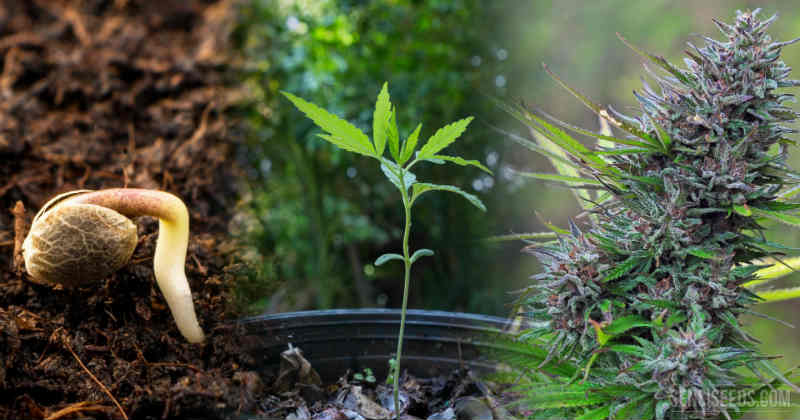
The different stages in the growth of a cannabis plant
It's purely out of botanical curiosity that we're going to describe today the different stages in the life cycle of the cannabis plant. Each stage requires different levels of light, nutrients and water. There are four main stages:
Germination
Germination, as the name suggests, refers to the moment when the cannabis seed germinates and sheds its shell. A good seed recognizes itself color and texture. It should be hard and dry, and light to dark brown in color. A green or white seed will not germinate. Placed in optimal conditions - humidity, darkness and warmth - the seed opens and germinates.
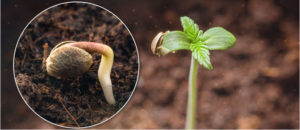
Once the seed has been opened and germination begun, the budding plant can be placed in soil. The root sinks into the soil, while the stem grows upwards. Two small leaves emerge from the stem; these are responsible for capturing the sunlight the plant needs to grow. This stage lasts from 5 to 10 days and requires 18 hours of light a day.
At a certain point, the first leaf characteristic of cannabis will emerge, in which case the plant is now considered a seedling.
Seedlings
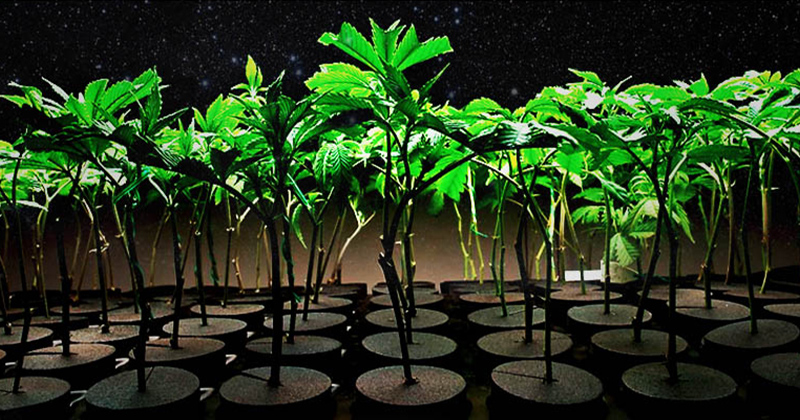
Young plants have leaves that resemble the shape of the emblematic cannabis leaves but are not yet striated like these. At first, they will have a single stripe, then develop more and more. A mature plant will have between 5 and 7 striae per leaf. Some may have more.
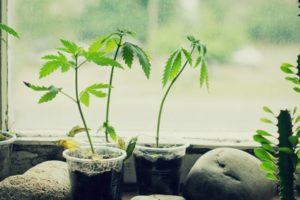
Seedlings are generally very green and their roots are small, so care must be taken not to over-water them or they will drown. It is at this stage that the plant is most vulnerable to disease and mildew. This stage lasts 2 to 3 weeks and also requires 18 hours of light a day.
Once the plant has developed the right number of striae on its new leaves, this is the sign that the plant has entered the vegetative state.
The vegetative state
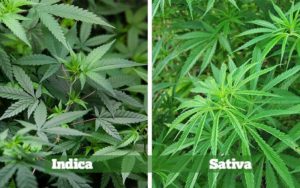
The vegetative state is that of strongest growth. Seedlings have moved from small pots to large ones, and roots and foliage are developing rapidly. Node spacing (the point at which secondary stems separate from the main stem) indicates the type of cannabis grown: for indica, For sativas, the nodes are wider apart and the foliage sparser.
It is at this stage that the plant can be manipulated. to increase yield, This is what we call the training. These techniques, used in the legal cannabis industry, involve holding the plant in certain positions to make it take a certain shape, or pruning certain parts so that the plant's energy is concentrated on the more profitable parts. Some use nets to separate the various stems, allowing them to develop more fully. Strategic leaf thinning can also maximize flower production.
A technique commonly used in cultivation indoor is called the topping. Cannabis grows naturally in the shape of a fir tree, as this shape is optimal for capturing sunlight. Generally speaking, flowers are concentrated towards the top of the main stem, which is where the most sunlight falls. Flowers on other stems are less important. The topping involves cutting off the top of the main stem to force the plant to develop new stems. Generally speaking growers indoor seek to develop low plants with several stems of the same size, since artificial light is emitted from above and doesn't change location.
This stage lasts from 3 to 16 weeks and requires 18 hours of sunlight a day, as well as plenty of water and nutrients as the plant grows.
Flowering
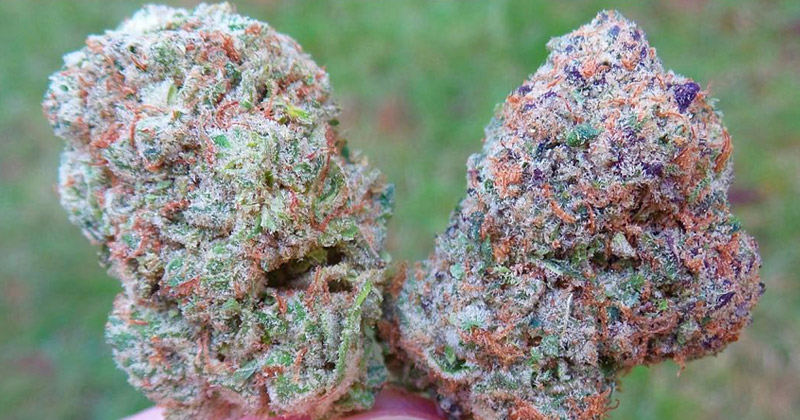
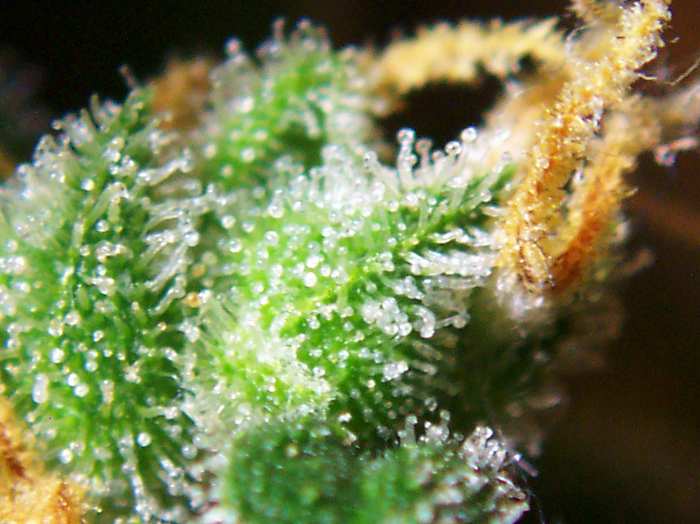
Flowering is the last stage in the plant's life cycle. It lasts from 8 to 11 weeks and occurs naturally as the days shorten and the plant receives only around 12 hours of light a day. In cultivation indoor, This reduction in light time is artificially reproduced. At this stage, the resinous flowers appear. They are then dried for consumption.
Flowering allows distinguish between male and female plants. They need to be separated to avoid pollination of female plants by male plants, since once pollinated, female plants concentrate on producing seeds.
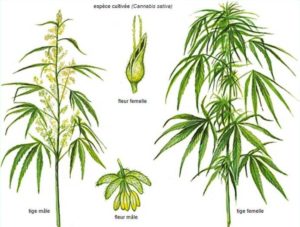
Once the first few weeks of flowering are over, pruning should be avoided to avoid stressing and disturbing the plant's hormones. Stakes may also be necessary to help the plant support the weight of the flowers. Once the flowers have reached maturity, it's time to harvest.





Medical Cannabis in Germany: THC Prices Vary by a Factor of 12

France already has 3,000 cannabis retail outlets. None of them are legal.

Morocco's exports of legal cannabis have expanded to 15 countries

Aurora Cannabis Doubles Its Production Capacity in Germany

Tilray is accelerating its operations in Europe thanks to a license in Portugal

Boston will host the 10th annual State of the Cannabis Industry Conference on October 26

A DEA report confirms that there are no fatal cannabis overdoses

A British patient is challenging the NHS's refusal to reimburse medical cannabis

October 2026 CBD Highlights: 10 Strains and Hash to Discover from 5 French Producers

