In Switzerland, the sale of cannabis in pharmacies is changing patterns of use without increasing the frequency of consumption


The Regulated sale of cannabis in pharmacies Can it change consumer habits without leading to an increase in consumption?
Preliminary results of the Swiss study SCRIPT, conducted in Bern, Biel, and Lucerne, provide some initial insights: after six months, legal access to the products has had virtually no effect on the frequency of use but appears to have encouraged a shift toward smoke-free consumption methods.
The experiment, conducted by the’University of Bern with the support of the’University of Lucerne, is based on a particularly interesting design: 1,177 participants were randomly assigned to either a group that could immediately purchase cannabis in pharmacies and a control group that must wait six months before gaining access to it.
The results presented are, however, preliminary. The report Published in early September, it has not yet undergone peer review, and the study is scheduled to continue through 2029.
A Swiss study designed as a randomized trial
SCRIPT, for "Safer Cannabis Research in Pharmacies" Trial, is part of the Swiss pilot testing program made possible by the amendment to the Narcotics Act. Its goal is to study the health and social consequences of regulated access to non-medical cannabis.
The model being tested is intentionally restrictive. The products are sold on a not-for-profit basis in nine pharmacies (five in Bern, one in Biel, and three in Lucerne), and their content of THC may not exceed 20%. Purchases are also limited to 2 grams of THC per transaction and 10 grams per month. Packaging must be plain, and advertising is prohibited.
The program is therefore not intended to replicate a traditional commercial market. Pharmacies also play an advisory role regarding risk reduction, particularly regarding smoking habits and smoking cessation.
The study population consists of people who are already regular users. The average age is 34, and 78% of the participants are men. At the start of the study, 52% reported using the substance daily, and nearly 48% reported using it weekly.
No apparent increase in the frequency of consumption
That was one of the central questions of the experiment: facilitate access to legal products Does having access to these products lead to more frequent consumption?
At the end of the first six months, SCRIPT does not highlight this phenomenon.
The frequency of use changed slightly in both groups, but the researchers describe the differences between them as negligible. In other words, access to pharmacies had no noticeable effect on how often participants used cannabis.
This finding is important, but it must be interpreted within the limits of the study. The participants were already regular users before taking part in the study. Therefore, SCRIPT does not allow us to determine whether a comparable model applied to the general population would affect the number of new users.
The change is most evident in consumption patterns
It is on the consumption patterns that the differences become much more noticeable.
At the start of the experiment, 78 % participants in the group with immediate access to dispensaries reported smoking cannabis exclusively. Six months later, that proportion had fallen to 58%.
At the same time, smokeless forms, particularly the vaporization and products taken orally, as well as «dual-use» products—which combine smoked and unsmoked items—have grown in popularity.
The control group showed much less change over the same period. To the researchers, this difference suggests that regulated access to pharmacies contributed to the observed change.
However, this does not mean that the participants have stopped using drugs. The proportion of people who had stopped was comparable in both groups. The observed effect therefore relates more to the way we consume rather than consumption itself.
This development is of particular interest to researchers because smoke inhalation is one of the health risks targeted by SCRIPT. Specifically, the experiment combines access to various products with guidance that directs participants toward potentially less risky behaviors.
Flowers still make up the vast majority
However, this diversification has not displaced traditional products. After six months, 87% of the participants with access to pharmacies reported having used the cannabis flowers provided by the study. A total of 61% had tried the e-liquids with THC (which are actually a mixture of PG/VG, 20% of THC, and 10% of CBD—not a vape pen), 55% of the resins and 24% the dyes.
In terms of sales volume, flowers account for approximately 65% of products sold, compared to 21% for e-liquids, 11% for resins, and only 3% for tinctures.
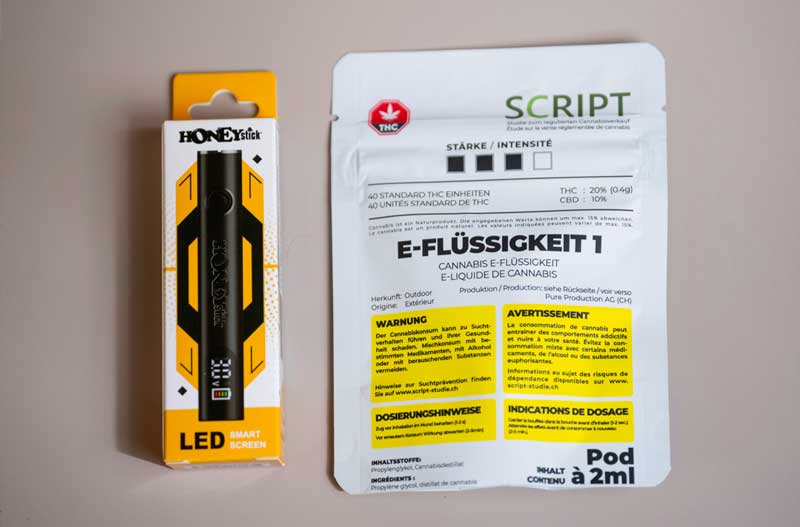
The THC e-liquid featured in the SCRIPT study
Furthermore, access to the regulated market has not completely replaced the black market. After six months, members of the authorized group were still obtaining 40 % of their smoked products through this method, compared to 51 % through the study.
This result is all the more interesting given that SCRIPT follows a relatively strict pricing policy. Prices mirror those observed on the illicit market, plus a simulated tax intended, in particular, to fund the consulting services offered in pharmacies.
The pharmacy was generally well-received
Another lesson from SCRIPT concerns acceptance of the distribution model. After six months, 87% Some participants in the control group found the in-store shopping experience at the pharmacy to be pleasant. 71% said they were satisfied with the advice they received and 79% believed they enjoyed a sufficient level of anonymity and confidentiality.
The qualitative interviews conducted in parallel highlight several recurring reasons: consistent product quality, knowledge of the products’ ingredients, a secure shopping environment, and the ability to avoid the illicit market.
Pharmacy staff also view the experience very positively. The employees surveyed described the participants as patient, open-minded, and well-informed. Some also explained that these interactions had helped change their own perceptions of consumers.
The role of the pharmacy thus extends beyond that of a mere distribution point: participants can receive information there about products, consumption habits, tobacco and nicotine, and other health-related topics.
The illicit market also raises the issue of THC information
Finally, one of the most striking findings in the report is found in the analysis of samples from the illicit market.
The researchers compared the THC concentration the concentration estimated by the participants compared with the concentration actually measured in the laboratory. Of the 69 samples analyzed, only one had a reported estimate that matched the measured concentration.
This discrepancy highlights a fundamental difference between a regulated market and a black market: the ability to know with greater precision the composition and potency of the product being purchased.
Results that should not be extrapolated to the entire Swiss population
The authors themselves emphasize the limitations of their work.
SCRIPT includes only adults who already use cannabis regularly. The study therefore cannot directly measure the effect of regulation on initiation among young people or among people who do not currently use the substance. Nor was it designed to determine whether a pharmacy-based system could, on a large scale, eliminate or significantly reduce the illicit market.
Above all, the data presented in September 2026 is still preliminaries and have not undergone the standard peer-review process.
Nevertheless, they provide an initial snapshot of a model of cannabis regulation very controlled: In this population of regular users, six months of access through pharmacies was not associated with an increase in usage frequency, while a shift toward smoke-free forms was observed.
The Swiss experience therefore does not yet provide a definitive answer to all the questions surrounding future regulation. However, it is beginning to yield concrete data on the outcomes of a model that combines Regulated sales, product control, taxation, and risk reduction, specifically the parameters that the Switzerland is currently seeking to document before determining the next steps in its cannabis policy.





















«Vincy Gold»: Humboldt Seed Company on the Hunt for Saint Vincent Sativas

Cronos Completes the Acquisition of CanAdelaar for 57.5 million euros

Cannabis with a "bloody" twist: Discover Sensi True Blood and Sensi Sangria, the two new strains from Sensi Seeds

Hemp: The Council of the EU Takes a Stand on New Production and Marketing Rules

Missouri's legal cannabis market accounts for 93 % of consumer spending

THC Gummies: How to Read a Certificate of Analysis Before Buying

British patients now have access to THCV-rich cannabis flowers

Spain: Medical Cannabis Is Coming to About 50 Hospitals

JIHE 2026: Japan’s Largest Trade Show Dedicated to Hemp and CBD Returns to Tokyo with More Than 100 Industry Players

New Caledonia: The Courts Clear the Way for the Return of CBD
-
 Business3 weeks ago
The legal cannabis market in New York exceeds 4 billion $ in revenue
-

 Cannabis in France4 weeks ago
Which countries legalized medical cannabis before France?
-
Cannabis in France1 week ago
France already has 3,000 cannabis retail outlets. None of them are legal.
-
Business4 weeks ago
South Korea is preparing to begin local production of medical cannabis to meet rising demand
-
Cannabis in the U.S.1 week ago
A DEA report confirms that there are no fatal cannabis overdoses
-
Cannabis in Thailand4 weeks ago
From the boom in dispensaries to a purely medical approach: Thailand is revising its cannabis policy
-
Cannabis and driving4 weeks ago
Medical Cannabis and Driving: New South Wales Ends Automatic Penalties for THC
-
Cannabis in France3 weeks ago
France’s Drug Policy Chief Defends Cannabis Prohibition... and Runs Into the Facts

















You must be logged in to post a comment Login