Ludovic Mendes: «A relaxation of the regulatory framework for CBD must benefit everyone»

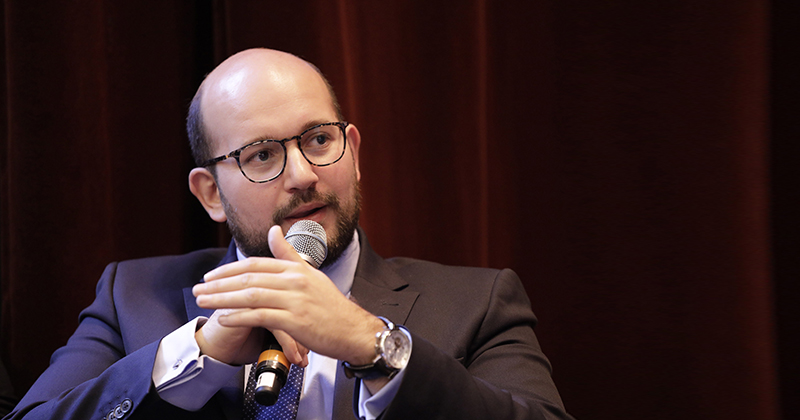
Ludovic Mendes is a member of parliament for La République En Marche. He is currently working in particular on the subjects of cannabidiol (CBD) and recognition of the possibility of a hemp industry dedicated to wellness. On the occasion from one of his recent videos, we asked him a few questions.
Hello Ludovic. You recently posted a video on your social networks showing you visiting a CBD shop. What did you see?
Everyone remembers the massive opening of CBD Shops in the summer of 2018 and then the rapid closure of the majority of them in the months that followed. For several months now I've been working from the National Assembly to obtain a clear and stable legal framework for the CBD / Wellness sector. As such, I'm committed to meeting as many players in this ecosystem as possible. So it was only logical to go and meet a CBD Shop manager from Metz, as well as his customers. For many people, going into a CBD Shop also means discovering the multitude of products that can be obtained from hemp: food products, cosmetics, e-liquids, oils and even confectionery!
What motivated you to work specifically on the subject of CBD and hemp wellness?
Above all, it's a question of individual and entrepreneurial freedom. Hemp has been used in France and throughout the world for centuries for a wide variety of purposes. Few people are aware that France is the European leader in hemp cultivation. However, if we don't adapt our legislative framework to incorporate the new uses of hemp, including CBD, we'll be overtaken by countries like Canada, which are making very rapid progress in this area and whose industries are developing very fast. I've met many entrepreneurs in the sector who are now forced to move abroad to be able to do business, even though CBD is legal in France...
Do you have any friends who use them?
That's right. I know a lot of people who use hemp CBD products for a lot more than you might think. For example, a friend of mine who suffers from liver problems uses hemp oil in his diet because it's one of the few proteins he tolerates well. Others use CBD oil and infusions for their relaxing and anti-stress effects. I myself use CBD E-liquid for my electronic cigarette, and it's a very interesting substitute for nicotine!
You signed a request for a fact-finding mission on the subject. Has the fact-finding mission been accepted? What could it lead to?
The principle of this Mission d'Information has been accepted. All that remains now is to set it up and integrate it into the National Assembly's already dense schedule. This Mission d'Information should enable us to hear from as many CBD industry players as possible (producers, extractors, retailers), but above all to inform our colleagues about what's at stake. There's a lot of education to be done on this issue. This applies both to public opinion and to politicians. For example, we need to keep reminding people that hemp for well-being only includes products with a THC content of less than 0.2%. Hemp suffers from a degraded and often caricatured image in France. We must relentlessly explain and demonstrate that hemp has a wide variety of uses, many of them virtuous. We need to combat the clichés that make many people think of trafficking and drug addiction when they think of cannabis.
Today, French entrepreneurs face many regulatory obstacles. Surrounding countries have less difficulty working on the subject, and their products are sold in stores in France and on the Internet, or even by home delivery. What message should we send them?
I want to tell them that a certain number of MPs are aware of this reality. The National Assembly is not a hermetically sealed bunker. The situation of many entrepreneurs in the CBD sector is complicated. Some are even being prosecuted for sometimes incomprehensible reasons. In France, cannabidiol is legal and authorized for sale. However, the use of hemp flower, which contains most of the CBD, remains prohibited. It is permitted to produce and market synthetic CBD, but not to use the molecule extracted from the natural flower. It's as if the use and marketing of vanilla beans were prohibited, but synthetic vanillin could continue to be produced and sold.
France is the world's third-largest producer of hemp, solely for industrial uses. The United States legalized hemp, including CBD, at the start of the year, and China is doubling down on the same production. Isn't there a risk of France losing this competitive edge?
Of course you can! We are falling behind many countries. This is true for Canada and China, but also for our closest European neighbors such as Luxembourg, Belgium and Italy. What's most infuriating is that European legislation authorizes the complete use of hemp flower... In France, there's a great deal of expertise in hemp cultivation and extraction. For several years now, we have been observing growing consumer demand for herbal products. This trend reflects a desire for more responsible consumption and a rediscovery of the virtues of certain plants that we had previously neglected. Hemp is no exception to this trend, but the current legislative framework does not allow the industry to develop properly.
Catalog varieties of hemp provide consistent but low CBD yields compared with the profiles of other varieties. Does it seem possible to you to open up these varieties for indoor production, as is the case in Switzerland, for example?
This is a question that needs to be addressed. If varieties offer higher CBD levels while guaranteeing compliance with THC concentration standards, it would be absurd not to consider including them in the catalog of varieties authorized for cultivation.
As a second step, we may also need to consider raising the maximum THC threshold. The European Parliament recently considered raising it to 0.3%. This is a good start, and efforts must continue to reach a level of around 1%.
Creuse has already started experimenting with indoor hemp. Would you support such experiments in Moselle?
Creuse is now a pioneering department in this field, thanks in large part to the work of my colleague Jean Baptiste Moreau and Eric Correia, President of Greater Guéret. Of course, I'd be very much in favor of the Moselle department getting involved in hemp cultivation. More generally, we need to take a global view of the issue and not overlook any player in the industry. A relaxation of the CBD regulatory framework tomorrow should benefit everyone, from grower to distributor. I'd like to see this progress serve the interests of French farmers and entrepreneurs, rather than increasing consumption of products imported almost exclusively from abroad.









JIHE 2026: Japan’s Largest Trade Show Dedicated to Hemp and CBD Returns to Tokyo with More Than 100 Industry Players

New Caledonia: The Courts Clear the Way for the Return of CBD

The Brazilian medical cannabis market continues to grow

Morocco: Three Cannabis-Based Medications Approved for the Treatment of Epilepsy

Canopy Growth Receives New EU-GMP Certification to Strengthen Its Presence in Europe

Three years after legalizing medical cannabis, Albania continues to establish regulations for it

The first plant-based medical THC spray arrives in the United Kingdom

Medical Cannabis in Germany: THC Prices Vary by a Factor of 12

France already has 3,000 cannabis retail outlets. None of them are legal.

Morocco's exports of legal cannabis have expanded to 15 countries
-
 Business2 weeks ago
The legal cannabis market in New York exceeds 4 billion $ in revenue
-

 Cannabis in France4 weeks ago
Which countries legalized medical cannabis before France?
-
Business4 weeks ago
South Korea is preparing to begin local production of medical cannabis to meet rising demand
-
Cannabis in France4 days ago
France already has 3,000 cannabis retail outlets. None of them are legal.
-
Cannabis in Thailand4 weeks ago
From the boom in dispensaries to a purely medical approach: Thailand is revising its cannabis policy
-
Cannabis in the U.S.5 days ago
A DEA report confirms that there are no fatal cannabis overdoses
-
Cannabis and driving3 weeks ago
Medical Cannabis and Driving: New South Wales Ends Automatic Penalties for THC
-
Cannabis in France3 weeks ago
France’s Drug Policy Chief Defends Cannabis Prohibition... and Runs Into the Facts















You must be logged in to post a comment Login