Emmanuelle Auriol vs. Nicolas Prisse: rationality vs. prohibition

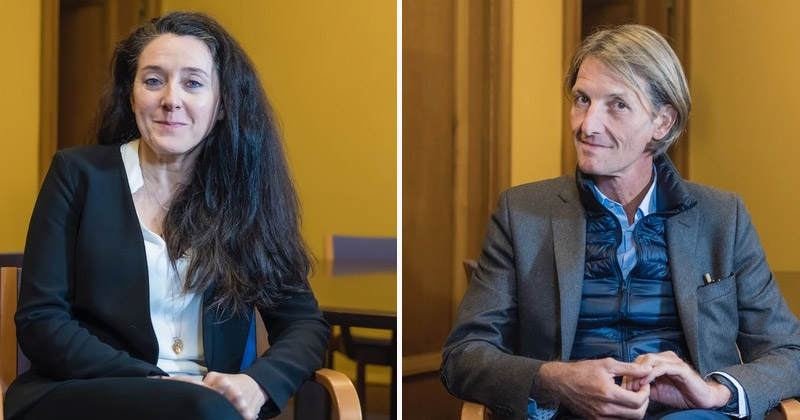
Edito. From November 7 to 9, 2017, the 10th Journées de l’Economie took place in Lyon. The program included, among other things, a conference on the cannabis economy.
On the sidelines of the event, the program «L’Autre Direct» interviewed two of the speakers: Emmanuelle Auriol, an economist and professor at the Toulouse School of Business, and Nicolas Prisse, director of the Interministerial Mission to Combat Drugs and Addictive Behaviors (Mildeca). Each offered a very different perspective.
Emmanuelle Auriol, economist
In the video below, Emmanuelle Auriol explains some of the reasons why she advocates for the legalization of cannabis.
First and foremost, she presents her perspective as an economist. In her view, the intense competition among dealers drives prices down and makes cannabis more attractive and accessible than it would be under a state-regulated system.
Cannabis prohibition eliminates the legal supply and forces consumers to seek out sources wherever they can. The social cost of prohibition is therefore very high, even as law enforcement efforts are extremely costly. Emmanuelle Auriol believes the government should regain control of the cannabis market, with the goal of reducing consumption.
She also reacts very strongly to the argument about what would happen to «neighborhoods» if cannabis were legalized. Her view is that a portion of the revenue from taxes on legal sales should be redistributed to areas in need, and that we cannot simply refuse to legalize on the pretext that certain areas rely on drug trafficking for their livelihood.
She also emphasizes that the black market for drugs is a demand-driven market and that users are rational. She therefore believes that consumers would not turn to harder drugs if cannabis were legalized, and that the argument for maintaining prohibition to prevent the supply of harder drugs is «silly.» «It’s like saying: we’re going to ban people from bungee jumping because otherwise they’ll jump off the tops of buildings,» she explains.
Nicolas Prisse, prohibitionist
Nicolas Prisse’s remarks were almost more interesting than Ms. Auriol’s. But not necessarily for the right reasons. If you’re looking for an argument that’s even slightly modern or a comment that goes beyond the «official line,» don’t watch the video below.
However, given Mr. Prisse's level, we are going to set aside our usual reserve.
For Mr. Prisse, cannabis is not «a market product» or a common consumer product. His arguments are that there isn’t just one type of cannabis (is Mr. Prisse a botanist?), that users aren’t rational in their consumption and purchases because of their addiction, and that cannabis is dangerous, but «not necessarily more dangerous [than alcohol],» he says.
When asked whether the ban on cannabis is effective given consumption levels in France, Mr. Prisse responds that this is «an oversimplification.» Rather than attributing the problem to the failure of a repressive policy, Mr. Prisse asks whether it might not instead be the failure of a policy focused on prevention and combating trafficking (which is almost the definition of a public drug policy—one that has opted for repression, but let’s set that aside).
Mr. Prisse then does not mince words when he explains that today, the only reason cited to justify the legalization of cannabis is that the French smoke a lot of it, «even though it may have economic benefits,» he adds.
He himself points out that we are the «European champions of a rather peculiar sport»—namely, cannabis use among young people, just like alcohol use. He also points to the numerous studies highlighting the dangers of cannabis among young people (it’s not as if everyone is saying this—the current situation is very effective at curbing youth use. Oh, wait—actually, not at all), or how cannabis makes it harder to quit smoking (WTF?!).
If cannabis were legalized, the system would be unable to regulate consumption by minors because, as Mr. Prisse himself admits, the tobacco and alcohol industries have failed to do so. Adult consumers, you know who to blame if there are no cannabis bars in France!
Mr. Prisse continues his interview by expressing support for the contraventionnalisation, which, for recreational users, consists of a reminder of the law accompanied by a penalty and a fine of an acceptable and deterrent (!) level, and, in the process, takes a swipe at the current criminalization, which it does not consider «miraculous.».
As a grand finale, Mr. Prisse concludes by explaining that «the policy to combat trafficking must be capable of better regulation of street supply « .
Mr. Prisse, it sounds like you’re sitting on the fence here. Instead of regulating the supply on the street, wouldn’t it be better to get rid of it altogether? Or else, like Mr. de Rugy did indeed suggest this to us, since the official line isn't legalization, can't you step outside your «mandate»—at the risk of making as much progress on the issue of cannabis as your predecessors did?
For our part, we listened carefully to what Mr. Macron said during his campaign. Follow his advice: be disruptive!








Cronos Completes the Acquisition of CanAdelaar for 57.5 million euros

Cannabis with a "bloody" twist: Discover Sensi True Blood and Sensi Sangria, the two new strains from Sensi Seeds

Hemp: The Council of the EU Takes a Stand on New Production and Marketing Rules

Missouri's legal cannabis market accounts for 93 % of consumer spending

THC Gummies: How to Read a Certificate of Analysis Before Buying

British patients now have access to THCV-rich cannabis flowers

Spain: Medical Cannabis Is Coming to About 50 Hospitals

JIHE 2026: Japan’s Largest Trade Show Dedicated to Hemp and CBD Returns to Tokyo with More Than 100 Industry Players

New Caledonia: The Courts Clear the Way for the Return of CBD

The Brazilian medical cannabis market continues to grow
-
 Business2 weeks ago
The legal cannabis market in New York exceeds 4 billion $ in revenue
-

 Cannabis in France4 weeks ago
Which countries legalized medical cannabis before France?
-
Cannabis in France6 days ago
France already has 3,000 cannabis retail outlets. None of them are legal.
-
Business4 weeks ago
South Korea is preparing to begin local production of medical cannabis to meet rising demand
-
Cannabis in the U.S.1 week ago
A DEA report confirms that there are no fatal cannabis overdoses
-
Cannabis in Thailand4 weeks ago
From the boom in dispensaries to a purely medical approach: Thailand is revising its cannabis policy
-
Cannabis and driving4 weeks ago
Medical Cannabis and Driving: New South Wales Ends Automatic Penalties for THC
-
Cannabis in France3 weeks ago
France’s Drug Policy Chief Defends Cannabis Prohibition... and Runs Into the Facts

















You must be logged in to post a comment Login