
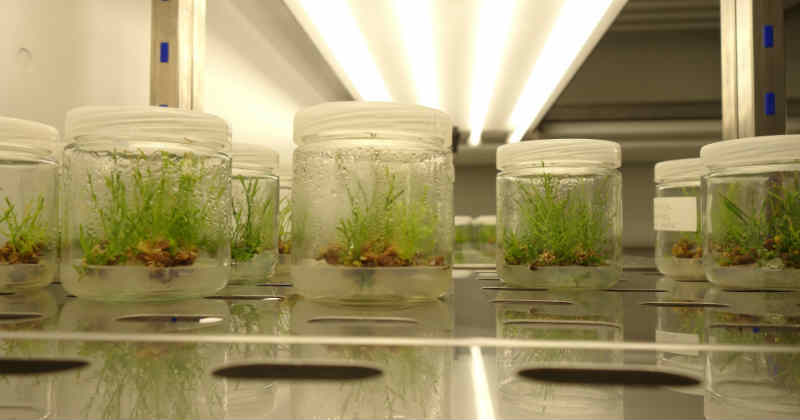
In vitro tissue culture: the end of cannabis cuttings?
Like any agricultural resource, cannabis is subject to production and propagation techniques designed to maximize yield and prevent losses due to contamination by viruses or pests. As a result, it will soon be possible to do without cannabis cuttings and to create and grow cannabis in a laboratory using cells.
The Benefits of In Vitro Culture
Tissue culture is, by definition, «the cultivation of cells from living tissue in an artificial medium.» It refers to a set of techniques used in biotechnology to grow plants in a sterile environment and create perfect clones through micropropagation. Tissue culture is already used in the agri-food industry to genetically modify plants and achieve uniform production—which could prove particularly useful for the cannabis industry, where the same «varieties» exhibit different characteristics depending on where they are grown. It corresponds to the following techniques :
- Meristem culture: First, meristems are harvested from the plant—these are undifferentiated cells found in buds that can give rise to all of the plant’s tissues. The advantage of meristems is that they are virus-free cells. Culturing them in vitro in a sterile environment allows for the production of healthy plants. It is even possible to use this process to cure an infected plant.
- In vitro propagation or micropropagation: Once the meristems have been selected, cloning can begin, and whole plants identical to the parent plant can be regenerated. Micropropagation produces identical, healthy plants, which is a major advantage for marketing a variety.
- Culture of immature embryos: The technique of culturing immature embryos makes it possible to speed up the conventional seed maturation process (approximately 2 months). The embryos are harvested a few days after fertilization, rather than waiting for the seed to reach maturity. This allows researchers to bypass the natural cycle and produce multiple generations per year.
- Inter-species Embryo Rescue : This technique makes it possible to transfer agronomic traits between different species or between wild and cultivated species. This allows researchers to select the most desirable traits from different varieties and combine them into a single variety.
- Haplo-diploidization: This technique makes it possible to obtain pure lines—that is, «to stabilize the favorable genetic combinations obtained through selection.» The goal is to homogenize the chromosomes of the two crossed species. Normally, this process requires numerous rounds of self-fertilization, but thanks to haplo-diploidization, it is possible to obtain pure lines in a few months instead of the 8 to 10 years required by the conventional method.
The Future of Breeding?
All of these processes could prove useful for the breeding which seeks to create new cannabis varieties by crossing different genotypes. With in vitro cultivation, it takes only one or two years to propagate and bring a new variety to market, compared to ten to fifteen years in a field or greenhouse. It also offers clear advantages for the industry by ensuring a healthy (uncontaminated) and stable (with consistent characteristics) product.
Will in vitro cultivation replace cuttings in commercial-scale cannabis production? It’s possible because, instead of having a room full of mother plants from which to take cuttings, you can store all your genetics on a shelf and recreate a plant on demand from fragments. This saves a considerable amount of time, space, and energy, but it requires advanced scientific knowledge and resources: a laboratory, a controlled environment with clean air, a cleanroom, and sterilized instruments are needed to prevent any contamination. In any case, tissue culture is proving extremely promising for growers engaged in genetic research, as it allows for the creation of new varieties in record time.
Darkest Shade of Grey Labs (DSG Labs) came up with the idea of developing in vitro cultivation techniques for cannabis and has since been developing a scientific platform focused on genetic preservation, pathogen identification and eradication, genetic sequencing, and the micropropagation of cannabis through tissue culture. These are powerful tools for breeding. According to Chris of DSG Labs: «Tissue culture has a multitude of interesting applications for cannabis.» «I have no doubt that these methods will be adopted by many growers around the world in the coming years,» he adds. in an interview with High Times.




A new tax of 0.5% could disrupt the hemp industry in Canada

Medical Cannabis and Driving: New South Wales Ends Automatic Penalties for THC

China's Yongji Health Takes Control of Tasmanian Botanics

Autism and Cannabis: Results from the First Placebo-Controlled Trial of NTI164

Which countries legalized medical cannabis before France?

From the boom in dispensaries to a purely medical approach: Thailand is revising its cannabis policy

South Korea is preparing to begin local production of medical cannabis to meet rising demand

In the United States, cannabis use among high school students has reached an all-time low

Medical cannabis use surges by 64 % in Denmark

