
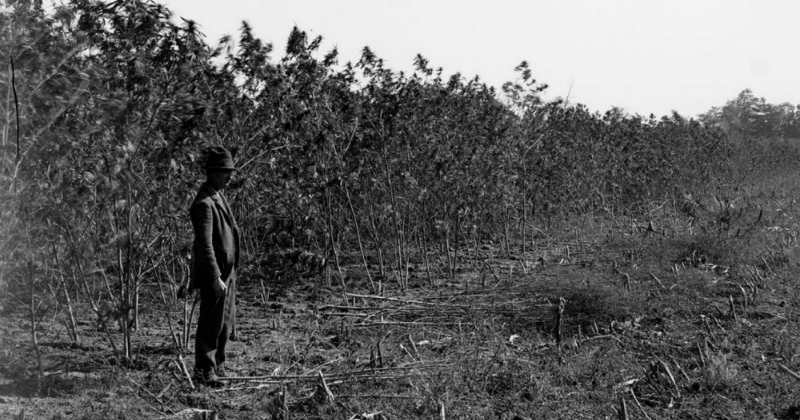
How did cannabis come to France?
Today, cannabis is the most widely used illicit substance in France, with at least 800,000 daily users, despite being banned. This plant, native to Asia, is probably one of the oldest known to humankind, but how did it arrive in our country? When did people first start using it?
The First Traces
Numerous archaeological and historical studies have uncovered evidence and traces of cannabis use dating back to prehistoric times. According to researchers at the Free University of Berlin, cannabis was likely imported into Europe from Asia, where traces of cannabis—some dating back 11,500 years—have been discovered by the horsemen tribe. Yamna, one of the tribes from which modern Europeans are descended. The Europeans lived in part off its trade and even used it as a medium of exchange. Thus, cannabis from the steppes and China made its way to Europe, but its cultivation did not take off immediately, and recreational use was not widespread.
Nevertheless, there are accounts of spiritual or medicinal use in certain rituals, particularly among the Scythes. This people apparently had a custom of sealing themselves inside tents to inhale cannabis fumes and experience the plant’s intoxicating effects.
In ancient times, and later during the Middle Ages, the cultivation of agricultural cannabis—commonly called hemp to distinguish it from its recreational or medical uses—flourished primarily for the extraction of its fibers, which were used to make ropes, textiles, and building materials. The seeds were also consumed on a massive scale due to their nutritional value. It is known that hemp-based ropes were traded in the port of Massilia—now Marseille—and the discovery of pipes during archaeological excavations suggests that some people were already aware of cannabis’s psychoactive properties. Hemp at that time indeed contained significantly more than the 0.2% of THC to which contemporary legal varieties are limited, as suggested by recent excavations having detected cannabinol in 800-year-old sediments, with the cannabinol resulting from the degradation of the THC.
Cannabis is becoming more widespread
Starting in the 9th century, with the arrival of Charlemagne, hemp cultivation expanded significantly in France, eventually becoming one of the local plant varieties used on a massive scale. This played a major role in the significant advancements of the Middle Ages, such as great maritime voyages and the development of writing. In fact, the sails and ropes of ships were mostly made from cannabis, just like the the first Bible printed using Gutenberg's invention in 1455. Even before that, monks who were scribes were copying Bibles onto hemp paper, by the light of oil lamps—the oil for which was also extracted from cannabis.
Meanwhile, recreational and medical use began to grow on a scale that is difficult to assess today, lost forever in the maze of obscurantism: the Inquisition gradually destroyed much of European science, including medical science, among which was the use of a large number of plants, including cannabis. Under the guise of combating witchcraft and Satanism, religious authorities thus relentlessly sought to ban cannabis—a goal that was not actually achieved until 1484, as the Renaissance was dawning, when Pope Innocent VIII condemned the use of cannabis.
Hemp made a major comeback in France during the modern era. At that time, the need for dozens of metric tons of hemp per ship and the importance of ships in conquest and expansion made hemp an extremely valuable resource—a source of conflict much like oil is today. European powers exported hemp to their colonies and sometimes even forced its cultivation there.
With the Enlightenment, knowledge about cannabis expanded. Diderot and d’Alembert described cannabis in their *Encyclopédie* as a plant that causes «dizziness, dizziness, in a word, a kind of intoxication.» In 1753, Carl von Linné, a Swedish botanist, gave cannabis its Latin name (or scientific name). Textile hemp became «Cannabis Sativa L.,» since hemp is a species of the botanical genus Cannabis, and it is cultivated (in Latin sativa) and the «L.» in honor of Linnaeus. Recreational and medical cannabis, on the other hand, is «Cannabis Sativa,» without the "L.".
But it was Napoleon’s conquests in the late 18th century—particularly in Egypt—that led to the widespread use of recreational cannabis in France. Indeed, since soldiers did not have access to alcohol, they turned to hashish to relax. The latter is often mixed with opium and other substances, and the harshness of the mission drives soldiers to seek refuge in getting high. Napoleon therefore forbade not only his soldiers but also his citizens from smoking the flowering tops of the hemp plant.
This ban will be flouted on all sides, and will even spark the interest of many scientists and writers in metropolitan France, notably Jacques Moreau de Tours, a renowned psychiatrist who published Hashish and Mental Illness, a book in which he discusses the medicinal, recreational, and spiritual properties of cannabis. He is convinced of the plant’s benefits and strongly criticizes those who try to ban it without even having tried it. Together with some writer friends, he founded the The Hashishins Club, where famous writers such as the poet Théophile Gautier, Victor Hugo, Charles Baudelaire, Honoré de Balzac, and Eugène Delacroix would gather to smoke cannabis and discuss various topics. Their favorite method of consumption was a sort of “space cake” of the era, known as dawamesk—a sweet mixture containing hashish that produced strong yet clear effects, which were particularly intriguing due to the wide variation in experience depending on the user, their mood, and the context of consumption.
But these practices came to a definitive end on July 12, 1916, in the midst of World War I, when the law «concerning the importation, trade, possession, and use of poisonous substances, notably opium, morphine, and cocaine,» which, for the first time, criminalized both public use and personal consumption. This law was enacted in response to rumors that the Germans were supplying cannabis and cocaine to French soldiers in order to demoralize them.
Later, on December 31, 1970, a law was passed that was the worthy successor to the 1916 law. The French narcotics law is focused on combating drug addiction and establishes a two-tier system of coercive measures. Drug users are considered both offenders and patients, and are subject to one year in prison and/or a €3,750 fine for simple possession. The law also penalizes the production, sale, and distribution of narcotics.
Even today, France penalizes the mere use of cannabis, whether for medical or recreational purposes.











Federal Cannabis Reform Once Again on Hold in the United States

Contest: Win a trip to Quebec to experience the hemp harvest firsthand

Bedrocan on Hold Amid Uncertainty Over Medical Cannabis

Newsweed Launches Its Own AI
A new tax of 0.5% could disrupt the hemp industry in Canada

Medical Cannabis and Driving: New South Wales Ends Automatic Penalties for THC

China's Yongji Health Takes Control of Tasmanian Botanics

Autism and Cannabis: Results from the First Placebo-Controlled Trial of NTI164

Which countries legalized medical cannabis before France?

