


Who was Brownie Mary?
The history of cannabis is steeped in larger-than-life figures who have all played a part in the democratization of the plant. One such influential figure is Mary Jane Rathbun, better known as Brownie Mary.
Medical cannabis activist and pioneer of the edibles, Brownie Mary burst onto the public scene in the 1980s. Mary Jane Rathbun's work in California, at the height of the HIV/AIDS crisis, was instrumental in the legalization of medical cannabis in the state. A somewhat unlikely heroine, Rathbun nonetheless remains a legendary part of cannabis folklore.
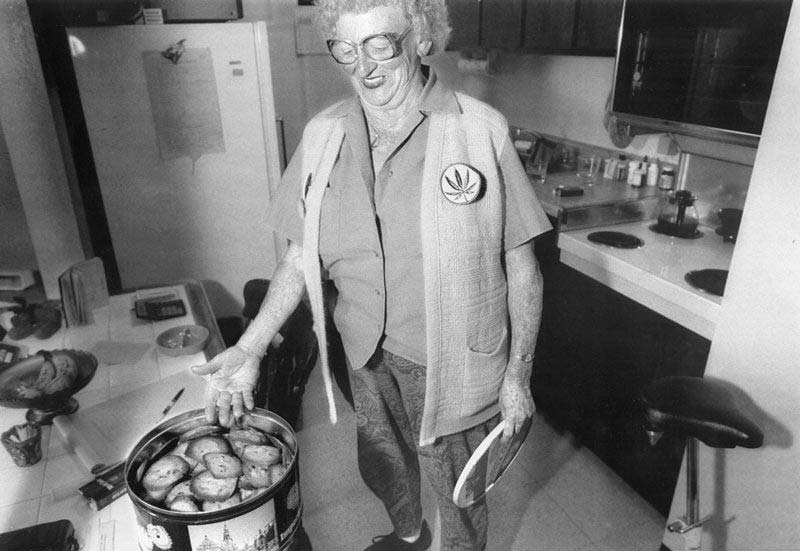
Brownie Mary
Brownie Mary's debut
Little has been officially documented about Brownie Mary's early life. According to accounts, she harbored a strong anti-establishment streak from her earliest childhood. Born in 1922 and raised in a working-class neighborhood, Mary left her parents' Minneapolis home in her teens to make her way in the world. An activist from an early age, she fought for causes such as abortion rights and the right to unionize. The late 1930s brought her to the counter-cultural center of San Francisco.
Her job as a waitress at the’International House of Pancakes allowed her to pay her bills, but didn't leave her with much money. After her husband left, Mary had to find a way to support their daughter, Peggy. That's when Mary stumbled upon a new sideline to make ends meet: baking brownies.
Rathbun advertises her «original recipe» for brownies with flyers on neighborhood bulletin boards. Her «magically delicious» brownies quickly propel her to fame in the city's predominantly gay Castro neighborhood.
In the early 1980s, Rathbun was baking up to 600 brownies a day, selling them from her home or distributing them on the streets of Castro with a basket. Then she met another cannabis activist, Dennis Peron, In 1974, Peron and Peron Peron met at Café Flore, a San Francisco institution, where they hit it off over a joint. Peron soon began selling his brownies from his Big Top weed supermarket on Castro Street.
Unfortunately, Rathbun's growing popularity also attracted the attention of the local police. A plainclothes policeman posing as a customer burst into his bakery on the evening of January 14, 1981 and seized over five kilos of weed. As fate would have it, this arrest (the first of three) represented a major turning point in Brownie Mary's life.
How did Brownie Mary get involved in medical cannabis activism?
Rathbun's first arrest earned her a sentence of 500 hours of community service. She spent many of these hours volunteering at the Shanti Project, a support group for people living with incurable diseases. This work opened his eyes to people in the gay community living with HIV/AIDS, who had been disowned by their loved ones and, to some extent, abandoned by the mainstream medical establishment. Having lost his only daughter Peggy in a car accident in the early 1970s, Rathbun adopted the AIDS community as his children.
People with HIV/AIDS told Mrs. Rathbun that her brownies eased their pain and stimulated their appetite. She was also told that they helped cancer patients undergoing chemotherapy.
A regular visitor to the AIDS ward at San Francisco General Hospital, Rathbun was arrested again in 1992 while delivering a herbal brownie to a cancer patient. She remains unrepentant, however, insisting on the medicinal value of her infused treats.
«I know from smoking weed for over 30 years that it's a drug that works,» Ms. Rathbun tells the’Associated Press in a 1992 interview. «It works for wasting syndrome. The kids have no appetite, but when they eat a brownie, they get out of bed and get ready to eat. And for chemotherapy, they eat half a brownie before a session, and when they come out, they eat the other half. It eases the pain. That's what I came to do.»
Despite arrests and formal warnings from the authorities, Rathbun stepped up brownie production in the mid-80s. More and more AIDS patients needed palliative care or relief from the nausea associated with early HIV treatment. Brownies were no longer a way to boost her retirement fund, but a way to help relieve the suffering of others. She financed the treats with her social security checks and anonymous donations from local retailers.
In 1992, Rathbun appeared before the San Francisco Board of Supervisors, preaching the benefits of medical cannabis. His testimony prompted the board to semi-decriminalize the plant, making possession of medical cannabis the lowest priority for arrests and prosecutions.
Joining forces: Brownie Mary and Dennis Peron
Rathbun's social justice instincts naturally evolved into a campaign for cannabis legalization. This shift was influenced, in part, by the work of a close friend and cannabis activist, Dennis Peron.
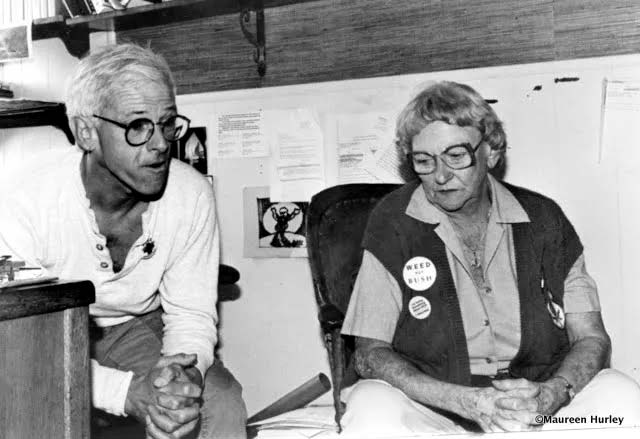
Brownie Mary and Dennis Peron
In the early 1990s, Dennis Peron set out to educate AIDS advocacy groups such as ACT UP about the therapeutic benefits of cannabis in alleviating AIDS symptoms. After a mixed reception from ACT UP, Peron invited Rathbun to share his experiences distributing cannabis to AIDS sufferers. Together, the two activists began to change opinions about cannabis, which had been classified as a Schedule 1 controlled substance since 1970.
Ms. Rathbun's advocacy also attracted the attention of medical professionals, who began to study the effects of cannabis on the immune systems of AIDS sufferers. In 2003, a landmark study clarified the therapeutic benefits of cannabis for people living with HIV/AIDS.
In 1991, Rathbun and Peron joined forces for Proposition P, a measure to make medical cannabis available in San Francisco and protect doctors from penalties for prescribing it. Rathbun was a regular presence at board meetings to champion the cannabis cause, with cannabis-inspired jewelry and pins, as well as her must-have vests.
Proposition P passed by nearly 80 % on November 5, 1991. Five years later, voters also passed Proposition 215, making California the first U.S. state to legalize medical cannabis. The passage of this landmark law set a precedent, and the states of Washington, Oregon and Alaska soon followed with their own medical cannabis initiatives.
A lasting legacy: the Brownie Mary and Dennis Peron Act
Mrs. Rathbun died of a heart attack in 1999, but her legacy lives on. Compassion was truly the modus operandi of Ms. Rathbun. Compassion, along with an unwavering belief in the healing power of cannabis, helped her launch cannabis law reform. Recent measures in California have recognized the the need to make cannabis accessible to low-income patients who need it most.
In 2019, Governor Gavin Newsom signed the SB 34, Dennis Peron and Brownie Mary Act, to exempt compassionate care programs from paying state cannabis taxes in California. Compassionate care programs, the original medical cannabis dispensaries have been ravaged by the cost of doing business since the California legalized cannabis for adult use, often forcing program participants back into the illicit market. The bill's main sponsor, State Senator Scott Wiener, issued a statement after the signing.
«For decades, compassionate programs have played a vital role in helping low-income people with serious health problems access their medicine,» said Wiener. «Taxing programs that give medical cannabis for free, and therefore have no revenue, makes no sense and has led to the closure of too many of these programs. SB 34 will allow compassionate care programs to survive and serve those in need.»
In 1992, the San Francisco Board of Directors declared August 25 «Brownie Mary Day» to honor her work in helping AIDS patients. It's a day that's still celebrated in San Francisco.
Dennis Peron and Mary Jane Rathbun also co-wrote a book three years before his death: Brownie Mary's Marijuana Cookbook and Dennis Peron's Recipe for Social Change. Alas, the book does not contain Rathbun's famous «magically delicious» brownie recipe.











CBD is said to promote athletic recovery, without improving performance

294 cannabis clubs in Chile: a booming movement with uneven distribution

Chronic Sciatica: New York Approves First Clinical Trial of a THC-Based Medication

United States: The DEA is accelerating the integration of medical cannabis at the federal level

Florida is nearing one million patients using medical cannabis

Uruguay Revives Its Plan to Allow Tourists to Legally Access Cannabis

In Brazil, researchers are developing an innovative CBD eye drop

Autism: Medical Cannabis Is Linked to Reduced Anxiety

The $28 billion U.S. hemp market remains under threat

