Drinks, space-cakes, candy: what will the «second wave» of Canadian legalization look like?

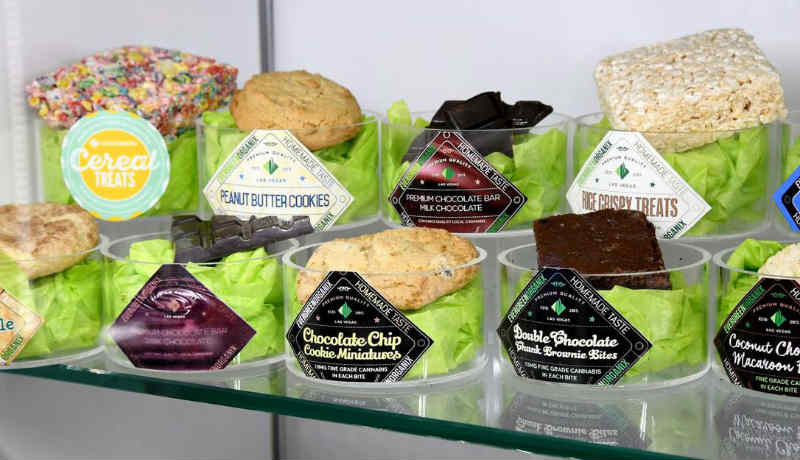
The legalization of cannabis in Canada is still incomplete. A considerable segment of the cannabis market is still illegal. edibles. Beverages, pastries space cake, Candy, and in general anything that can be ingested, will only be legal in 2019, probably around October 17. Health Canada therefore has just under a year to finalize regulations. In the meantime, entrepreneurs are already gearing up for the «second wave» of legalization.
A promising market
When you hear edibles, we immediately think of space-cakes. But the edibles is also beer, wine, honey and, in general, anything that can be eaten or drunk. The principle of edibles is that they circumvent the stigma associated with consuming cannabis in its smokable form. For many entrepreneurs, cannabis drinks and edibles are a way of making it more socially acceptable. Edibles have the advantage of being more discreet and less stigmatized. Andrew Doolittle, owner of Pot & Pan Kitchen, an edible’edibles in Maine, explains: «Our target customers are everyday people who want to use cannabis but don't want to smoke it.
Bruce Linton, CEO of Canopy, adds that the drink has an important socializing potential: «Many people find it socially more comfortable to share a drink». The company has also received an investment of over $4 billion from Corona beer producer Constellation Brands. Generally speaking, the beverage industry is getting closer and closer to the cannabis industry.
A product that is of particular interest to investors and entrepreneurs is cannabis beer. Molson Coors has partnered with a Canadian company to create a beer, and Heineken is already marketing a THC-infused beer in California. Two Canadian companies are also in the process of developing a beer brewed directly with cannabis in view of the forthcoming legalization of edibles in Canada.
According to a survey conducted last year by Dalhousie University, almost half of Canadians were willing to taste edibles but even more were concerned about the risks associated with consumption by children. A more recent Deloitte survey estimates that six out of ten users will choose edibles, a less stigmatized format, according to Jennifer Lee, one of the survey's drivers.
According to The Star, the edibles, once legalized, will account for around 50% of the dollar value of cannabis sales. The advantage of this market is that companies will find it easier to develop a brand and identity around a specific product range. Indeed, brands will be more differentiated in terms of taste and packaging than for oil and flowers.
A complex regulatory framework
In and of itself, visit edibles are already available, as there's nothing to stop private individuals cooking their own with the flowers they buy in stores. However,, legal sales will have to be subject to a strict regulatory framework that promises to be complex, as food is always a delicate subject when it comes to health. Cases of poisoning, particularly among children, have already been reported even before legalization. Health Canada must do everything in its power to minimize these incidences by putting in place regulations to prevent these products from becoming attractive to children, for example.
In Colorado, the edibles were legalized in 2014 with virtually no restrictions or regulation. After an increase in intoxication among children, the state introduced regulations. These regulations include: child-resistant packets, a universal cannabis symbol and a maximum dose of 10 milligrams of THC per dose. Visit edibles can't have the shape of an animal, fruit or person.
Similarly, Health Canada will have to impose marketing restrictions and dose limits on these products. According to agency spokesperson Tammy Jarbeau, Health Canada is considering imposing a universal cannabis symbol on packaging and banning certain product forms, ingredients and flavors that would be too appealing to children. For example, candy may not be allowed. Visit candies are a bestseller in the United States.
Over the coming year, the federal government will be holding talks with industry players to work with them on the regulations that will apply in terms of’edibles. In Montreal, a conference organized by the Conseil de la Transformation Alimentaire du Québec was held recently. It brought together Canadian and American entrepreneurs to discuss future opportunities and challenges related to the edibles. The Council has also set up a commission to assess all aspects of the future market. Entrepreneurs and institutions must be ready to navigate a complex legal environment.













Medical Cannabis in Germany: THC Prices Vary by a Factor of 12

France already has 3,000 cannabis retail outlets. None of them are legal.

Morocco's exports of legal cannabis have expanded to 15 countries

Aurora Cannabis Doubles Its Production Capacity in Germany

Tilray is accelerating its operations in Europe thanks to a license in Portugal

Boston will host the 10th annual State of the Cannabis Industry Conference on October 26

A DEA report confirms that there are no fatal cannabis overdoses

A British patient is challenging the NHS's refusal to reimburse medical cannabis

October 2026 CBD Highlights: 10 Strains and Hash to Discover from 5 French Producers

CBD in France: Traceability, Retail Stores, THC and Driving… What the New Bill Proposes
-
 Business2 weeks ago
The legal cannabis market in New York exceeds 4 billion $ in revenue
-

 Cannabis in France3 weeks ago
Which countries legalized medical cannabis before France?
-
Business3 weeks ago
South Korea is preparing to begin local production of medical cannabis to meet rising demand
-
Cannabis in Thailand3 weeks ago
From the boom in dispensaries to a purely medical approach: Thailand is revising its cannabis policy
-
Cannabis and driving3 weeks ago
Medical Cannabis and Driving: New South Wales Ends Automatic Penalties for THC
-
Cannabis in Argentina4 weeks ago
Argentina Opens Its Market to Hemp Flowers Containing 1% of THC
-
Autism3 weeks ago
Autism and Cannabis: Results from the First Placebo-Controlled Trial of NTI164
-
Cannabis in France2 weeks ago
France’s Drug Policy Chief Defends Cannabis Prohibition... and Runs Into the Facts

















You must be logged in to post a comment Login