Study: the degradation of active cannabis ingredients under different storage conditions

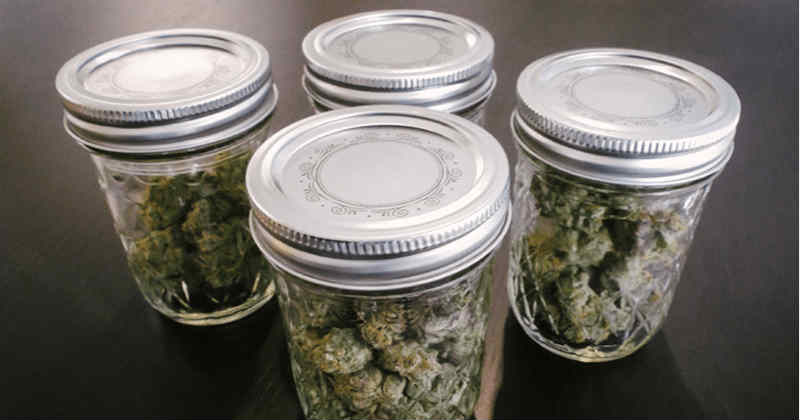
A recent study set out to test different cannabis storage conditions to study the degradation process of its active ingredients. The researchers used six different products, in resin or flower form, with different THC contents but all relatively potent. Four samples of each product were taken and placed under different storage conditions for 4 years:
- A: light and ambient temperature (22°C)
- B: darkness and room temperature
- C: darkness and refrigeration (4°C)
- D: darkness and frost (-20°C)
Study results
The concentration of THC, in CBN (CBN is the degradation product of THC) and in CBD was measured approximately every 100 days over the four years. Under conditions A and B, almost 100% of THC was degraded after four years. This degradation occurred exponentially and according to the law of first-order chemical kinetics (monomolecular nucleophilic substitution - i.e. CBN substituting THC). The study does not specify the rate of degradation in conditions C and D, but we deduce that it is much slower, or even insignificant in freezing cases.
Nor does the study specify whether there is a difference between the degradation of active ingredients in the hashish and flowers. On the other hand, it indicates that light influences the rate of degradation and the stoichiometry (quantity of reactants involved in a chemical reaction) of THC/CBN conversion. If degradation is faster, this may be because there are more reagents involved in the chemical conversion, but these parameters may also be independent since temperature only has an effect on degradation speed.
From the data collected, the researchers developed models to calculate the initial THC content from the current THC and CBN content under A storage conditions. This technique loses in accuracy over time with 5-10% margin of error over a long period. It is also possible to predict shelf life from these measurements.
In this way, it is possible to determine the age of cannabis and its initial potency based on its composition and storage conditions. According to the researchers, this may have interesting applications for law enforcement agencies in the analysis and analysis of cannabis. storage of cannabis products.










JIHE 2026: Japan’s Largest Trade Show Dedicated to Hemp and CBD Returns to Tokyo with More Than 100 Industry Players

New Caledonia: The Courts Clear the Way for the Return of CBD

The Brazilian medical cannabis market continues to grow

Morocco: Three Cannabis-Based Medications Approved for the Treatment of Epilepsy

Canopy Growth Receives New EU-GMP Certification to Strengthen Its Presence in Europe

Three years after legalizing medical cannabis, Albania continues to establish regulations for it

The first plant-based medical THC spray arrives in the United Kingdom

Medical Cannabis in Germany: THC Prices Vary by a Factor of 12

France already has 3,000 cannabis retail outlets. None of them are legal.

Morocco's exports of legal cannabis have expanded to 15 countries
-
 Business2 weeks ago
The legal cannabis market in New York exceeds 4 billion $ in revenue
-

 Cannabis in France4 weeks ago
Which countries legalized medical cannabis before France?
-
Business4 weeks ago
South Korea is preparing to begin local production of medical cannabis to meet rising demand
-
Cannabis in France4 days ago
France already has 3,000 cannabis retail outlets. None of them are legal.
-
Cannabis in Thailand4 weeks ago
From the boom in dispensaries to a purely medical approach: Thailand is revising its cannabis policy
-
Cannabis in the U.S.5 days ago
A DEA report confirms that there are no fatal cannabis overdoses
-
Cannabis and driving3 weeks ago
Medical Cannabis and Driving: New South Wales Ends Automatic Penalties for THC
-
Cannabis in France3 weeks ago
France’s Drug Policy Chief Defends Cannabis Prohibition... and Runs Into the Facts
















You must be logged in to post a comment Login