The CBD, between victory and panic: Kanavape ruling and vote at the United Nations


2020 was an eventful year, especially for the CBD. And the end of this year is no exception, with two major developments regarding the status of this molecule: a ruling by the CJEU on CBD in industrial hemp products, and a UN decision on a WHO recommendation concerning CBD-based medicines. Unfortunately, in recent times, widespread confusion and misunderstandings about the issues at stake risk jeopardizing the positive progress made in CBD regulation.
On November 19, The Court of Justice of the European Union (CJEU) issued a ruling on the Kanavape case. Following this positive decision, which reaffirms the place of products such as the Kanavape e-cigarette within the framework of the free movement of goods across all EU Member States, a number of experts have offered their analysis.
The Professor Yann Bisiou, an associate professor of private law and criminal sciences and one of the most eminent specialists in French narcotics law, has provided excellent analyses of the situation, explaining to Nice Matin that “for entrepreneurs looking to develop this market in France, this is an extremely positive sign,” and noting that the ruling “also opens the market to Canadians, who are heavyweights in the cannabis industry”[1].
While the analysis of the consequences in France and Europe is very accurate, during one of the many discussions and debates held in recent days to understand, explain, and analyze the impacts of this historic ruling, Professor Bisiou’s remarks on the “cascade of domino-like consequences” unfortunately ventured into delicate territory, fraught with confusion. In a video released by the organization NORML France, he stated:
«Europe has adopted a common position in which it refuses to reclassify CBD, ahead of the upcoming international discussion at the [UN] Commission on Narcotic Drugs. How can the [European] Commission maintain this common position when the CJEU has ruled that CBD is not a narcotic?»
However, this seemingly innocuous statement contains several misinterpretations that, in the current context, can spread misconceptions and cause real harm to the CBD industry.
This sentence is, in fact, in line with a the mistaken belief that the December vote at the UN is a referendum on whether or not to classify CBD as a narcotic. This is not the case.
To get a clearer picture, it is important to distinguish between the various events, which occur simultaneously but are not always related to one another.
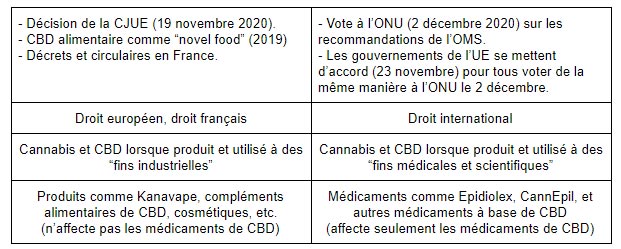
Key takeaways:
- CBD is not and will not be classified as a narcotic by the UN
- The UN vote The December 2 announcement regarding the WHO's recommendations has nothing to do with the Kanavape case or, more generally, with industrial hemp.
- The vote concerns only Epidiolex and other similar drugs
- If the vote were to pass, there would be less red tape for manufacturers of plant-based CBD products. If the vote were to fail, there would be no change.
1/ CBD is not, has not been, and will not be listed in the schedules of the international drug conventions.
“How can the [European] Commission maintain this common position when the CJEU has told it that CBD is not a narcotic?»
The Aix Court of Appeals, which is involved in the Kanavape case, noted that “CBD is not listed as such in the Single Convention.”[2] on narcotics. The definition of “narcotic” in international law is very simple: “The term ‘narcotic’ refers to any substance listed in Schedules I and II, whether natural or synthetic” (Article 1(j) of the Single Convention on Narcotic Drugs of 1961). CBD does not appear in any of these schedules, so it is not a narcotic. It is not possible to “downgrade CBD” if it is not classified.
For a substance to be listed in the Schedules of the 1961 Convention, the World Health Organization (WHO) must, following a rigorous scientific review, determine that there is a risk of harm and dependence, and recommend classification in a specific Schedule. The process is as follows:
- A country or entity submits a substance to the WHO for review; ;
- A Expert Committee Convened by the WHO conducts a scientific evaluation of the substance and may recommend its inclusion in one of the Schedules, or may not recommend its inclusion; ;
- If the WHO has recommended classifying the substance in a Schedule, governments meet at the UN to vote: “yes,” “no,” or “abstain.” If the WHO has not recommended classifying the substance, no country has the authority to impose this classification internationally (though they may still do so within their own borders).
The WHO has conducted three scientific assessments of CBD in its history, each time with the possibility of recommending its classification as a narcotic: in 1970[3], in June 2018 and November 2018. The WHO has never recommended it. It is therefore impossible for the states to have included it there.
The same is true, in fact, for other “drugs” used in medicine that the WHO has refused to recommend for classification in the Schedules of Narcotics. This is the case, for example, with ketamine and tramadol, which are essential for pain management, particularly in emergency situations such as accidents or disasters, especially in developing countries. Just like CBD, these substances are not listed in the Conventions’ schedules (despite the fierce determination of certain countries, such as China and Egypt, to classify them there), because the WHO has not recommended it.
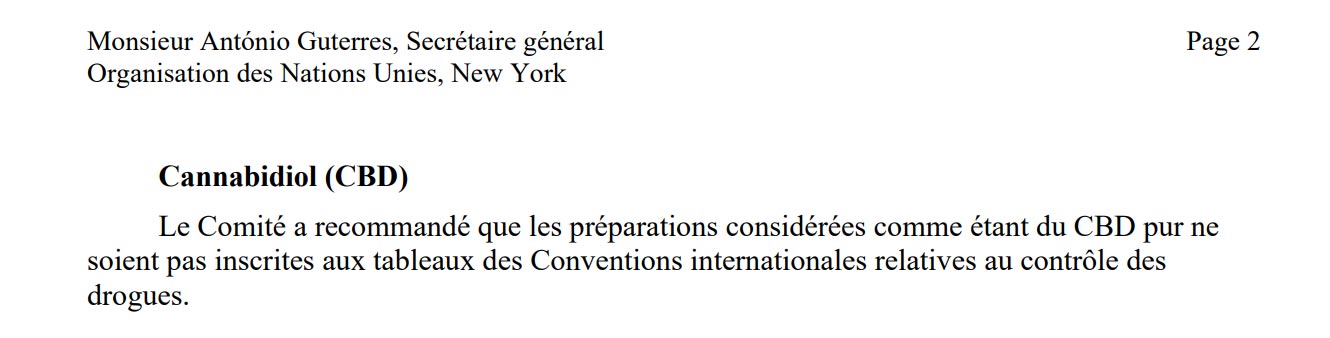
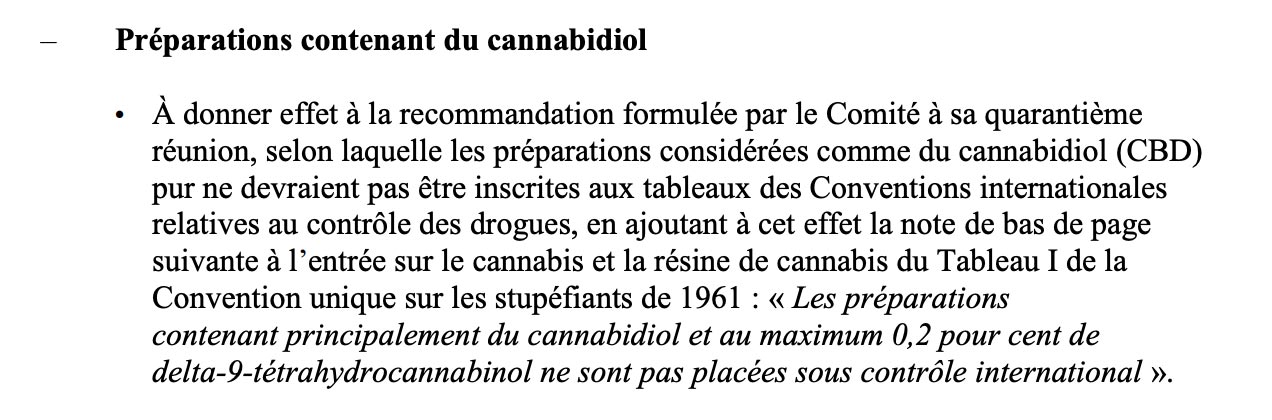
What do they really mean? the WHO's recommendations ? Just read them!
“Cannabidiol can be obtained through chemical synthesis or prepared from the cannabis plant. A pharmaceutical preparation, Epidiolex, derived from the plant, [has] been approved. The Committee noted that pharmaceutical preparations derived from the cannabis plant that lack psychoactive effects will contain traces of Δ⁹-THC.” [which is listed in the Tables]. […] In accordance with the recommendation not to subject preparations considered to be pure cannabidiol to testing, but recognizing that traces of Δ⁹-THC may be present in these preparations—for example, at a concentration of 0.15 % in Epidiolex—, […] The Committee recommends adding the following footnote to Schedule I of the 1961 Single Convention on Narcotic Drugs: ‘Preparations containing primarily cannabidiol and no more than 0.2 % of delta-9-tetrahydrocannabinol are not subject to international control.’[4]
On the one hand, there is no mention of e-cigarettes, cosmetics, or food; the group’s work focused solely on its mandate: medical (and scientific) uses.
Second, it becomes clear that this is not actually about “reclassifying CBD,” but rather about reclassifying the “traces of Δ⁹-THC” present in CBD medications derived from the cannabis plant. For the time being, under international law, Epidiolex can indeed be considered a narcotic because it is derived from the plant and, as a result, contains residual traces of THC.[5] –and certainly not because CBD itself is classified as a narcotic!
TheWHO acknowledges that’Is there a difference between “pure cannabidiol” and the pharmaceutical preparations available today, which contain traces of THC?, but in amounts that “do not produce any effects indicative of a risk of abuse or addictive potential.”
In a way, their recommendation seeks to place CBD products derived from medicinal plants on the same level as “pure CBD,” which is more likely to be synthetic in origin (although it’s not quite that simple, since CBD produced in vitro (may also contain traces of THC produced during the chemical synthesis process).
2/ The WHO’s recommendations do not apply to Kanavape, CBD dietary supplements, or cosmetics… they apply solely to CBD medications!
When it comes to cannabis and CBD, European law differs from international law in many respects. There are two main areas of CBD law that must be distinguished. The CJEU mentions this in its press release: “strictly controlled trade for medical and scientific purposes.”[6] which is distinct from trade in other goods and merchandise subject to the free movement regime. And this aspect highlights one of the points of convergence between European and international law: the goals and purposes of the production and use of cannabis products (medical on the one hand, industrial on the other).
The 1961 Single Convention on Narcotic Drugs defines these concepts, requiring States, “subject to [certain provisions], to limit exclusively for medical and scientific purposes ”the production, manufacture, export, import, distribution, sale, use, and possession of narcotics” (Article 4(c) of the Convention). “The provisions of the Convention ‘subject to’ which [this paragraph] […] does not apply are […] Article 2, paragraph 9”[7] that is, the exemption from the Convention’s scope of application for “industrial purposes.” Article 2(9) clearly states that “[governments] are not required to apply the provisions of this Convention to narcotic drugs that are commonly used in industry for purposes other than medical or scientific purposes”[8]
Basically, a narcotic cannot be legal “except in cases where the Single Convention permits, on an exceptional basis, [its] use for industrial purposes.”[9] that is, for any purpose other than medical use or scientific research.
Therefore: the legal framework governing the Conventions and Schedules applies only to medical and medical research uses, and not to industrial uses. And the WHO’s mandate is solely to recommend changes to the Schedules, and thus changes to the legal framework governing medical and scientific uses. The WHO and the classification in the Tables cannot alter the body of the Convention, particularly Articles 2(9) and 28, which exclude “industrial hemp” from this entire matter.
So Why are European Union countries going to vote against the WHO’s recommendation on CBD medications? As the representative of the U.S. Office of National Drug Control Policy (ONDCP) explained, in their view, the trace amounts of THC in Epidiolex do not in themselves justify classifying it as a narcotic. The U.S. acknowledges that the CBD molecule is not classified as a narcotic and, as explained by the 40th WHO Expert Committee, should not be classified as such. The THC present in Epidiolex does not make it “psychoactive,” and the U.S. therefore already considers it a non-narcotic medication.
The opposition from the U.S., like that from the EU, is more of a procedural nature. The the European Union's position agrees with the U.S. on this point, explaining that the “no” vote does not represent opposition to the CBD as such, but rather that “The recommendation, as drafted, does not provide the necessary legal certainty ”and is not an appropriate solution for cannabidiol."[10] The details are somewhat complex, but the EU, in its common position, is clear about its support for industrial (i.e., non-medical) CBD, mentioning the “Potential high-value applications of cannabidiol, for example in the health, cosmetics, and food sectors, as well as the economic and environmental potential of industrial hemp cultivation.”.[11]
The EU, however, remains crystal clear when it comes to the WHO recommendation itself, which, strictly speaking, applies only to “pharmaceutical preparations” ”that have no psychoactive effects and are produced from the cannabis plant"[12] and not industrial hemp products.
This position was adopted by European governments on November 23, 2020, as reported by CNDmonitor – that is, the day before the Kanavape ruling. European governments, like many stakeholders in the hemp sector, knew the verdict was coming, but their position was not affected by Kanavape, since the two issues—Kanavape/hemp and Epidiolex/WHO/vote—are completely unrelated.
Just like chili peppers, which are subject to certain regulations when prepared for use as a medicine (according to monographs 2529 or 2336 of the European Pharmacopoeia), and to other types of regulations when capsaicin is extracted from it to make personal defense sprays[13], and yet other types of regulations when it is used as food… You have to get used to the fact that different rules apply to Cannabis sativa and its products, when they are used for different “purposes.”.
The EU's Position just like that of France is also very positive, supporting 4 of the WHO’s 6 recommendations and fully recognizing the medical benefits of cannabis and the need to improve conditions to facilitate access and availability for patients.
So there’s certainly cause for celebration—not only because of the Kanavape ruling on industrial hemp, but also, more generally, because of the EU’s stance on medical cannabis!
-
- ^ Starting at the 16:20 mark in the video “The Kanavape Case Continues with S. Beguerie and Attorney Pizarro”
- ^ Paragraph 34 of the’Judgment of the Court (Fourth Chamber) of November 19, 2020, Case C-663/18
- ^17th Meeting of the WHO Committee of Experts; see Crimson Digest (Volume 1), page 39
- ^ See the French version of the annex to the Letter from the Director-General of the WHO to the Secretary-General of the United Nations, dated January 24, 2019
- ^To be precise: THC is currently listed in the Schedules of another convention, the 1971 Convention on Psychotropic Substances—which makes the situation very complex. In addition to the recommendation on CBD, the WHO proposes moving THC to Schedule I of the 1961 Convention, where cannabis and cannabis resin are already listed. It is in this context (where THC is listed in Schedule I of the 1961 Convention) that this WHO recommendation must be understood.
- ^ Court of Justice of the European Union, Press Release No. 141/20 “Judgment in Case C-663/18, B S and C A v. Public Prosecutor’s Office and National Council of the Order of Pharmacists.” Luxembourg, November 19, 2020.
- ^ Commentary on the Single Convention of 1961; page 106, §10.
- ^Article 2(9) of the Convention and Commentary on the Single Convention of 1961; pages 69–70. It should be noted that, in addition to Article 2(9), the 1961 Convention includes a specific provision in Article 28 that also excludes the cultivation of the cannabis plant from the scope of “international drug law.».
- ^ Commentary on the 1961 Single Convention; page 109, §25(a).
- ^Council of the European Union. COM(2020) 659 final. Council Decision on the position to be taken, on behalf of the European Union, at the reconvened sixty-third session of the Commission on Narcotic Drugs, with regard to the scheduling of substances in the schedules annexed to the Single Convention on Narcotic Drugs of 1961, as amended by the 1972 Protocol, and to the Convention on Psychotropic Substances of 1971. [Classified document]
- ^ Ibid.
- ^ Ibid.
- ^Yes, “pepper bombs” are actually very often made from chili peppers.





















«Vincy Gold»: Humboldt Seed Company on the Hunt for Saint Vincent Sativas

Cronos Completes the Acquisition of CanAdelaar for 57.5 million euros

Cannabis with a "bloody" twist: Discover Sensi True Blood and Sensi Sangria, the two new strains from Sensi Seeds

Hemp: The Council of the EU Takes a Stand on New Production and Marketing Rules

Missouri's legal cannabis market accounts for 93 % of consumer spending

THC Gummies: How to Read a Certificate of Analysis Before Buying

British patients now have access to THCV-rich cannabis flowers

Spain: Medical Cannabis Is Coming to About 50 Hospitals

JIHE 2026: Japan’s Largest Trade Show Dedicated to Hemp and CBD Returns to Tokyo with More Than 100 Industry Players

New Caledonia: The Courts Clear the Way for the Return of CBD
-
 Business3 weeks ago
The legal cannabis market in New York exceeds 4 billion $ in revenue
-

 Cannabis in France4 weeks ago
Which countries legalized medical cannabis before France?
-
Cannabis in France1 week ago
France already has 3,000 cannabis retail outlets. None of them are legal.
-
Cannabis in the U.S.1 week ago
A DEA report confirms that there are no fatal cannabis overdoses
-
Cannabis in Thailand4 weeks ago
From the boom in dispensaries to a purely medical approach: Thailand is revising its cannabis policy
-
Cannabis and driving4 weeks ago
Medical Cannabis and Driving: New South Wales Ends Automatic Penalties for THC
-
Cannabis in France3 weeks ago
France’s Drug Policy Chief Defends Cannabis Prohibition... and Runs Into the Facts
-
Studies on cannabis2 weeks ago
Cannabis Oil and Endometriosis: A Promising Study for Pain Relief
















You must be logged in to post a comment Login