Two-speed medical cannabis in Europe: France and Spain face up to their restrictive models

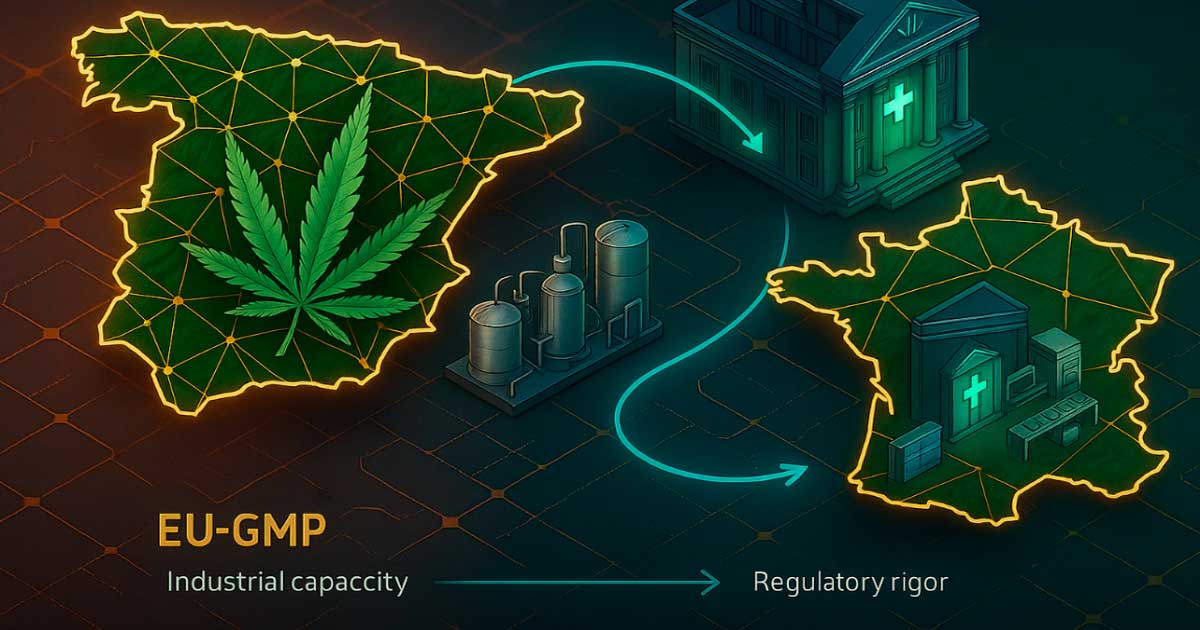
While Germany and the UK are redefining European standards for medical cannabis, France and Spain remain locked into cumbersome, fragmented regulatory frameworks. The contrast is all the more striking given that these two countries are among the largest potential markets - with almost 5 million annual users in Spain and over 5 million in France - and have major assets in terms of clinical research and pharmaceutical capacity.
In France, five years of experimentation have resulted in the treatment of fewer than two thousand active patients; in Spain, despite ten authorized companies, no domestic market has emerged before the reform announced for late 2025.
As the Cannabis market report Spain 2025, The country has already exported over 22 tonnes of medical flower by 2025, yet remains unable to serve its own patients. Neither France nor Spain lack skills or infrastructure; it's their restrictive models that prevent them from converting their industrial capacity into a truly large-scale market.
The restrictive convergence of the French and Spanish models in the face of an opening Europe
While Germany and the United Kingdom have built access models based on a broad available in pharmacies, and various formats including inhalable flower, and telemedicine services and telepharmacy to streamline the patient journey, France and Spain have deliberately opted for control frameworks designed primarily for secure the regulatory process, and only then to allow access.
In Germany, this open architecture has led to massive adoption of medical cannabis: more than 160 tonnes imported by 2025, thousands of patients monitored remotely, and a market where inhalation - essential in the management of acute pain - is regulated.
Admittedly, the German and British models present a risk: too much concentration of prescriptions in a few private platforms, attracting criticism of potential abuses. But this model has enabled a rapid transition for patients who previously self-medicated: they now have access to structured clinical follow-up.
Conversely, France and Spain have built systems whose priority is institutional control, often influenced by the concerns of security forces - hence the strict exclusion of flower, despite its documented clinical use in other countries.
This choice contrasts all the more sharply with the results observed in the two countries: data from the French experiment show a outstanding safety profile, with only 86 significant adverse events and fewer than 20 hospitalizations - even though the program deals with severe indications: neuropathic pain (60 % of active patients), multiple sclerosis, epilepsy, cancer or palliative care. Spain will adopt similar indications, with a broader definition of chronic pain.
The other major difference lies in the access architecture. In France, over 2,200 professionals have been trained, including almost 1,000 dispensing pharmacists, enabling a gradual evolution of the model initially focused on hospitals: in 2025, 53 % of prescriptions are already dispensed by pharmacies, A sign that the ecosystem is looking to expand. Spain, on the other hand, remains an even more closed model: hospital prescription only, dispensing reserved for the 353 hospital pharmacies, and a structural inability to mobilize the pharmacy network - making it difficult to ramp up quickly and posing a major challenge for already saturated hospitals.
Finally, the two countries share an additional constraint: an access architecture dependent on product registration, even if the regulatory structures are very different: France operates with finished products, supplied directly in their pharmaceutical form, while Spain imposes a master model, The pharmacist prepares each product in the dosage determined for a specific patient.
In both cases, the’Register each product aligns these systems with the most restrictive models in Europe, such as those in Poland or Ukraine, in contrast to open markets such as Germany or the UK, where simple compliance with pharmaceutical standards is sufficient for market access, without a full pharmaceutical dossier for product registration - which facilitates the entry of new suppliers.
These restrictive frameworks certainly have their advantages: a strong clinical legitimacy, This is a major difference from the German and British models, where the majority of patients pay out-of-pocket. But the French and Spanish systems are still far from being able to meet the real needs, estimated at several hundred thousand patients in each country. The graphs from the French experiment perfectly illustrate this asymmetry: after four years of effort, only 1,683 patients remain active. In Spain, the market has still not begun: no prescriptions until the second half of 2026, even though the country has exported over 22 tonnes of medical cannabis up to September 2025.
In a nutshell: where Europe is moving towards open, multi-channel, patient-centric models, France and Spain remain structured as if the main risk were to be the access itself - and not the disease these treatments are intended to alleviate.
Paradoxes of unfinished development: linking industry, patients and the healthcare system
While France and Spain share a restrictive access model, their industrial trajectories are very different - but converge towards the same blockage: the inability to link real productive capacity to a functional domestic market. Yet both countries have dynamic ecosystems: in Spain, some 70 companies active in the medical segment represent 148 million euros in assets, concentrated in a few large-scale projects - several hectares of greenhouse cultivation, extraction, irradiation and processing platforms and EU-GMP infrastructures.
In France, despite the lack of domestic production in the experimental phase, a sovereign sector is emerging: Overseed, which raised over 8 million euros, Chenevia or even DelleD-La Fleur are seeking to structure a national value chain capable of supplying the domestic market and targeting exports. So it's not industrial ambition that's lacking, but the framework to connect it to real access.
Spain is a particularly striking example of this paradox. The country has an advanced pharmaceutical infrastructure, but its industry is almost exclusively export-oriented. According to Cannabis market report Spain 2025, more than 22 tonnes of medical flowers were exported in 2025... while only 8 tonnes come from domestic crops. The remaining 14 tonnes were used for reconditioning, biomass extraction or irradiation for microbiological control, prior to re-export to Portugal, Germany, the UK or Switzerland.
This means that two out of every three products exported from Spain have never been grown on Spanish soil. This model, close to that of an integrated pharmaceutical hub, offers obvious potential - formulation, development of new formats, clinical trials, analysis, regulatory services - but also exposes us to extreme dependence on volatile foreign markets, As demonstrated by the recent Portuguese blockage linked to stricter reporting and licensing standards, or as illustrated by tensions over the German import quota, or the 2023-2024 dronabinol shortage which led to clinical deterioration for 86 % of the patients concerned.
France, for its part, has a dense pharmaceutical fabric, a powerful pharmacy network and a credible start-up ecosystem, but these assets remain disconnected from the real market. All experimentation relies on imports, subject to geopolitical and logistical uncertainties. This structural fragility is compounded by a persistent political instability parliamentary dissolution, fall of the government, successive postponements, delayed TRIS, and lack of roll-out schedule.
Patients remain in a transitional system, threatening the access of nearly 1,500 people if the framework is not adopted before 2026. Despite investment by manufacturers, uncertainty on the part of the state is hampering the consolidation of a sovereign sector.
CBD acts as a further indicator of this inability to regulate what we tolerate. In France, the 2021 Conseil d'Etat ruling had stabilized the industry, allowing hundreds of stores to open and legitimizing sales in tobacconists' shops. However, the 2026 Finance Bill seeks to refocus the market within the tobacconists' monopoly and to apply a tax of 26 %, threatening the competitiveness of the industry, jobs and consumer accessibility - a paradox for a non-narcotic product widely used for well-being and which is going to be included in the CAP.
In Spain, the situation is even more incoherent: total absence of regulation, restrictive case law since 2021 for producers, unofficial ban on sales in estancos, unregulated retail distribution. Regulation similar to that of tobacco (restriction to minors, quality control) could improve the situation. However, it is essential to keep taxation low and authorize distribution via independent stores and online platforms.
In the end, both France and Spain show the same limitations: a growing industrial sector, massive social use, but a government unable to build a stable, clear and coherent access market. Until this link between industry, prescribers and patients is established, neither nation will be able to claim a major role in the European architecture of medical cannabis.
Europe's leadership potential requires structural reforms
France and Spain have many elements of European leadership: clinical expertise, pharmaceutical infrastructure, export industry, innovative ecosystems, and a potential market of over ten million users between the two. Almost one in three Europeans who use cannabis lives in one of these countries.
Yet their access models - designed to reassure regulators rather than serve patients - produce systems so restrictive that they remain incapable of absorbing real demand, disconnected from the European dynamic of widening access. To overcome this paradox, both countries need to build on their strengths, but move from a model of limitation to one of integration, where industry, prescribers and patients finally form a coherent system.
The first emergency is open access beyond reference centers and standardize prescribing. This means fully integrating community pharmacies, enabling telemedicine within a secure framework, and adapting acquisition procedures to bring in formats that are genuinely useful in the clinic - including inhalable forms that are currently excluded, even though they are crucial for certain acute pain and symptoms.
It's just as important secure upstream industry. Both countries need to maintain a stable framework for domestic production, support the registration of new products, make large-scale experimentation and observational studies viable, and harmonize quality requirements to mitigate the volatility of international markets. A clear and predictable basis for producers - whether they are already exporters or just starting out - is essential to guarantee patient supply, rather than continuing to expose the system to shortages or short-term political arbitration.
The procedure is clear: build a wide, pharmaceutical, controlled but truly functional access point. Otherwise, France and Spain will continue to produce a sterile paradox: abundant expertise, a high-performance industry, millions of users - but no market. In a Europe rapidly converging towards more mature models, they now have only two options: reform or let others set the standards for medical cannabis for the next decade.
























Medical Cannabis in Germany: THC Prices Vary by a Factor of 12

France already has 3,000 cannabis retail outlets. None of them are legal.

Morocco's exports of legal cannabis have expanded to 15 countries

Aurora Cannabis Doubles Its Production Capacity in Germany

Tilray is accelerating its operations in Europe thanks to a license in Portugal

Boston will host the 10th annual State of the Cannabis Industry Conference on October 26

A DEA report confirms that there are no fatal cannabis overdoses

A British patient is challenging the NHS's refusal to reimburse medical cannabis

October 2026 CBD Highlights: 10 Strains and Hash to Discover from 5 French Producers

CBD in France: Traceability, Retail Stores, THC and Driving… What the New Bill Proposes
-
 Business2 weeks ago
The legal cannabis market in New York exceeds 4 billion $ in revenue
-

 Cannabis in France3 weeks ago
Which countries legalized medical cannabis before France?
-
Business3 weeks ago
South Korea is preparing to begin local production of medical cannabis to meet rising demand
-
Cannabis in Thailand3 weeks ago
From the boom in dispensaries to a purely medical approach: Thailand is revising its cannabis policy
-
Cannabis and driving3 weeks ago
Medical Cannabis and Driving: New South Wales Ends Automatic Penalties for THC
-
Autism3 weeks ago
Autism and Cannabis: Results from the First Placebo-Controlled Trial of NTI164
-
Cannabis in France2 weeks ago
France’s Drug Policy Chief Defends Cannabis Prohibition... and Runs Into the Facts
-
CBD1 week ago
In Brazil, researchers are developing an innovative CBD eye drop

















You must be logged in to post a comment Login