Patients increasingly turn to cannabis to treat mood disorders


Analysts at CB2 Insights conducted a survey of the main conditions for which patients use medical cannabis in the United States. Their report highlights the predominance of mental health and mood disorders, and underscores the lack of recognition of such conditions in legal medical cannabis programs and research. The researchers call for more research into cannabis as a potential treatment in a context of social and health emergency.
The study
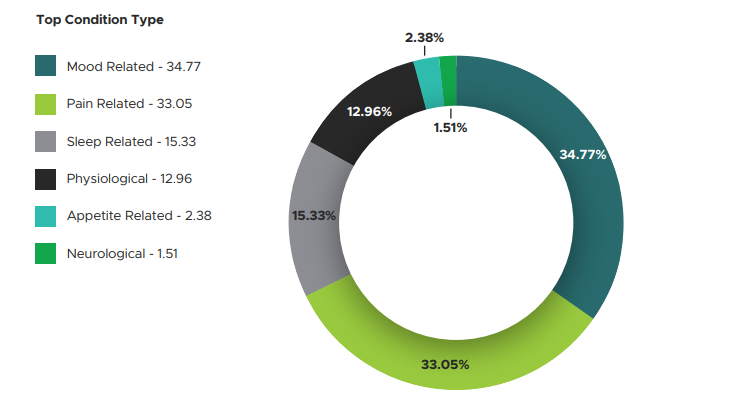
The researchers surveyed 463 patients from 16 different clinics in 4 different states (Massachusetts, Maine, Connecticut, Delaware) over a 4-week period. They first listed the specific conditions that attracted patients to the use of medical cannabis, then grouped them into categories. At the top of the list were mood disorders (depression, anxiety, PTSD), which accounted for 34,77% of patients, followed by pain-related conditions (33,05%), sleep disorders (15,33%), physiological disorders (12,96%), appetite disorders and neurological disorders (<5%).
33 US states and Washington DC have already set up medical cannabis programs. However, there are major discrepancies between these programs: some states authorize almost 40 illnesses, while others allow only 8, and still others leave the decision to practitioners, who can prescribe cannabis when they deem it necessary. In total, at least 70 illnesses are recognized for the use of medical cannabis, but in the majority of cases, mood disorders are not.
In Massachusetts and Maine, where the majority of patients surveyed reside, doctors are authorized to prescribe medical cannabis when they deem it necessary. Patients can therefore have access to it to treat mood disorders, and it seems that many of them do, since this is the primary reason for prescribing medical cannabis according to this study. Other studies, on the other hand, show that it's more likely to be chronic pain prevails but perhaps it's simply because of the lack of access to cannabis for mood disorders.
Of the 26 states that have established a list of diseases, none include mood disorders in their program - with the exception of post-traumatic stress disorder (24 states). This suggests that the use of cannabis to treat mood disorders is not a priority among research and regulators, despite the fact that it is common practice among patients. It's also possible that cannabis is still suffering from prohibitionist propaganda, which has always associated it with psychosis.
Mood disorders, a health emergency
According to the U.S. Centers for Disease Control (CDC), antidepressant use has increased by 65% since 1999. According to CB2 Insights researchers, the propensity of doctors to prescribe antidepressants and the growing dependence of patients on these drugs suggest that mood disorders should be given greater recognition by government authorities. The CDC recently published a study according to which in 25 states and at federal level, suicide is now among the top 10 causes of death, and is directly contributing to the country's falling life expectancy.
In France, it is estimated that nearly one person in five has suffered, is suffering or will suffer from depression in the course of his or her life. The National Suicide Observatory report published a year ago, shows that there is on average more than one suicide per hour in France (around 10,000 per year). Suicide has become the second leading cause of death in the 15-29 age group worldwide, after road accidents and stroke. according to WHO figures, Depressive disorders are the world's leading cause of morbidity and disability.
Despite these figures, mental health disorders are still poorly understood and poorly treated. Cannabis could be a possible alternative to antidepressants, given that it actually plays a role in mood regulation by acting on the endocannabinoid system. Research is lacking on the subject, but patients seem to be turning more and more to cannabis to treat these conditions.
Analysts at CB2 Insights choose to work with real data (Real World Data) to be able to highlight the gap between cannabis regulation and actual patient practice, and potentially direct research towards these practices. «RWD could be the key to filling in the grey areas left by the restrictions on traditional randomized clinical trials. Cannabis opens up an infinite horizon for research. However, unlike other medications that have come onto the market, the proliferation of cannabis as a medicine has short-circuited the structure of traditional clinical trials.».








JIHE 2026: Japan’s Largest Trade Show Dedicated to Hemp and CBD Returns to Tokyo with More Than 100 Industry Players
New Caledonia: The Courts Clear the Way for the Return of CBD

The Brazilian medical cannabis market continues to grow

Morocco: Three Cannabis-Based Medications Approved for the Treatment of Epilepsy

Canopy Growth Receives New EU-GMP Certification to Strengthen Its Presence in Europe

Three years after legalizing medical cannabis, Albania continues to establish regulations for it

The first plant-based medical THC spray arrives in the United Kingdom

Medical Cannabis in Germany: THC Prices Vary by a Factor of 12

France already has 3,000 cannabis retail outlets. None of them are legal.

Morocco's exports of legal cannabis have expanded to 15 countries
-
 Business2 weeks ago
The legal cannabis market in New York exceeds 4 billion $ in revenue
-

 Cannabis in France4 weeks ago
Which countries legalized medical cannabis before France?
-
Business4 weeks ago
South Korea is preparing to begin local production of medical cannabis to meet rising demand
-
Cannabis in France4 days ago
France already has 3,000 cannabis retail outlets. None of them are legal.
-
Cannabis in Thailand4 weeks ago
From the boom in dispensaries to a purely medical approach: Thailand is revising its cannabis policy
-
Cannabis in the U.S.5 days ago
A DEA report confirms that there are no fatal cannabis overdoses
-
Cannabis and driving3 weeks ago
Medical Cannabis and Driving: New South Wales Ends Automatic Penalties for THC
-
Cannabis in France3 weeks ago
France’s Drug Policy Chief Defends Cannabis Prohibition... and Runs Into the Facts
















You must be logged in to post a comment Login