The recent history of cannabis in Canada

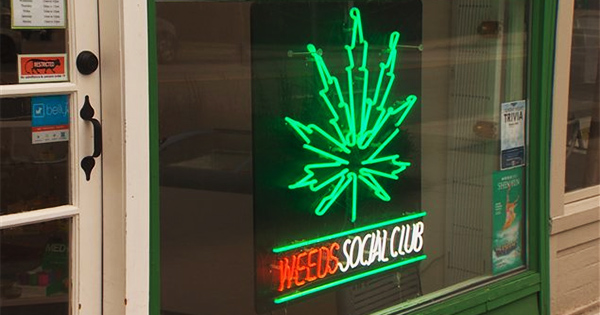
British Columbia has already authorized some medical cannabis treatments, and the legalizing cannabis in Canada should move forward in earnest in 2016 with the election of Justin Trudeau. But like many countries, Canada has had a complicated relationship with cannabis in recent years. Recap.
1922
Emily Murphy, feminist before her time and Canada's first female judge, publishes «The Black Candle», a lengthy 400-page topo against drug use and the threat of the «yellow and black races». In it, Murphy quotes a police chief as saying that weed smokers «go berserk and are capable of killing and engaging in all manner of violence on others, using cruel methods without any sense of morality».
1923
Parliament ratifies the «Prohibition Act for the Improper Use of Opium and Other Drugs», which classified cannabis, and other substances such as heroin and codeine, as illegal drugs. The law included a passage allowing foreign drug dealers to be deported, and historians have seen in hindsight that it penalized Asian Canadians more severely than whites.
1932
This is the first time that Canadian police have recorded a seizure of cannabis cigarettes. «They are particularly dangerous to young people, whose use is extremely confined, and all indications point to the fact that their illicit sales take place in cabarets and dance halls where young people, previously not connected with narcotic use, congregate», reported the Chief of the Canadian Narcotics Service, Colonel C. H. L. Sharman, in March 1933.
1936
The film « Reefer Madness »released in the U.S. and Canada, depicts a melodramatic story of teenage cannabis smoking, leading to a hit-and-run, murder, attempted rape, hallucinations, and even a descent into the hells of addiction and madness. The film was originally titled «Tell Your Children» and was funded by a church group.

Screenshot of Reefer Madness
1938
The Toronto Daily Star publishes an article on the perils of cannabis under the headline «Cannabis smokers seized by sudden urge to kill: officers warn cannabis is even being distributed in schools».
1961
With the awakening of the counterculture in the 60s, the use of cannabis, and other drugs, increased among middle-class youth. The passage of the Narcotic Control Act increased the maximum penalty for cannabis possession to 7 years« imprisonment. The maximum sentence for trafficking is set at 25 years, which is considered a life sentence in Canada. These stiff penalties did nothing to curb cannabis use.
1969
Under the mandate of Prime Minister Pierre Trudeau, father of current Prime Minister Justin Trudeau, the Canadian government convened a Royal Commission to establish an evidence-based drug policy, chaired by Gerald Le Dain, who would later sit on the Supreme Court. «This is an opportunity for Canada to lead the world,» John Lennon told the commission.

Prime Minister Pierre Trudeau in 1977. His hand is placed on Justin Trudeau's head.
1972
20 young women spend 98 days at the Addiction Research Foundation in Ontario trying to determine the effects of daily cannabis use, with a battery of physical and mental tests. The findings of this study, known as Project E206, were never made public.
1973
Le Dain commission publishes an 1148-page report, which found cannabis-related penalties to be «grossly excessive» and «completely unreasonable». The commission noted the concerns of health professionals that chronic cannabis use may lead to mental disorders such as schizophrenia, but found no evidence to support a link with violent crime.
This commission was already casting doubt on the link between cannabis use and a switch to harder drugs, and declared that cannabis possession did not «justify imprisonment». The commission was praised for its work by legal experts and doctors, but did not result in any legal changes.
1977
Canadian newspapers quote Prime Minister Pierre Trudeau in a speech to the Young Liberals Club at the University of Toronto: «Government policy is such that if you have a joint and smoke it for your own pleasure, you shouldn't be harassed.» He also reportedly dodged questions about his own cannabis use and suggested that legislative change was on the cards.
1979
Progressive Conservative Prime Minister Joe Clark gives a speech announcing the government's intention to reform parts of the Criminal Code on cannabis, but the government is ousted before any changes can be made. Trudeau's Liberals were re-elected and signed the United Nations« »Convention on Psychotropic Substances", which shelved any changes to cannabis legislation.
1981
The United States, through the voice of Ronald Reagan, declare war on drugs. This highly repressive policy would influence the USA and Canada for the next 20 years.
1987
Canada's Drug Strategy was created to coordinate the efforts of various governments and NGOs on the problem of drug abuse in Canada.
1990-1994
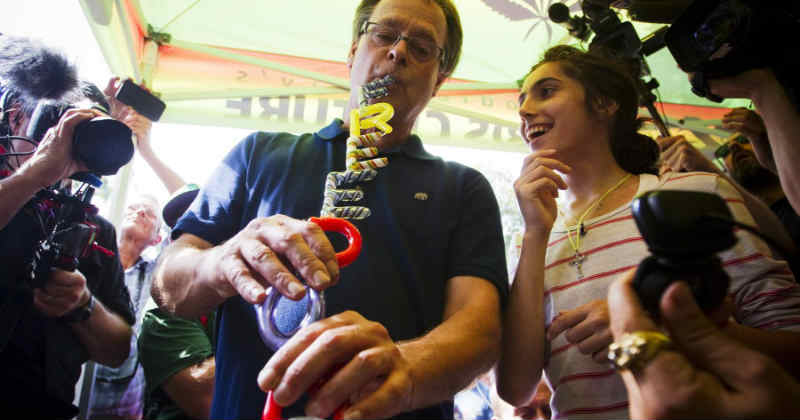
The libertarian activist Marc Emery was convicted of selling copies of 2 Live Crew's album As Nasty As They Wanna Be, which had been banned in Ontario for obscenity. After his conviction, Emery began selling copies of High Times magazine in protest against a 1998 law prohibiting the literary promotion of «the production, preparation or consumption of illicit drugs».
In 1994, Emery, then managing a Vancouver headshop and selling cannabis seeds by mail, helped finance a lawsuit in which an Ontario court overturned a literary ban. His support eventually earned him the nickname of Canada's «Prince of Cannabis».

Marc Emery on his return to Canada in 2013, after 5 years in prison in the USA for the illegal sale of cannabis seeds.
1997
The government of Liberal Prime Minister Jean Chrétien passes the Substances and Drug Control Act, repealing the 1961 Narcotic Control Act. The law was strongly criticized by the Canadian Police Association and the Canadian Bar Association, notably for postponing a possible war on drugs.
1997-2000
Terrence Parker, a man with epilepsy who uses cannabis to relieve his seizures, is arrested and jailed for possession of cannabis. The ensuing legal battle led the Ontario Court of Appeal to rule that «the prohibition against possessing or cultivating cannabis for personal use and thereby treating the accused's epilepsy deprives him of his rights to liberty and security of the person», setting a legal precedent from which most future judgments will flow.
2001
In response to the Parker affair, the government introduced the Regulating Access to Canadian Medical Cannabis Act, allowing patients to grow their own cannabis or obtain it from the Canadian Ministry of Health or authorized producers.
2002
A Senate study reaffirms the conclusions of the Le Dain commission: «The commission concluded that the criminalization of cannabis has no scientific basis. We confirm this conclusion and add that the continued criminalization of cannabis remains unjustified according to scientific data on the danger it poses».
2008
Police discover 40,000 cannabis plants in an Ontario cornfield, a find valued at $40 million and the largest drug seizure in Canadian history.
2009
Marc Emery was sentenced in absentia to 5 years in an American prison for selling cannabis seeds to customers in the USA. Emery, who already had several convictions in Canada, was extradited in 2010 and served 4 years of his sentence.
2012
26,099 Canadians are charged with cannabis possession during the year. Stephen Harper's Conservative government introduces the «Safe Streets and Communities Act», creating mandatory minimum prison sentences for cannabis cultivation. At the same time, the federal Liberal party, under the interim leadership of Bob Rae, votes overwhelmingly to support policies to legalize and tax cannabis. In the USA, the Colorado and Washington adopt the legalization of cannabis for recreational use.
2013
The Canadian Association of Chiefs of Police announce that they do not support the decriminalization or legalization of cannabis, But they suggested that people caught in possession should be fined rather than arrested. «Under the current law, the only option for police in cases of simple possession is to turn a blind eye,» said Jim Chu, the association's president, at the time. New Liberal leader Justin Trudeau tells the press that he smoked cannabis when he was a Member of Parliament and reaffirms his party's support for cannabis legalization. Uruguay becomes the first country to legalize cannabis.
2014
The «Regulation of Cannabis for Medical Purposes» law comes into action in Canada and creates a market of government-approved medical cannabis producers. A court ruling prevents further legal changes that could ban cannabis plants for personal medical use.
2015
Vancouver becomes the first city to regulate a gray market of cannabis dispensaries that have exploded in number: they sell a substance that isn't illegal, but whose acquisition channels aren't necessarily legal. Conservatives threaten to call in the Canadian Mounties to shut down cannabis stores.
During his campaign, Stephen Harper declares cannabis infinitely worse than tobacco, 86% of Canadians support the legalization or decriminalization of cannabis, even among Conservatives (75%).
Justin Trudeau finally confirm that he will keep his campaign promise to legalize cannabis in Canada.









«Vincy Gold»: Humboldt Seed Company on the Hunt for Saint Vincent Sativas

Cronos Completes the Acquisition of CanAdelaar for 57.5 million euros

Cannabis with a "bloody" twist: Discover Sensi True Blood and Sensi Sangria, the two new strains from Sensi Seeds

Hemp: The Council of the EU Takes a Stand on New Production and Marketing Rules

Missouri's legal cannabis market accounts for 93 % of consumer spending

THC Gummies: How to Read a Certificate of Analysis Before Buying

British patients now have access to THCV-rich cannabis flowers

Spain: Medical Cannabis Is Coming to About 50 Hospitals

JIHE 2026: Japan’s Largest Trade Show Dedicated to Hemp and CBD Returns to Tokyo with More Than 100 Industry Players

New Caledonia: The Courts Clear the Way for the Return of CBD
-
 Business3 weeks ago
The legal cannabis market in New York exceeds 4 billion $ in revenue
-

 Cannabis in France4 weeks ago
Which countries legalized medical cannabis before France?
-
Cannabis in France1 week ago
France already has 3,000 cannabis retail outlets. None of them are legal.
-
Business4 weeks ago
South Korea is preparing to begin local production of medical cannabis to meet rising demand
-
Cannabis in the U.S.1 week ago
A DEA report confirms that there are no fatal cannabis overdoses
-
Cannabis in Thailand4 weeks ago
From the boom in dispensaries to a purely medical approach: Thailand is revising its cannabis policy
-
Cannabis and driving4 weeks ago
Medical Cannabis and Driving: New South Wales Ends Automatic Penalties for THC
-
Cannabis in France3 weeks ago
France’s Drug Policy Chief Defends Cannabis Prohibition... and Runs Into the Facts
















You must be logged in to post a comment Login