Cannabis Europa 2024 Day 1: Europe's «tipping point


This year, the Cannabis Europa conference in London was brimming with positive energy following a year of significant developments in the cannabis industry.
Hosting thousands of delegates from the leading cannabis companies With participation from national organizations, patient advocacy groups, and policymakers, this year’s conference once again focused heavily on the German market, while also providing in-depth analysis of Europe’s second-largest market, the United Kingdom.
The list of speakers was also expanded, and lively debates on cannabis legalization were led by unexpected guests, as the event sought to include voices from outside the cannabis bubble.
Despite the wide variety of topics and speakers, one theme remained constant. The cannabis movement is now gaining real and effective momentum after a period of bleak financial prospects and lackluster regulatory progress.

Cannabis Europa Conference
Preliminary Remarks
Stephen Murphy, CEO of Prohibition Partners, set the tone right from the start by looking back on the conference’s inception in 2018, just a few months before medical cannabis was legalized in the United Kingdom and the initial «green rush» gained momentum, turning into a full-blown frenzy.
With 19 legal markets now open for business and the «United States on the verge of a resurgence,» Mr. Murphy exclaimed that this was now an «exciting time to be in the cannabis industry.».
However, emphasizing the lessons the industry must learn from its past, he suggested that it is now «our collective responsibility to build an industry with strong ethics and a positive legacy.».
«Today, the cannabis industry continues to open the door to opinions, attitudes, and social debates that go beyond cannabis itself. I didn’t put too much pressure on everyone this morning, but your actions and decisions have a much greater impact.».
He was quickly followed by Prohibition Partners’ lead analysts, Alex Khourdaji and Lawrence Purkiss, who discussed their recent European report—the 9th edition—laying the groundwork for the discussions to come.
They discussed the surprising findings of the report, and after their conclusions sparked some controversy, they examined the methodology behind the figures.
The differences between Germany—which remains 1.7 times larger than the British market—and the drastically higher consumption rates in the latter were the focus of the discussions.
We were surprised to find that import figures are relatively similar on a monthly average basis in the United Kingdom (2,600 kg) and Germany (2,700 kg).
With an estimated 60,000 patients prescribed medical cannabis in the United Kingdom, the figures suggest that these patients consume, on average, twice as much as German patients.
Despite nearly quadrupling in size in 2023, they suggest that the industry is growing only to the extent that strict regulations allow. Furthermore, the sector remains hampered by the limited number of doctors who actively prescribe, since only 200 doctors out of a possible total of 80,000 do so. This problem is, however, mitigated by the growth of telehealth clinics.
Growth in the United Kingdom
Still in the United Kingdom, another discussion group met that morning to discuss the outlook for the British market and the potential for change with the new government set to take office next month.
It was the first lively session of the day, during which panelists and audience members debated the direction of the booming British medical industry.
Pierre Van Weperen, CEO of Grow Pharma, said he expected to see 100,000 patients by the end of the year, even though he believed that the political parties likely to take power had no intention of changing the current framework.
«People forget that even if you change that, we're working with a healthcare system that's in shambles. There will always be a private market.».
However, he suggested that the United Kingdom was unique in its skepticism toward private health care, and stated that he was not convinced that price was the key factor preventing patients from turning to the medical market, but rather that it was a matter of awareness.
He suggested that «anything we can do to raise awareness is a good thing» and that the industry should strive to do more advertising while adhering to strict marketing guidelines.

Cannabis Europa Conference
Robin Emerson, CEO of Jorja Healthcare, disputed this view, arguing that brands that appear to appeal to adult consumers bring the medical industry into disrepute.
Jonathan Hodgson, Curaleaf International’s director for the United Kingdom and the Nordic countries, seems to agree that raising awareness is the cornerstone of growth in the United Kingdom.
«That’s what we need to do better as an industry—find these patients and bring them in, which is difficult to do given the regulations—rather than fighting over 50,000 or 60,000 patients,» he said.
Suggestions from the panel and the audience that the sector should unite rather than compete prompted further comments from the audience that few people had invested money in awareness campaigns.
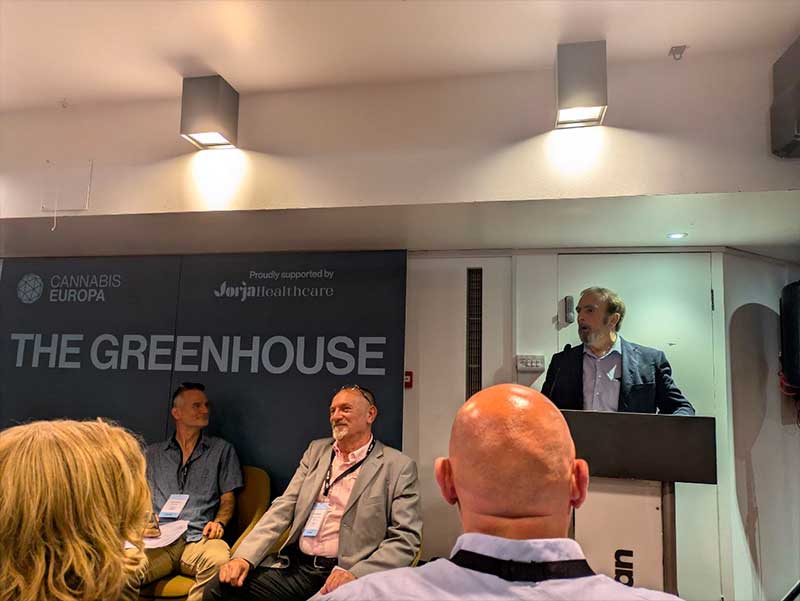
This heated debate reached its climax toward the end of the conference, when Peter Reynolds, a cannabis advocate and industry veteran, faced off against Peter Hitchens, a prominent cannabis skeptic, to discuss the merits (or dangers) of cannabis decriminalization.
Mr. Reynolds began by suggesting that the United Kingdom had been plagued by a flawed drug policy since 1928, and that prohibition was not only the worst social policy since the war, but was also far more responsible for the decline of society than drugs themselves.
According to him, prohibition put money in the hands of criminals and posed a greater danger to children than cannabis itself, but he clarified that he did not believe cannabis was harmless.
«We have all the laws necessary to protect people without banning personal possession of anything… There is no doubt that the law has exactly the opposite effect. Laws against cannabis are the main cause of its harmful effects on children, precisely because it is banned.».
Mr. Hitchens responded by focusing primarily on the apparent correlation between cannabis use and mental health issues, adding that he was always struck by the enthusiasm with which Mr. Reynolds defended «what must be the most foolish cause.».
He added that the reason prohibition wasn't working was that it wasn't being enforced effectively, to which Mr. Reynolds replied that it was because the police had realized it was a «waste of time.».
«It's because of this ban that the police don't have time to deal with more serious crimes,» Mr. Reynolds added.
Cannabis Europa Conference
As might be expected, the two men were unable to reach a consensus regarding the potential health consequences of frequent cannabis use. Mr. Reynolds stated that these correlations were «tenuous at best,» suggesting that it was statistically much more likely for a person to be struck by lightning than to develop a mental illness caused by cannabis.
For his part, Mr. Hitchens drew comparisons with thalidomide (an argument often put forward by opponents of cannabis), suggesting that, in the absence of rigorous testing, cannabis remained dangerous.
«We’re at the same point we were 50 years ago, when research suggested that smoking was bad for your health. That was very bad for cigarette companies, just as it is today for people who attend conferences on cannabis.»
While Mr. Hitchens found little common ground with the rest of the audience, one passionate member of the audience wondered why he would deny patients treatments that could save their lives.
Mr. Hitchens replied that he was «fully in favor of medical research» and that if cannabis were proven to have medical benefits, he would support its use as a medicine, adding that he «does not deny that it may have medical benefits.».
A «starting gun for Europe”
In the wake of a series of cannabis-related events across Europe, the excitement was palpable in many discussion groups throughout the day, particularly with regard to the German market.
After cannabis was removed from the list of controlled substances on April 1, 2024, the panel quickly turned its attention to the tremendous growth that medical companies had experienced in the market.
Thomas Schatton, CEO of 420 Pharma, said that since the change, sales had «literally doubled,» adding that some pharmacies were so overwhelmed that they were forced to shut down their hotlines.
By streamlining the ordering process, he realized that the many employees he had previously hired to manage inventory were no longer needed.
«This is great for the cannabis industry… it’s a shift that’s taking place in society. We need to capitalize on this momentum and build a solid foundation. It’s not just a change in the law, but a change in people’s mindsets.»
Constantin von der Groeben, CEO of Demecan, who suggested that Germany had reached a «tipping point.».
«I’ve never seen anything like this in all my years working in the industry. It’s wonderful to be in this industry today, and that hasn’t always been the case.».
As for Demecan, one of only three German companies currently authorized to grow cannabis, he added that now that the restrictions on cultivation have been lifted, his company has already asked the BfArM to grow more varieties and expand its product range.

Cannabis Europa Conference
«I encourage everyone to take an interest in German culture; I think we can compete with imports.»
Taking a broader view, Kai-Friedrich Niermann, an industry expert and attorney specializing in cannabis law, said that changes could also be on the horizon within the European Parliament, following the creation of a working group focused on cannabis policy.
«If there is a new legal basis for cannabis policies in the European Union, it will be much easier for each country to legalize cannabis safely and in accordance with the law, without risking infringement proceedings from other nations. This is very, very important and could be a game-changer in the EU.».
However, Dirk Heitepriem, president of the German Cannabis Industry Association, suggested that this could take a long time.
«If we thought the German process was slow, the EU takes even longer. But I agree with Kai that a change is taking place.»
























JIHE 2026: Japan’s Largest Trade Show Dedicated to Hemp and CBD Returns to Tokyo with More Than 100 Industry Players

New Caledonia: The Courts Clear the Way for the Return of CBD

The Brazilian medical cannabis market continues to grow

Morocco: Three Cannabis-Based Medications Approved for the Treatment of Epilepsy

Canopy Growth Receives New EU-GMP Certification to Strengthen Its Presence in Europe

Three years after legalizing medical cannabis, Albania continues to establish regulations for it

The first plant-based medical THC spray arrives in the United Kingdom

Medical Cannabis in Germany: THC Prices Vary by a Factor of 12

France already has 3,000 cannabis retail outlets. None of them are legal.

Morocco's exports of legal cannabis have expanded to 15 countries
-
 Business2 weeks ago
The legal cannabis market in New York exceeds 4 billion $ in revenue
-

 Cannabis in France4 weeks ago
Which countries legalized medical cannabis before France?
-
Business4 weeks ago
South Korea is preparing to begin local production of medical cannabis to meet rising demand
-
Cannabis in France4 days ago
France already has 3,000 cannabis retail outlets. None of them are legal.
-
Cannabis in Thailand4 weeks ago
From the boom in dispensaries to a purely medical approach: Thailand is revising its cannabis policy
-
Cannabis in the U.S.5 days ago
A DEA report confirms that there are no fatal cannabis overdoses
-
Cannabis and driving3 weeks ago
Medical Cannabis and Driving: New South Wales Ends Automatic Penalties for THC
-
Cannabis in France3 weeks ago
France’s Drug Policy Chief Defends Cannabis Prohibition... and Runs Into the Facts

















You must be logged in to post a comment Login