Has the Italian Court of Cassation just banned the sale of diet cannabis?

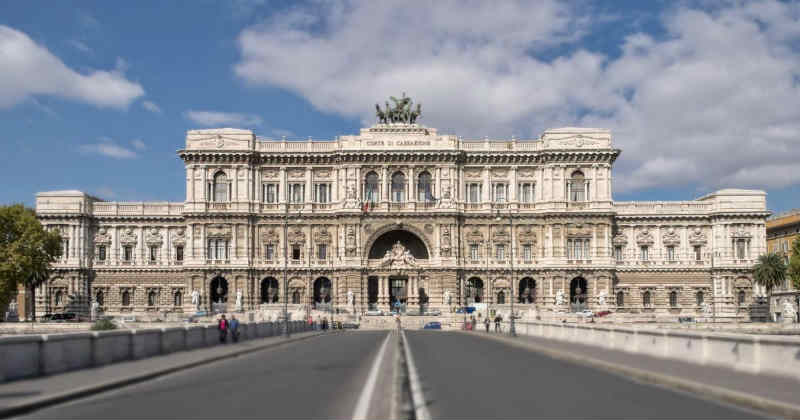
It's not a good time to be in business«.« cannabis light »in Italy. Not long ago, Matteo Salvini, the Minister of the Interior, had announced that he intended to close them down one by one. Last Thursday, a ruling by the French Supreme Court further weakened this flourishing but politically controversial industry.
The decision was taken to resolve a jurisprudential conflict between the sentences handed down by two criminal courts: one favorable and the other unfavorable to the sale of cannabis light and its derivatives. In reality, the decision of the Italian Court of Cassation does little to resolve the confusion.
A European issue
The hemp trade is regulated at European level. Initially, this trade was limited to intra-industrial trade, and the raw materials used were mainly fibers and seeds. However, the growing interest in CBD has focused attention on hemp flowers, giving rise to a new sector, that of hemp wellness, whose products are sold directly to the consumer.
European directives say nothing about the industrial use or marketing to the public of flowers and products derived from them. As «silence is consent», European entrepreneurs have exploited this legal vacuum, but the marketing of these products is worrying national authorities.
In France, the government considers that the European directive authorizing trade in hemp varieties registered in the Common Catalogue of Agricultural Plants, with THC levels not exceeding 0.2%, applies only to hemp stalks and seeds, and not to flowers and leaves (which contain CBD). By-products intended for everyday consumption must contain no trace of THC.
To date, no French or European court has definitively ruled on the validity of this French interpretation. The Cour de cassation has suspended pending the verdict of the European Court of Justice in the Kanavape trial, and numerous acquittals have undermined the’MILDECA's restrictive interpretation. The question therefore remains unanswered in France. On the other hand, the Italian Court of Cassation has ruled that the marketing of flowers, leaves, oils and resins should be considered as drug trafficking and therefore a crime.
The verdict
The court verdict essentially says two things:
- 1: «Marketing Cannabis Sativa L and, in particular, leaves, inflorescences, oils and resins obtained from the cultivation of the above-mentioned hemp variety, does not fall within the scope of the law n. 242 of 2016, which qualifies as lawful only the cultivation of hemp varieties listed in the common catalog of agricultural plant species within the meaning of Council Directive 2002/53/EC, of June 13, 2002, which exhaustively lists the derivatives of the above-mentioned crop that may be marketed».
- 2: «Consequently and in accordance with art. 73, paragraphs 1 and 4, d.P.R. n. 309/1990, the conduct, transfer, sale and, in general, the marketing to the public, for any reason whatsoever, of products derived from the cultivation of Cannabis Sativa L are a crime. unless these products are not narcotic in nature« .
As the name suggests, the 2016 law, otherwise known as «Provisions for the promotion of hemp cultivation and the agro-industrial hemp supply chain», is designed to support and develop the Italian hemp industry. It includes, in Article 2, a precise list of products or uses that justify the cultivation of hemp. The absence of flowers, leaves, oils and resins from this list justifies this verdict.
Products include «food and cosmetic products manufactured exclusively in compliance with the disciplines of the respective sectors» and «semi-finished products, such as fibers, shrimps, powders, wood chips, oils or fuels, for supply to industries and craft activities in various sectors, including energy».
A questionable decision
With regard to by-products, the Court's reservation seems to refer to the THC content of the products. In the end, the Italian Court of Cassation's ruling resembles the French government's position. Without banning CBD and hemp-derived convenience products, it limits their marketing in a roundabout way. In short, leaves, flowers, oils and resins cannot be sold directly to the public, and products derived from or containing them must not contain THC (which is virtually impossible).
However, the verdict does not specify that the products must contain no trace of THC, it only says «unless these products are not actually narcotic». At 0.2% THC, a product will not really have a narcotic effect. This qualification is therefore debatable. Two lawyers working on the subject Lorenzo Simonetti and Caludio Miglio explain There will be an opportunity to challenge this sentence. Nothing in law is untraceable. There's an 80 million euro deal on the table«.















CBD in France: Traceability, Retail Stores, THC and Driving… What the New Bill Proposes

Organigram Enters the Race for Aurora Cannabis

Medical Cannabis: Augur Associates’ latest report provides an update ahead of the publication of the decrees

Golden Buds is relaunching its Nova High vape pens with a cannabinoid formula that’s out of the ordinary

Cannabis is now Canada's fifth-largest commercial crop

Bedrocan Finally Declared Bankrupt

After CBD, Can Wellness Exist Without Cannabinoids?

Uganda Launches a Cooperative Dedicated to Medical Cannabis

Ukraine: First Cancer Patient Prescribed Medical Cannabis

Cannabis Oil and Endometriosis: A Promising Study for Pain Relief
-
 Business1 week ago
The legal cannabis market in New York exceeds 4 billion $ in revenue
-

 Cannabis in France3 weeks ago
Which countries legalized medical cannabis before France?
-
Business3 weeks ago
South Korea is preparing to begin local production of medical cannabis to meet rising demand
-
Cannabis in the Netherlands4 weeks ago
One year after the launch of the Dutch cannabis experiment, the first trends are emerging
-
Cannabis in Thailand3 weeks ago
From the boom in dispensaries to a purely medical approach: Thailand is revising its cannabis policy
-
Cannabis and driving3 weeks ago
Medical Cannabis and Driving: New South Wales Ends Automatic Penalties for THC
-
Cannabis in Argentina4 weeks ago
Argentina Opens Its Market to Hemp Flowers Containing 1% of THC
-
Autism3 weeks ago
Autism and Cannabis: Results from the First Placebo-Controlled Trial of NTI164
















You must be logged in to post a comment Login