Study: a controversial substance in European CBD e-liquids


Scientists have detected the presence of vitamin E acetate in some European CBD e-liquids. Also known as tocopherol acetate, this controversial substance is believed to be responsible for the deaths of 68 people. The study, conducted by Fundación Canna, The CBD e-liquid research team analyzed 15 samples of CBD e-liquids, purchased anonymously to avoid any risk of fraud.
Vitamin E acetate was found in e-cigarettes and in the lungs of 68 patients who died in hospital, although it is not known whether there is a causal link between the two events. And of the 15 CBD e-liquids analyzed by the Spaniards, one tested (largely) positive for tocopherol acetate.
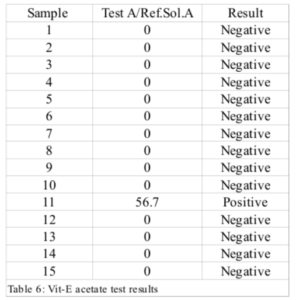
«There is no data to prove that this substance can be dangerous when inhaled via e-liquids., the scientists qualify. However, the presence of vitamin E acetate in people with serious lung problems makes it more likely that they'll need it. not recommended for consumption.»
7 % less CBD than promised on the label
The researchers also looked at the actual CBD levels observed in each bottle. And the results aren't good. When you buy a CBD e-liquid for an electronic cigarette, you'll get an average of 7 % less cannabidiol than promised on the label. And, in fourteen cases, the levels of the molecule are lower. For one of these bottles, the actual level is even 80 % below the commercial promise. In other words, almost half as much.
Conducted in partnership with the Phytoplant Research laboratory (which develops plant-based medicines) and the Catalan public agency Institut de Recerca i Tecnologia Agroalimentaries, This study confirms the fears of CBD professionals. «It pisses me off to see 10-20 % of CBD, it's completely wrong», says a French salesman contacted by Newsweed.
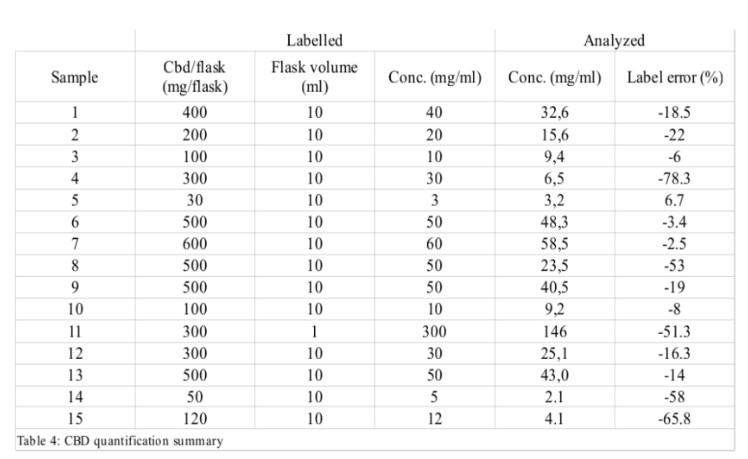
In all, only one sample proposes a CBD level 6 % higher than the dose indicated on the label. «The difference between the promise of the label and the actual quantity is very high., conclude the authors. The lack of homogeneity [between samples] is also significant. This highlights a lack of controls, and a lack of good manufacturing practices.
Finally, the authors of the study analyzed the presence of THC, traces of which were found in all the samples. «This suggests that CBD is derived from cannabis biomass, and is not synthetic. » But beware of saliva tests! «Depending on the quantity consumed, this substance may test positive for drug use. »






















October 2026 CBD Highlights: 10 Strains and Hash to Discover from 5 French Producers

CBD in France: Traceability, Retail Stores, THC and Driving… What the New Bill Proposes

Organigram Enters the Race for Aurora Cannabis

Medical Cannabis: Augur Associates’ latest report provides an update ahead of the publication of the decrees

Golden Buds is relaunching its Nova High vape pens with a cannabinoid formula that’s out of the ordinary

Cannabis is now Canada's fifth-largest commercial crop

Bedrocan Finally Declared Bankrupt

After CBD, Can Wellness Exist Without Cannabinoids?

Uganda Launches a Cooperative Dedicated to Medical Cannabis

Ukraine: First Cancer Patient Prescribed Medical Cannabis
-
 Business1 week ago
The legal cannabis market in New York exceeds 4 billion $ in revenue
-

 Cannabis in France3 weeks ago
Which countries legalized medical cannabis before France?
-
Business3 weeks ago
South Korea is preparing to begin local production of medical cannabis to meet rising demand
-
Cannabis in the Netherlands4 weeks ago
One year after the launch of the Dutch cannabis experiment, the first trends are emerging
-
Cannabis in Thailand3 weeks ago
From the boom in dispensaries to a purely medical approach: Thailand is revising its cannabis policy
-
Cannabis and driving3 weeks ago
Medical Cannabis and Driving: New South Wales Ends Automatic Penalties for THC
-
Cannabis in Argentina4 weeks ago
Argentina Opens Its Market to Hemp Flowers Containing 1% of THC
-
Autism3 weeks ago
Autism and Cannabis: Results from the First Placebo-Controlled Trial of NTI164

















You must be logged in to post a comment Login