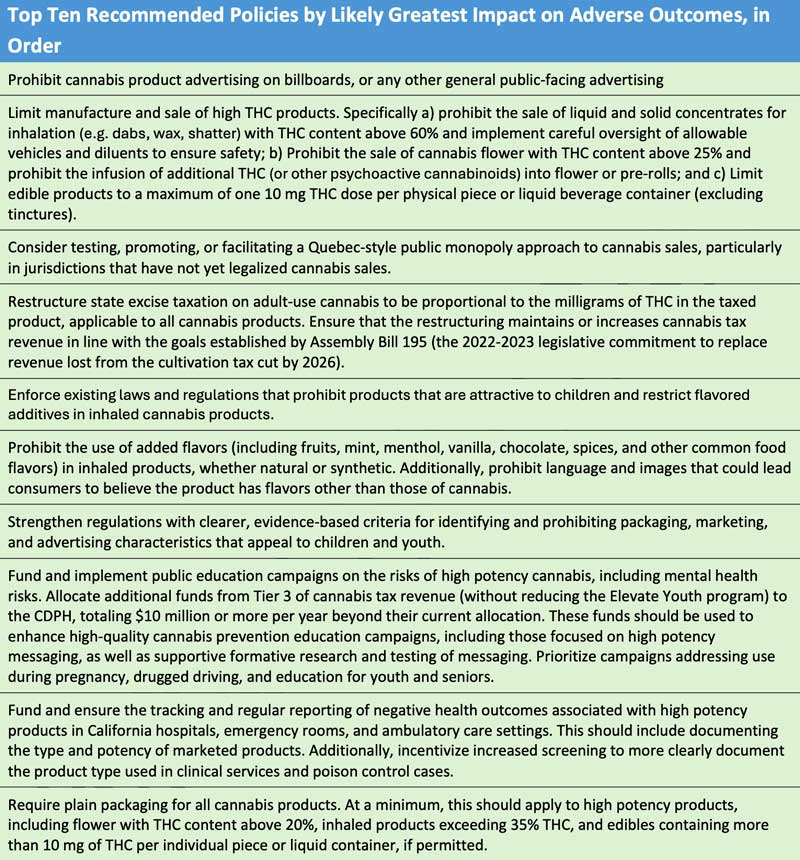
A new report released Wednesday by a panel of experts convened by the California Department of Public Health (CDPH) makes a number of major policy recommendations that would radically alter the landscape of the state's cannabis market, such as limiting the THC content of cannabis flower and concentrates, requiring products to be sold in plain packaging and establishing a state-run cannabis monopoly, similar to the stores operating in Quebec.
ADVERTISING
Here's an overview of their recommendations and the potential impact they could have on the California cannabis market.
The subject of cannabis potency in California
The High Potency Cannabis Think Tank highlights a crucial trend: the gradual evolution of the cannabis industry towards products with high THC content.
The THC content of cannabis flowers often exceeds 20%, while concentrates sometimes reach 90% THC. The report warns against this increase in potency, which risks increasing cannabis-related disorders and have a negative impact on mental health. He is also concerned about the appeal of more potent products to young consumers, and stresses the need for proactive regulation to limit access and exposure to these products.
« Our recommendations concern the regulation of cannabis... taking into account the harmful effects of excessive consumption of a legal intoxicant and protecting young people. »explains Rosalie Liccardo Pacula, from the University of Southern California.
ADVERTISING
One of the key recommendations is to set THC content ceilings: 25 % of THC for cannabis flower and 60 % for concentrates. Edible products would also be subject to stricter regulation, with a maximum 10 mg THC per package - is now 100 mg.
Products with a high THC content should be packed in neutral packaging, This would limit the brands and design elements likely to attract young people. The report also calls for a ban on cannabis-based flavored products, like the tobacco industry practices to reduce the appeal to young people.
Public monopoly sales model
The report recommends that California adopt a public monopoly model for cannabis sales, similar to the Société Québécoise du Cannabis (SQDC) in Quebec.
This model would establish stronger government oversight and reduce access points to the illegal market.
ADVERTISING
In California, this could particularly affect regions that have chosen not to legalize cannabis at the local level. A centralized model could enable state authorities to implement uniform policies in terms of power, packaging and access for young people.
Tax reform based on THC content
Report suggests restructuring California's tax system on the cannabis by adopting a THC-based model, moving away from the current sales-based structure ad valorem.
By linking the THC tax rate, the government could discourage high-power products, which are often associated with higher rates of cannabis dependence and mental health problems.
Advertising and marketing restrictions
Recognizing the marketing's role in influencing behavior consumers, the report recommends banning billboards and the consumer advertising likely to attract a young audience. Visit age control on cannabis websites would also become stricter, to ensure that minors have only limited access to these sites.
Daniele Piomelli, co-author of the report and director of the Center for the Study of Cannabis at UC Irvine, emphasized that the proposed changes could be of great benefit to public health.
«It is essential to limit exposure [...] to reduce the risk of long-term damage to health,» stressed Daniele Piomelli, particularly for young people and vulnerable populations.
Financing public health campaigns
The report recommends’invest at least $10 million from cannabis tax revenues for public health campaigns.
These campaigns would inform consumers of the risks associated with high-potency cannabis use, including the effects on mental health, pregnancy and driving.
The researchers also stress the need to track and report negative effects cannabis on the health, in particular in emergencies related to the potent cannabis use.
Limiting the influence of unregulated hemp products
These products, often marketed as convenience goods, can be legally sold to minors in convenience stores.
Aware of this flaw, the Governor Gavin Newsom recently set up the emergency regulations to ban intoxicating hemp products with detectable THC content. This action complements the report's emphasis on the urgent need for consistent regulations to limit young people's access to hemp-based psychoactive products.
Aurélien founded Newsweed in 2015. Particularly interested in international regulations and the various cannabis markets, he also has an extensive knowledge of the plant and its uses.
Follow all the latest news about vaporizers on LesVapos, tests and buying advice for dried herb vaporizers and concentrates.
Buy cannabis seeds feminized and autoflowering direct from Barney's Farm in Amsterdam, free seeds with every order.
If you're in the UK and need some amazing Cali Weed Strain Seeds, Barney's Farm has the best selection.
Buy the best feminized cannabis seeds from Original Sensible Seeds, including their flagship variety Bruce Banner #3.
Discover the CBD flowers with Le Chanvrier Français
Mon-Cbd-Francais.com is the online CBD wholesaler for professionals. Benefit from wholesale prices, delivery (within 24 hours), recognized brands, analyzed and controlled products.
Weecl is the leading French B2B supplier in cannabinoids. They master the entire production chain to offer you the very best products.
Deli Hemp Pro, CBD wholesaler to ensure your store's success!
Find your happiness with the best of CBD on the CBD.fr online store, the leader in France since 2003.
With CBDOO, Access a wide range of carefully selected CBD varieties at a fair price.
CBD Discounter, Your cheap CBD expert: low prices on flowers, resins, oils, vapes and derivatives: 10-OH-HHC, CBDP, CBG9, CBDX... Premium quality and 24-hour delivery.
CBD’EAU is a French store in CBD quoted by Wikipedia on cannabidiol. Since 2018, available online and in-store: lab-tested hemp flowers, resins, oils, and cosmetics.





























 Cannabis in France3 weeks ago
















You must be logged in to post a comment Login