
Sebastien Cotte fights to legalize medical cannabis for his son, 8-year-old Jagger

Despite the recognition of the therapeutic benefits of cannabis in 33 states, the U.S. federal government, and in particular the Drug Enforcement Agency, still refuses to remove cannabis from the most restrictive category of the list of controlled substances. In response to this inaction, several patient advocacy groups and medical cannabis activists have filed lawsuits against the U.S. Department of Justice. Among them is Sébastien Cotte, a French expatriate living in the United States and the father of a young boy who is treated with medical cannabis.
Sébastien's Testimony
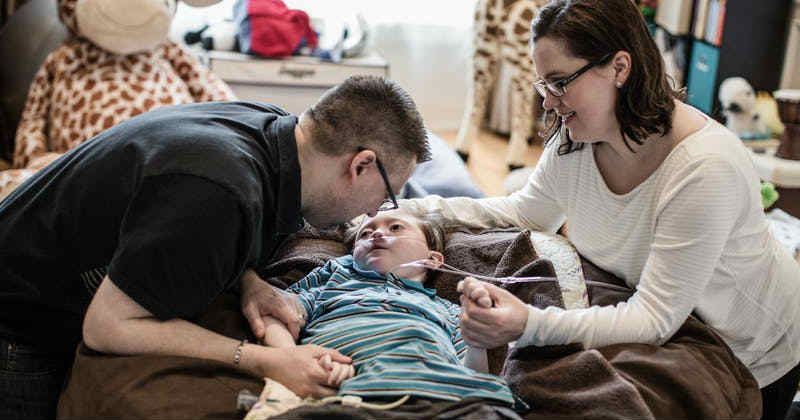
It was with great emotion that Sébastien Cotte shared with us his testimony during Cannabis Europa. Sébastien is the father of little Jagger, who is now 8 and a half years old. Jagger was diagnosed before his first birthday with a mitochondrial disorder—Leigh syndrome—a degenerative and incurable disease. It’s a devastating diagnosis, as 95% of children diagnosed before the age of 2 do not live past age 4. The fact that Jagger is now 8 years old is thanks to cannabis and his parents’ courage.
It all started in 2013 when Sébastien came across a documentary about Charlotte Figi, a young girl with epilepsy whose parents discovered that CBD oil helped calm her daily seizures. While living in Georgia, the Cotte family decided to move to the Colorado, where cannabis has been legal since 2012 so they could treat their son with cannabis, as they are among those designated by the government as «medical refugees.».
The first doses of cannabis brought about noticeable changes in their son’s behavior. Three days after the first dose of CBD, Jagger started smiling again—a first victory for the couple. «We saw a huge improvement right away,» explains Sébastien. «He started smiling again… His seizures have decreased, his pain has subsided, and we’ve been able to stop giving him morphine and OxyContin, two extremely potent medications.».
The success of this treatment for Jagger prompted Sébastien to campaign and lobby to change the laws in his state, Georgia, which has since legalized medical cannabis. However, Georgia’s law is problematic: it allows for the possession of cannabis but does not permit its sale. Patients are therefore only partially within the law. What’s more, the threat of federal enforcement constantly hangs over them, and they generally cannot travel from one state to another with Jagger’s treatment.
A Lawsuit Against the Government
In 2017, a group of patients and activists—including Sébastien—sued the Department of Health in court to compel the DEA to reconsider cannabis’s classification as a controlled substance in order to allow its medical use. The lawsuit was originally directed against Jeff Sessions, but after his resignation The new attorney general is being targeted, as is Charles «Chuck» Rosenberg, the director of the DEA.
The court that filed this complaint initially refused to hear the case, arguing that the DEA had jurisdiction over the matter and that the group should first address the agency directly—a process that could take up to nine years, according to the group’s attorney. The group therefore decided to appeal. «We simply want a chance to prove and demonstrate that cannabis has medical properties and that it can help patients and children like Jagger,» explains Sébastien. Standing alongside him are: the father of a little girl with epilepsy, a veteran suffering from post-traumatic stress disorder, a former player for the National Football League and Cannabis Cultural Association, a nonprofit organization.
The hearing took place on December 12 Finally, according to Michael S. Hiller, the plaintiffs’ attorney, it went rather well. In his view, the questions posed by the three judges revealed a genuine interest. They discussed the recent FDA approval of Epidiolex or because the government holds patents on medical cannabis. He also pointed out that the ban on medical cannabis was unconstitutional because it directly violated the Fifth Amendment to the Constitution, which stipulates that the government must protect the life and health of its citizens.
If the appeal is granted, the case will be returned to federal court and a trial will be held. Otherwise, the case will be sent to the Supreme Court, which accepts only 10% of the cases submitted to it.











Argentina Opens Its Market to Hemp Flowers Containing 1% of THC

The French Socialist Party still doesn't know how to approach the legalization of cannabis

Science in the City International: Paris at the Heart of Transatlantic Scientific and Medical Dialogue

Christine Fréchette is alienating Quebec’s cannabis industry

Rima Hassan: When «Drugs» Become a Political Weapon

From Marathons to Ultratrails: How Extreme Running Affects the Endocannabinoid System

Four days of THC may make breast cancer less aggressive, according to a new study

Medical Cannabis: 14 Organizations Finally Call for Enforcement of the Law

One year after the launch of the Dutch cannabis experiment, the first trends are emerging

High Ground: The Crash of a Plane Full of Marijuana That Made History in Yosemite
-
 Cannabis and driving1 week ago
Cannabis and CBD: French Drivers Can Now Lose Their License Even Without a Positive Test Result
-
Cannabis in France2 weeks ago
Cannabis Legalization: The LFI Bill Has a Major Problem—THC
-

 Cannabis in the Netherlands3 days ago
One year after the launch of the Dutch cannabis experiment, the first trends are emerging
-
Cannabis in France4 days ago
French medical cannabis remains stalled at the Ministry of Health
-
Business3 days ago
The United Kingdom Is Moving Closer to a Regulated CBD Market
-
Cannabis in Europe2 weeks ago
Andorra Paves the Way for Medical Cannabis Cultivation
-
Cannabis in France2 weeks ago
Drought: Could Hemp Become the New Hope for French Farmers?
-
Cannabis in Quebec2 weeks ago
Cannabis in Quebec: The 21-Year-Old Age Requirement in the Spotlight















You must be logged in to post a comment Login