
Scientists identify a variety of cannabis resistant to HLVd

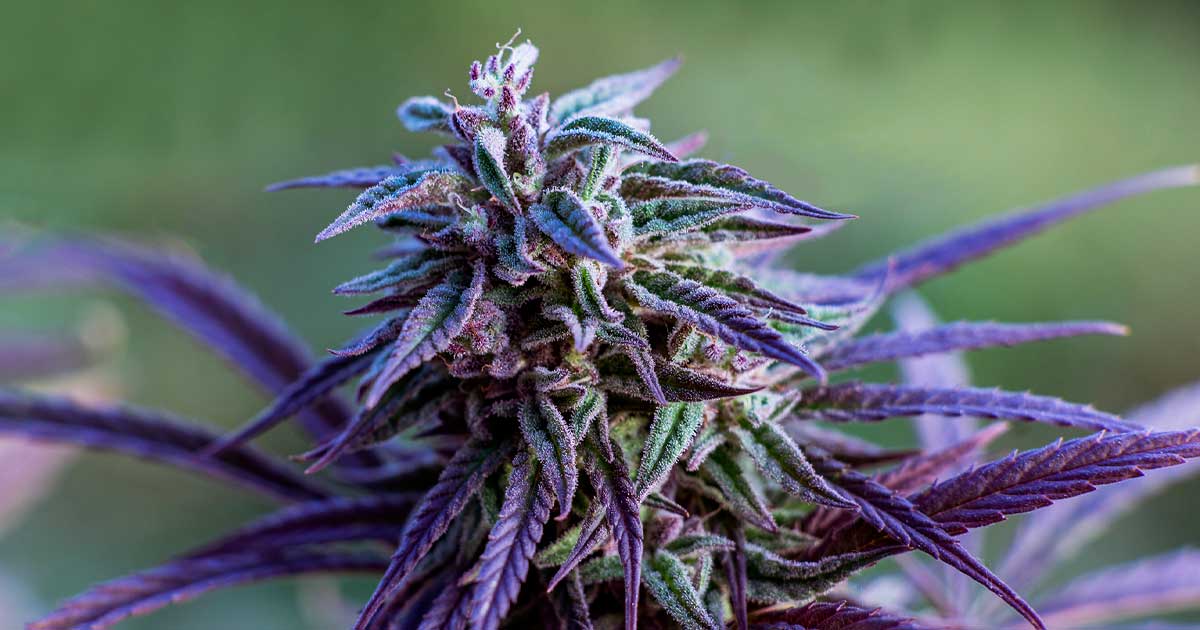
The Hop latent viroid (HLVd), a a viroid found worldwide in hops, but which, in recent years, has spread to cannabis and continues to threaten crops.
SFGate reports, however, that scientists from Medicinal Genomics, a Massachusetts-based company, has observed a cannabis strain called Jamaican Lion, which appears to be partially resistant to HLVd and turns purple when fighting the viroid.
Kevin McKernan, Scientific Director of Medicinal Genomics, presented the study « The Hop Latent Viroid Shares a 19-Nucleotide Sequence with Cannabis sativa COG7 »at the CannMed23 conference in Florida.".
The Jamaican Lion variety has thus proven to be resistant to the viroid and is turned a deeper shade of purple while it was fighting off the viroid. Jamaican Lion is a CBD-rich strain.
«We don’t know why [this is happening]. It could be an immune response, but we don’t see this [purple staining] increasing to the same extent in the uninfected control,» McKernan said.
Viroids can spread through biological pathways or be transmitted by growers via their hands or tools. Disinfection using a 10% bleach solution can reduce infection.
The scientists rubbed the viroid directly onto the plant’s cut leaves to infect them, and then injected the viroid into a plant. Six weeks later, the plant variety remained uninfected even after the test was repeated 57 times. Although the researchers were able to detect the HLVd In the plant's roots, the tissues of the leaves and flowers tested negative up until harvest.
Effects of the HLVd viroid on plants
HLVd produces smaller flowers and significantly less THC. When viewed under an electron microscope, the mature trichomes – where most of the THC is found – resemble a deflated balloon rather than a round ball. A study shows that 90% of California cannabis is infected with HLVd and that yield losses could reach $4 billion. While the viroid is bad news for cannabis, viroids only infect plants and therefore pose no physical danger to humans.
It is not yet clear why the plant was resistant to the viroid. McKernan explained that it had turned purple due to increased production of anthocyanin, a chemical that can cause plants to turn purple. The team believes that scientists should investigate whether there are more purple plants resistant to HLVd, as anthocyanin production is already linked to resistance against viroids.
«There are studies that link anthocyanin production to viroid infection. This applies to various plants and viroids, but these anthocyanins are a known immune response in plants,» said McKernan on SFGate.
Zamir K. Punja stated at the conference that HLVd should be considered a «major threat» to cannabis farms. Punja refers to HLVd as the «COVID of the cannabis world.» The findings suggest that THC yields in infected plants can drop by up to 40%.
The long-term solution to Medicinal Genomics One way to combat HLVd is to help breeders develop resistant cultivars—perhaps purple varieties—that do not suffer any loss in yield or potency.























Argentina Opens Its Market to Hemp Flowers Containing 1% of THC

The French Socialist Party still doesn't know how to approach the legalization of cannabis

Science in the City International: Paris at the Heart of Transatlantic Scientific and Medical Dialogue

Christine Fréchette is alienating Quebec’s cannabis industry

Rima Hassan: When «Drugs» Become a Political Weapon

From Marathons to Ultratrails: How Extreme Running Affects the Endocannabinoid System

Four days of THC may make breast cancer less aggressive, according to a new study

Medical Cannabis: 14 Organizations Finally Call for Enforcement of the Law

One year after the launch of the Dutch cannabis experiment, the first trends are emerging

High Ground: The Crash of a Plane Full of Marijuana That Made History in Yosemite
-
 Cannabis and driving1 week ago
Cannabis and CBD: French Drivers Can Now Lose Their License Even Without a Positive Test Result
-
Cannabis in France2 weeks ago
Cannabis Legalization: The LFI Bill Has a Major Problem—THC
-

 Cannabis in the Netherlands5 days ago
One year after the launch of the Dutch cannabis experiment, the first trends are emerging
-
Cannabis in France6 days ago
French medical cannabis remains stalled at the Ministry of Health
-
Business5 days ago
The United Kingdom Is Moving Closer to a Regulated CBD Market
-
Cannabis in Europe2 weeks ago
Andorra Paves the Way for Medical Cannabis Cultivation
-
Cannabis in Argentina3 days ago
Argentina Opens Its Market to Hemp Flowers Containing 1% of THC
-
Cannabis in France3 weeks ago
Drought: Could Hemp Become the New Hope for French Farmers?











You must be logged in to post a comment Login