How do International Conventions allow the legalization of cannabis?

On March 15, at the UN Commission on Narcotic Drugs, the report High Compliance was presented. In 110 pages, High Compliance dissects the 1961 Single Convention on Narcotic Drugs, generally held to be a legal stranglehold preventing states from legalizing recreational cannabis.
The result? Not at all: in both the text and the general spirit of the Convention, it is in fact perfectly legal and legitimate to regulate the non-medical cannabis industry.
A dive into the abyss of little-known international cannabis law.
The Single Convention is the international treaty governing all national and local laws on cannabis. Sadly, however, the analysis of this treaty is riddled with omissions and errors.
In particular, analysts have the unfortunate tendency to quote only selected parts of the Convention. This is the case for article 4(c) of the Single Convention, which defines the treaty's scope of application.
Article 4(c): A framework agreement for the medical-pharmaceutical sectors
Here's how Article 4(c) is quoted: «The Parties shall take such legislative and administrative measures as may be necessary [...] to limit exclusively to medical and scientific purposes the production, manufacture, export, import, distribution, trade, use and possession of narcotic drugs.»
And here is article 4(c) in full: «The Parties shall take such legislative and administrative measures as may be necessary [...]. subject to the provisions of the present Convention, to limit the production, manufacture, export, import, distribution, trade, use and possession of narcotics exclusively to medical and scientific purposes.»
The 8 words systematically omitted are very important, as they explain that the Unique Convention does not restrict cannabis to medical and scientific purposes only. In fact, it limits it to these purposes, but subject to certain provisions.
So what are these provisions? Just read the Convention to find out... but for the lazy, the Official Commentary on the Convention explains it even more explicitly: it's a series of articles that shape different levels of exemption for drugs when used for purposes other than medical and scientific.
So, the Convention limits cannabis to medical/scientific purposes, subject to the exemption for non-medical/non-scientific purposes. In the words of 1961, and echoing the preamble to the Single Convention and all its concrete measures (which concern only medicines, doctors, pharmacists, prescriptions, etc.), this can be analyzed as defining a Convention that seeks to apply above all only to the medical sphere: a “framework agreement of the medical-pharmaceutical sectors for the control of certain drugs”. Certainly not a “prohibition convention”.
Article 2(9): an exemption for the non-medical cannabis industry
Another article of the Single Convention that is systematically poorly analyzed, or truncated, is Article 2(9) :
«The Parties are not obliged to apply the provisions of this Convention to narcotic drugs which are commonly used in industry for purposes other than medical or scientific purposes, provided that: (a) They take measures to prevent, by appropriate denaturing processes or by any other means, that drugs used in this way may be abused or produce harmful effects (article 3, paragraph 3) and that in practice the harmful substance may be recovered».»
Here, the word “denaturation” is brandished as if it prevented the exemption of non-denatured cannabis. However, it clearly states that “any other means” may be used, other than denaturation.
To understand this article, and interpret it legitimately, we need to draw on two principles of international law:
Ut res magis valeat quam pereat
On the one hand, one of the cardinal rules of international law, introduced by Grotius, is the principle of useful effect, or ut res magis valeat quam pereat. The latter prescribes that we “must“read all the applicable provisions of the treaty in such a way as to make sense of them all, harmoniously”.
One of the corollaries of this cardinal principle is the obligation to interpret a treaty in its entirety, and for all its parts to make sense. A treaty cannot be interpreted in such a way as to leave certain sections without effect or meaning. There is little more to be said, given the systematic omissions in articles 2(9) and 4(c).
Similarly, if we interpret the words “the harmful substance can be recovered” as synonymous with “denaturing”, we render inoperative the words “or by any other means”, which breaks with the principle of useful effect. It is therefore not possible to interpret this article without the any other means he contemplates.
This is also borne out by the fact that many narcotics are single molecules: while it is possible (albeit doubtful) to interpret this article as an obligation to remove THC from cannabis, it is impossible to remove codeine from codeine, for example. The interpretation in which denaturation is mandatory would therefore only be operative for herbal or multi-component products, which once again violates the principle of the ’right to know".’ut res magis valeat quam pereat.
Intertemporality in international law
On the other hand, the insertion of intertemporal markers (and the clear wish expressed by the negotiators in this respect) invites us to consider article 2(9) in the context of today's everyday language - contrary to the general rule that a treaty should be interpreted with the meaning the words had at the time the treaty was negotiated.
Both “denaturation” and “other means” must therefore be considered in the context of today's vocabulary, not that of 1961. And, in 2022, other means of reducing risk and abuse... that's harm reduction.
Intertemporality also makes it easy to find an echo in the expression “cannabis industry” in the terms “commonly used in the industry”. WHO, UN, INCB, all refer to recreational cannabis as “the non-medical cannabis industry”, in full correspondence with the terminology of article 2(9).
Check and Malta
It's not just the High Compliance that postulates this: it's also the case of the Maltese law adopted in December 2021, which legalizes “use for purposes other than medical and scientific” in the context of “harm and risk reduction” (HRR).
Yes, Malta is the first country to legalize the cannabis industry in compliance with the Single Convention on Narcotic Drugs.
What's also important is that the cannabis industry in Malta will take the form of Cannabis Social Clubs - social economy structures on a human scale, which are known to minimize the health and social damage associated with problematic cannabis use.
It's also an interesting prospect for, and thanks to cannabis, reappropriating and redefining the concept of ’industry”.
Don't judge a book by its cover: read it!
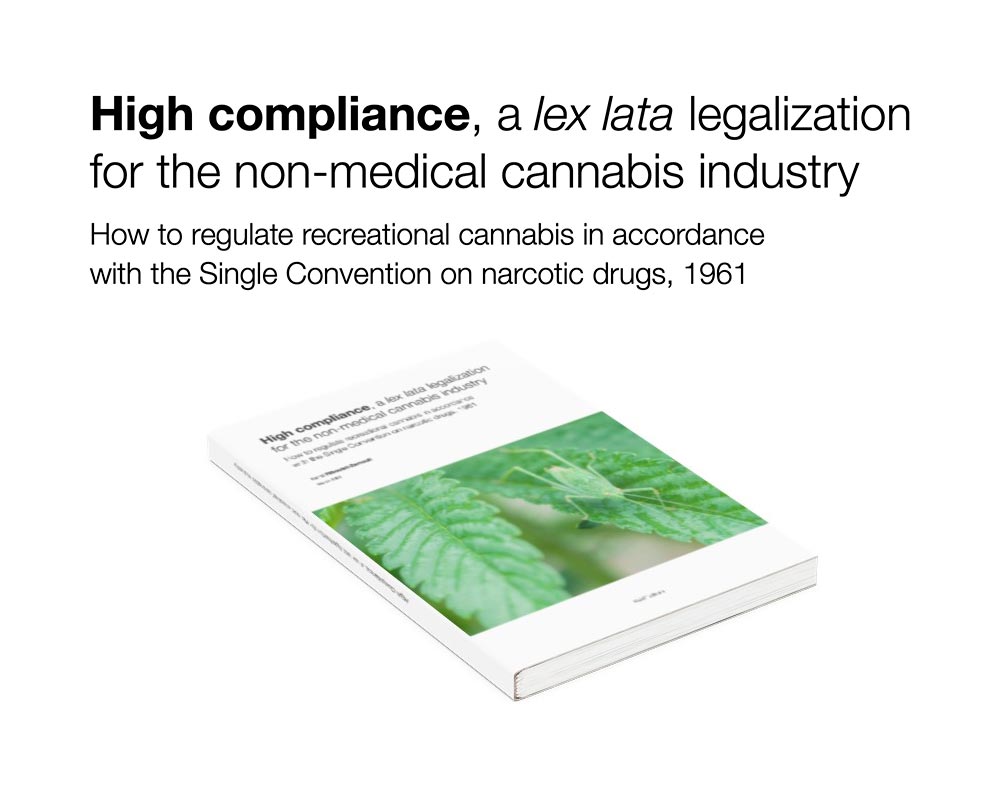
High Compliance coverage
Other principles of international law, such as in dubio mitius and others, detailed at length in the study, reinforce the suggested interpretation. Unfortunately, analysts who criticize the thesis developed in High Compliance have rarely read the text and considered these arguments.
This is the case, for example, with Peter Homberg, across the Rhine based solely on the 4-minute speech delivered at the United Nations to introduce High Compliance, Without having bothered to read the report, Homberg calls the proposed interpretation “fallacious”. The fallacy seems to come from those who claim that the clothes make the man. If the level of Germany's top experts can be summed up by criticizing a legal analysis without even having read it - and thus an analysis that disregards such cardinal principles of international law as can be ut res magis valeat quam pereat- there is little to hope for future reforms of our German friends.
It is disturbing that experts whose professional activity is partly based on their ability to decipher a complex legal panorama (what would happen if it were simplified!?), should criticize a legal thesis developed over many years, and based fundamentally on the primary sources of the Convention and its travaux préparatoires, without even having read it.
But when we see how the Single Convention is quoted and interpreted by many who have only partially read it, it would seem that intellectual laziness is not indifferent to the difficulty of breaking out of biased thought patterns.
Anslinger already knew
All this may seem a bit far-fetched, given that, on the face of it, everyone knows that the Convention is the armed wing of the war on drugs. But how do we know this? Do we question this certainty? On reading the Convention Unique, however, where the word “prohibition” hardly appears at all, we have every right to wonder.
The history of the Convention Unique (analyzed in the introduction to High Compliance) sheds some light on the subject.
Written between 1951 and 1961, it predates by a decade the declaration of a “war on drugs” by U.S. President Richard Nixon in 1971, and the internationalization of U.S. prohibitionist policy marked by the creation of the DEA in 1973.
Harry Anslinger, a staunch defender of cannabis prohibition, and negotiator of the Single Convention for the United States, was very disappointed by the Convention. The historian William McAllister documents the negotiations, Anslinger left out of spite, leaving the negotiation to his underlings.
Anslinger subsequently vigorously opposed ratification of the Convention by the United States. However, Anslinger, Many people see the Convention Unique as Anslinger's creation, but it's quite the opposite! A whole host of countries, from France to the USSR, opposed the application of compulsory prohibition. The consensus was for a basic Convention “generally acceptable” to all countries; in view of the ten years of discussions, the Convention negotiators would never have agreed on a hyper-prohibitive treaty.
In fact, in the 1970s, the United States took over a pre-existing (and rather soft) treaty on the control of psychoactive drugs... and, by applying a rigorist (and dubious in view of the principle of ut res magis valeat quam pereat) have turned it into a tool of war against those who use these drugs. It is this pervasive interpretation, alas, that creates cognitive biases that sometimes prevent us from seeing the words written in black and white in the treaty.
Yet there's no reason why we shouldn't try to overcome these biases, and see things differently... especially when we know that discretion and the ability of states to interpret international law in good faith is one of the main components of the concept of sovereignty. Throwing off the yoke of the United States and relying on the full sovereignty of States means regaining the ability to analyze, interpret and implement international law.
At a time when the question of sovereignty seems to have been captured by an extreme fringe of the political field, and almost taboo for the rest, knowing how to use this sovereignty to put forward rational public policies on drugs can be a key element in an approach seeking to restore the content, interest and relevance of politics.
It would also be appropriate for society as a whole to grasp concepts previously associated with the worst developments in the contemporary world, such as the concept of ’industry”: we're thinking first and foremost of ”big industries“ like tobacco and alcohol.
But we're the only ones standing in the way of thinking and building, based on the rich history of cannabis communities from Barcelona to Valletta, from Kingston to Amsterdam, from Montévidéo to Mendocino, via Paname and Ktama, an industry for the 21st century that's sustainable, humane, protects health, employment and the environment...
From now on, no one can use this or that treaty as an excuse to prevent us from doing so. It's time to legalize in full sovereignty, respecting both international law and the rights of adult citizens who use cannabis.





















JIHE 2026: Japan’s Largest Trade Show Dedicated to Hemp and CBD Returns to Tokyo with More Than 100 Industry Players

New Caledonia: The Courts Clear the Way for the Return of CBD

The Brazilian medical cannabis market continues to grow

Morocco: Three Cannabis-Based Medications Approved for the Treatment of Epilepsy

Canopy Growth Receives New EU-GMP Certification to Strengthen Its Presence in Europe

Three years after legalizing medical cannabis, Albania continues to establish regulations for it

The first plant-based medical THC spray arrives in the United Kingdom

Medical Cannabis in Germany: THC Prices Vary by a Factor of 12

France already has 3,000 cannabis retail outlets. None of them are legal.

Morocco's exports of legal cannabis have expanded to 15 countries
-
 Business2 weeks ago
The legal cannabis market in New York exceeds 4 billion $ in revenue
-

 Cannabis in France4 weeks ago
Which countries legalized medical cannabis before France?
-
Business4 weeks ago
South Korea is preparing to begin local production of medical cannabis to meet rising demand
-
Cannabis in France4 days ago
France already has 3,000 cannabis retail outlets. None of them are legal.
-
Cannabis in Thailand4 weeks ago
From the boom in dispensaries to a purely medical approach: Thailand is revising its cannabis policy
-
Cannabis in the U.S.5 days ago
A DEA report confirms that there are no fatal cannabis overdoses
-
Cannabis and driving3 weeks ago
Medical Cannabis and Driving: New South Wales Ends Automatic Penalties for THC
-
Cannabis in France3 weeks ago
France’s Drug Policy Chief Defends Cannabis Prohibition... and Runs Into the Facts
















You must be logged in to post a comment Login